
Harvest
Contracts
Sign up

Create a Painting Contract

Harvest helps painting contractors streamline their operations by tracking time and expenses, ensuring efficient project management and invoicing.

Start from a template

AGREEMENT DRAFT

Add your logo here

Scope of work

Payment terms

Duration

Signatures

Client

Sign here

Contractor

Sign here

Get paid via:
Credit card / Debit card
ACH
Wire transfer

Customize contract

Appearance

Add a logo
Show contract title

Contract settings

Include payment terms Total fee, deposit, and schedule
Include termination clause Notice required to end the contract
Include signature blocks Both parties sign at the bottom

Essential Elements of a Painting Contract

A painting contract should clearly define the scope of work, which includes specifics about the areas to be painted, surface preparation, and any exclusions. This clarity helps prevent misunderstandings that can lead to disputes. According to the Arbitration Foundation of America, poorly specified contracts lead to 70% of service disputes. Therefore, it's crucial to outline tasks such as sanding, filling holes, and the number of coats to be applied.

Another critical element is the payment terms. Contracts should specify the total cost, deposit amount, and payment schedule—especially for larger projects. Harvest can assist in this area by allowing painting contractors to set up invoices with payment terms, including deposits and schedules for phased projects. This ensures that payment processes are streamlined and transparent.

Legal compliance is also essential. In the U.S., contracts must include an offer and acceptance, consideration, and mutual consent to be legally binding. Ensuring these elements are present helps secure the legality of the agreement.

Customizing Your Painting Contract

Customizing a painting contract to fit the specific needs of a project is vital for both residential and commercial jobs. The average residential painting job is around $3,500, whereas commercial projects can average $50,000, with some reaching into the millions. This difference often means that commercial contracts are more detailed, incorporating compliance requirements and extensive insurance documentation.

Customization involves including clauses for change orders and termination, detailing how changes to the scope will be managed. While Harvest does not directly handle change order clauses, it can track additional time and expenses incurred, ensuring you have a clear record of project changes.

Contract templates can be a practical starting point. They save time and ensure consistency across different projects. By integrating these templates with digital tools, contractors can streamline estimating, scheduling, and project management processes, making operations more efficient.

Ensuring Legal and Professional Compliance

Adhering to legal and professional standards is non-negotiable for painting contractors. In California, for example, contractors must display their CSLB license number on all advertisements. Contractors should carry general liability insurance and workers' compensation as per state law to protect against unforeseen incidents.

Harvest supports contractors by tracking time and expenses, which are crucial for maintaining budgetary compliance. Although Harvest does not manage compliance with local regulations, its ability to track project costs and expenses helps contractors maintain financial oversight.

Including warranty terms in contracts is also standard practice. These should detail what is covered and for how long, typically 2-3 years for workmanship, though Harvest does not directly manage these terms. Instead, it aids contractors in tracking associated costs, ensuring that financial records are accurate and up-to-date.

Practical Tips for Contract Creation

Creating a comprehensive painting contract involves several key steps. First, gather all basic details, including business and client information and the job location. Then, define the scope of work with precision, listing all tasks, areas, and exclusions.

Set a clear timeline, including start and completion dates, and outline how delays will be handled. This helps manage client expectations and project workflow. Finally, obtain signatures from all parties to make the contract legally binding. This step formalizes the agreement and reduces the risk of disputes.

Utilizing customizable contract templates can simplify this process. These templates can be stored and reused for different job types, ensuring that you don't start from scratch each time. Integrating contract management with digital tools for estimating and scheduling can further streamline operations.

Create a Painting Contract with Harvest

Harvest provides tools to create detailed painting contracts, track project time, and manage expenses efficiently.

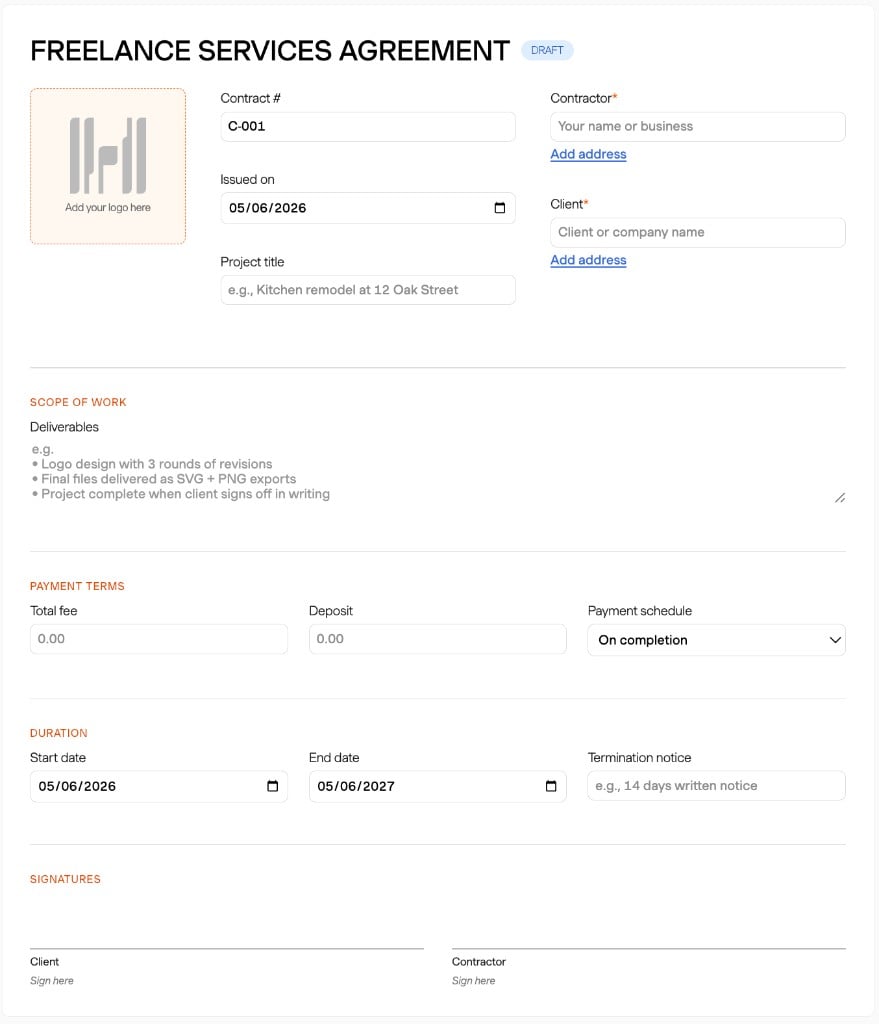
Screenshot of Harvest's painting contract creation interface

Create a Painting Contract FAQs

  • A painting contract should include the scope of work, payment terms, timeline, and warranty details. It ensures clarity and protects both parties legally.

  • Customization involves defining specific tasks, areas, and exclusions. Use templates that allow you to adjust clauses for change orders and termination as needed.

  • Yes, contracts must include an offer, acceptance, consideration, and mutual consent. State-specific regulations may also apply, such as displaying contractor licenses.

  • A clear scope of work prevents misunderstandings by detailing exactly what will be done. This reduces the risk of disputes, which occur in 70% of service contracts without clear terms.

  • Harvest helps by tracking time and expenses, allowing contractors to manage project budgets and invoicing efficiently, though it doesn't handle contract creation directly.

  • Common mistakes include vague scopes of work, not verifying insurance, and focusing solely on price. Clear terms and verifying credentials can prevent these issues.

  • Digital tools streamline operations by integrating contract management, estimating, scheduling, and project tracking, making processes more efficient and transparent.