
Harvest
Contracts
Sign up

Independent Contractor Agreement Template

Independent contractors can lead to cost savings, but misclassification risks are high. Harvest helps contractors manage time, expenses, and invoicing efficiently.

Start from a template

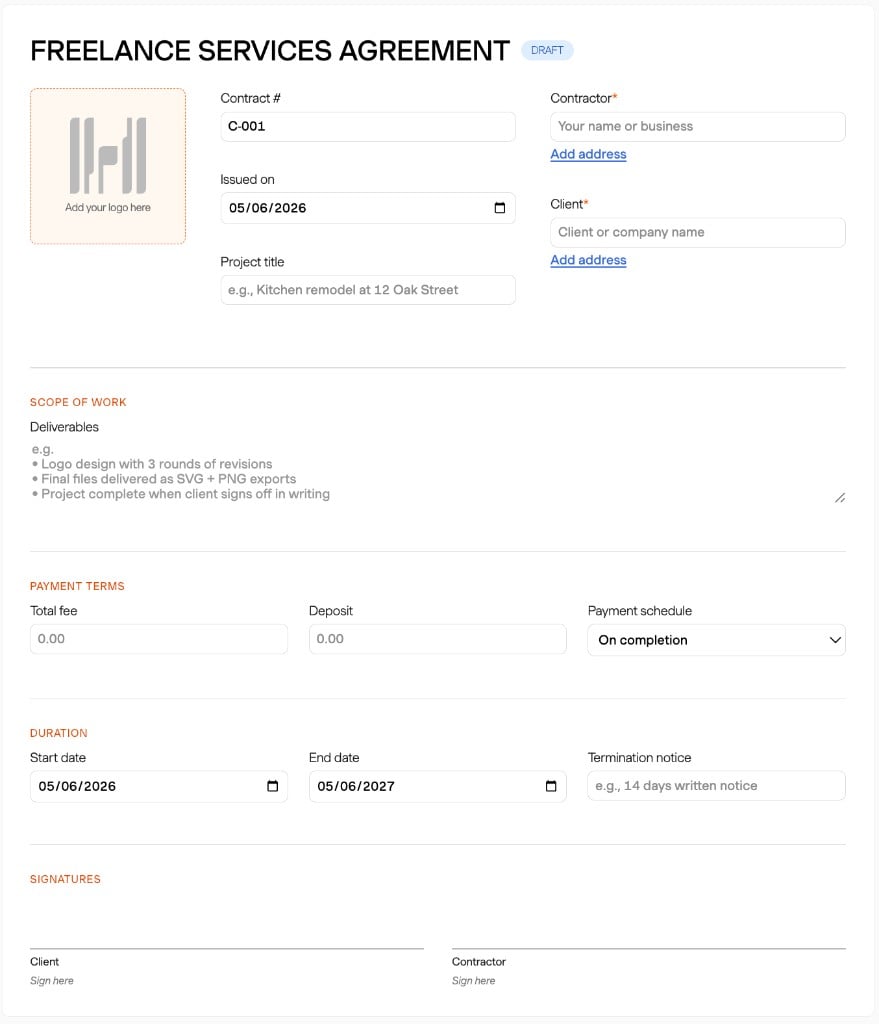
AGREEMENT DRAFT

Add your logo here

Scope of work

Payment terms

Duration

Signatures

Client

Sign here

Contractor

Sign here

Get paid via:
Credit card / Debit card
ACH
Wire transfer

Customize contract

Appearance

Add a logo
Show contract title

Contract settings

Include payment terms Total fee, deposit, and schedule
Include termination clause Notice required to end the contract
Include signature blocks Both parties sign at the bottom

Understanding Independent Contractor Agreements

An independent contractor agreement is essential for defining the business relationship between a company and a contractor. These agreements help ensure that both parties understand their responsibilities, the scope of work, and compensation terms. They also provide a layer of legal protection by clearly establishing the contractor's independent status, which can help avoid misclassification issues that potentially lead to significant penalties. For example, under California's AB 5 law, businesses can face fines of $5,000 to $15,000 for each misclassification violation, and up to $25,000 for willful misclassification. Therefore, a well-crafted agreement is not just a formality but a strategic necessity.

Harvest supports contractors by facilitating detailed compensation tracking and reporting, which can be integrated into the broader business management process. Although Harvest does not draft legal agreements, it aids businesses by providing tools to manage contractor invoicing and expense tracking efficiently. Using Harvest, contractors can organize their time and expenses, ensuring accurate compensation based on hours worked and project milestones.

Key Elements of an Independent Contractor Agreement

Effective independent contractor agreements should include several critical components. First, they must clearly specify the contractor's independent status to avoid misclassification, which can result in financial liabilities under the Fair Labor Standards Act (FLSA). This includes not only stating the independent nature of the relationship but also ensuring the contractor controls their work methods and schedule. Second, confidentiality and intellectual property clauses are vital, especially in industries like healthcare and technology, where sensitive information and proprietary creations are involved.

While Harvest does not draft these legal clauses, it offers robust tools for managing the financial aspects of contractor engagements. For instance, Harvest allows for detailed tracking of contractor hours and project-related expenses, which can be crucial for managing compensation terms outlined in the agreement. This integration helps ensure that contractors are paid accurately according to their agreements, reinforcing the contractual relationship without overstepping into legal territory.

Customizing Your Contractor Agreement

Customizing an independent contractor agreement involves tailoring it to meet the specific needs of your business and the contractor's role. Essential customization areas include defining the scope of work, compensation details, and termination conditions. It's crucial to avoid generic templates that might not fit your business model or industry requirements. For example, in the tech industry, clear deliverables and timelines are vital to ensure project success without long-term employment commitments.

Harvest can complement the customization process by providing detailed reports on contractor deliverables, hours worked, and costs involved. These reports can serve as documentation to support the agreement's terms, ensuring transparency and accountability. Although Harvest doesn't provide templates, its tools are invaluable for maintaining accurate records of contractor engagements, which can protect your business in the event of a dispute or audit.

Legal Considerations When Using Agreement Templates

When using independent contractor agreement templates, there are significant legal considerations to keep in mind. Regulatory scrutiny around contractor classification has increased, with both U.S. federal and state regulations imposing heavy penalties for misclassification. For instance, employers may be liable for unpaid federal income tax withholding and FICA taxes, as well as penalties under the FLSA.

It’s essential to ensure that any template used is compliant with relevant local laws and adequately reflects the actual working relationship, a concept known as "substance over form" in EU regulations. While Harvest does not provide legal advice or agreement templates, it supports contractors and businesses by managing time tracking and expense documentation. This operational support can help reinforce compliance by providing clear records of the contractor's work and compensation, which are critical elements of any contractual agreement.

Integrating Harvest for Better Contractor Management

Integrating Harvest into your contractor management process can streamline operations and improve accuracy. Harvest offers tools to track contractor hours, manage expenses, and generate invoices, all of which are essential for maintaining clear and accurate financial records. This integration can help ensure that the terms of your independent contractor agreements are met, especially concerning compensation and deliverables.

By using Harvest, businesses can not only track time and expenses but also generate detailed reports that document contractor activities and costs. These reports can serve as critical evidence of compliance with agreement terms, enhancing transparency and reducing the risk of disputes. While Harvest doesn't provide legal contract templates, its robust tracking and reporting features are indispensable for managing the financial aspects of contractor relationships effectively.

Independent Contractor Agreements with Harvest

Explore how Harvest helps manage time, expenses, and invoicing for contractors, complementing your agreement template.

Screenshot of independent contractor agreement in Harvest.

Independent Contractor Agreement Template FAQs

  • An independent contractor agreement should include the contractor's independent status, a scope of work, compensation details, confidentiality clauses, and termination conditions. These elements help define the business relationship and protect against misclassification.

  • Customization involves tailoring the agreement to your specific business needs. This includes defining the project scope, deliverables, compensation, and termination terms. Avoid using generic templates that may not fit your industry-specific requirements.

  • Yes, independent contractor agreements are legally binding if they clearly define the terms of the relationship, including the scope of work and compensation. However, they must comply with local laws to be fully enforceable.

  • Misclassifying independent contractors can lead to significant penalties under laws like California's AB 5 and the Fair Labor Standards Act. Businesses may face fines, back taxes, and other liabilities. A well-drafted agreement helps mitigate these risks.

  • Harvest supports contractor management by tracking time, managing expenses, and generating invoices. These capabilities help businesses maintain accurate financial records, supporting the terms outlined in contractor agreements.

  • Common mistakes include failing to clearly define the contractor's independent status, using overly generic templates, and neglecting important clauses like confidentiality and intellectual property rights. It's critical to ensure the agreement fits specific business and legal requirements.