
Harvest
Contracts
Sign up

Fixed Price Contract Template

Fixed price contracts require precise management to avoid scope creep and cost overruns. Harvest helps by managing project budgets and timelines effectively.

Start from a template

AGREEMENT DRAFT

Add your logo here

Scope of work

Payment terms

Duration

Signatures

Client

Sign here

Contractor

Sign here

Get paid via:
Credit card / Debit card
ACH
Wire transfer

Customize contract

Appearance

Add a logo
Show contract title

Contract settings

Include payment terms Total fee, deposit, and schedule
Include termination clause Notice required to end the contract
Include signature blocks Both parties sign at the bottom

Understanding Fixed Price Contracts

Fixed price contracts are agreements where a buyer pays a predetermined sum for a specific scope of work, regardless of the actual costs incurred by the seller. This model is often chosen for its ability to provide cost certainty and transfer the risk of cost overruns to the vendor. According to recent trends, such contracts are becoming increasingly popular, with a new U.S. Executive Order mandating their use in federal agencies as the default procurement method.

Fixed price contracts are particularly common in industries like construction and software development. In construction, these contracts help ensure that projects are completed within budget, with established blueprints and milestones. However, the rigidity of fixed price agreements can sometimes lead to challenges such as scope creep, which can decrease profit margins by up to 15% if not managed properly.

It's crucial that fixed price contracts include key components such as a detailed Scope of Work (SOW), clear payment terms, and clauses for managing changes. These elements help prevent misunderstandings and ensure that projects are delivered on time, with studies showing that such agreements are 25% more likely to meet deadlines compared to other contract types.
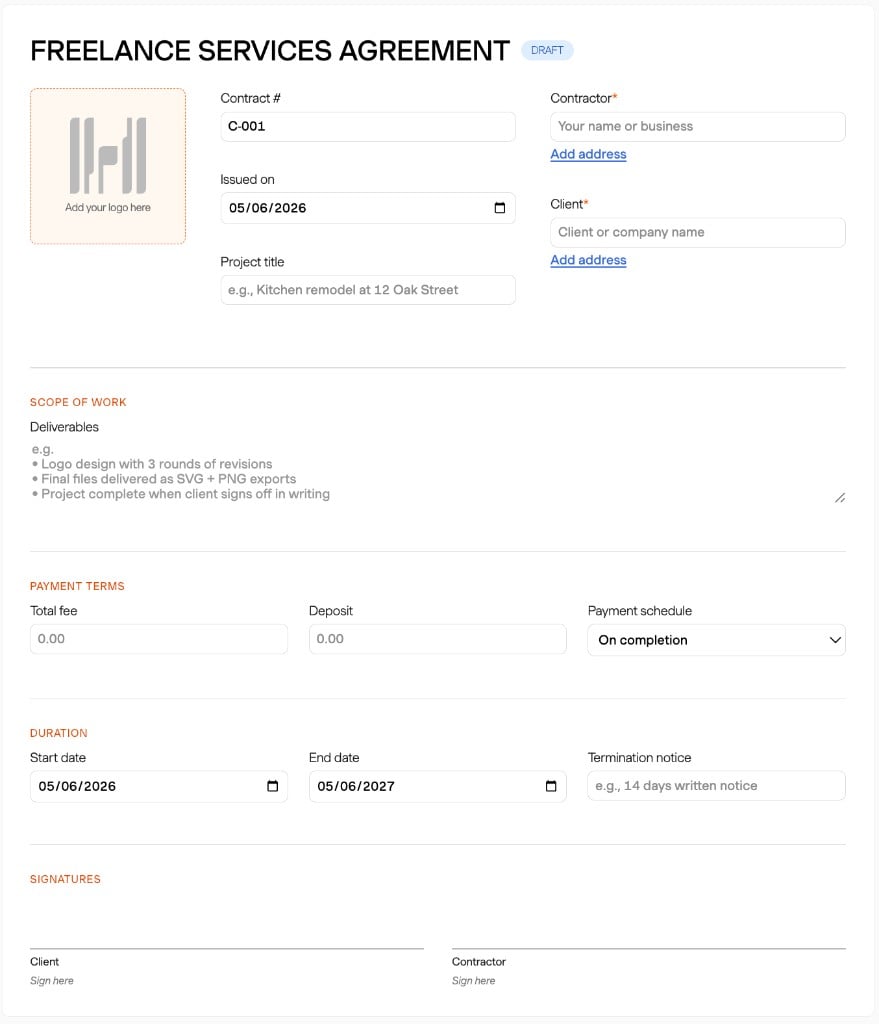

Components of a Fixed Price Contract Template

A robust fixed price contract template should encompass several essential components to ensure clarity and enforceability. First, a comprehensive Scope of Work (SOW) is critical. This section should clearly define all deliverables, responsibilities, exclusions, and acceptance criteria. Without a detailed SOW, projects are prone to scope creep, which can significantly erode profitability.

Additionally, the contract must outline the fixed price along with payment terms. It's advisable to include milestone-based payment triggers to maintain accountability and progress tracking. Effective change management procedures are also vital, allowing for adjustments in project scope or timelines without financial strain. These procedures often include provisions for written approvals before any deviations from the original plan.

Finally, a well-crafted contract should address liability and dispute resolution, providing mechanisms to handle any disagreements that may arise. While Harvest does not provide specific legal terms for construction contracts, it supports project management by allowing users to adjust project budgets and timelines, helping manage these aspects effectively.

Managing Fixed Price Contracts with Harvest

While Harvest does not offer specific legal contract terms, it excels in managing project budgets and timelines, which are crucial components of fixed price contracts. With Harvest, contractors can easily differentiate between Fixed Fee and Time & Materials projects, setting appropriate billing methods to match the contract type.

One of the significant challenges in fixed price contracts is handling changes in project scope. Harvest addresses this by allowing users to adjust project budgets and timelines as needed. This flexibility supports the implementation of change management procedures, ensuring that scope changes are accounted for without impacting the overall project cost significantly.

Moreover, Harvest's capabilities in tracking time and expenses provide valuable insights that inform invoicing and cost management. While it does not handle progress payments based on milestones directly, the data harvested from time tracking can be used to inform these processes, ensuring that payments are aligned with project progress.

Best Practices for Fixed Price Contract Management

Effective management of fixed price contracts requires a disciplined approach to scope definition and cost estimation. Initially, it's essential to document all deliverables, responsibilities, and acceptance criteria in detail. As industry experts suggest, a well-defined scope is the cornerstone of successful contract management, preventing scope creep and unexpected expenses.

Another best practice is to set clear timelines and milestones. Establishing delivery schedules and payment triggers based on milestones helps maintain accountability and ensures that project progress is aligned with client expectations. Regular quality checks and performance metrics should be incorporated to guarantee that deliverables meet the required standards.

Legal review of pricing terms, liability clauses, and dispute mechanisms is also crucial to protect both parties. Although Harvest does not provide specific legal language, its support in managing project budgets and timelines can significantly enhance contract management processes. By integrating these best practices with Harvest's capabilities, contractors can manage fixed price contracts more effectively, reducing risks and improving project outcomes.

Manage Contracts with Harvest

Explore how Harvest manages fixed price contract budgets and timelines, ensuring cost control and project success.

Harvest interface showing fixed price contract management features.

Fixed Price Contract Template FAQs

  • A fixed price contract is an agreement where the buyer pays a set amount for a specific scope of work, regardless of the actual costs incurred by the seller. This type of contract transfers the risk of cost overruns to the vendor or service provider.

  • Fixed price contracts are favored in construction because they provide cost certainty and transfer the risk of cost overruns to the contractor. With defined blueprints and milestones, these contracts help ensure that projects are completed on budget.

  • Common challenges in fixed price contracts include scope creep, inaccurate cost estimation, and variations in input prices. These issues can lead to decreased profit margins if not managed properly. Implementing a detailed Scope of Work (SOW) and effective change management procedures can help mitigate these risks.

  • Harvest assists in managing fixed price contracts by allowing users to set project budgets and timelines. It supports changes in project scope and provides tools for tracking time and expenses, which are critical for effective contract management.

  • Yes, Harvest allows for adjustments in project budgets and timelines, facilitating the management of changes in project scope. This flexibility is crucial for maintaining control over fixed price contracts.

  • Yes, fixed price contracts can be applied to projects of all sizes, not just small ones. For larger projects, breaking them into phases with individual fixed prices can maintain predictability and control.

  • A fixed price contract template should include a detailed Scope of Work (SOW), the fixed price, clear deliverables and milestones, payment terms, change management procedures, and clauses for liability and dispute resolution.

  • To prevent scope creep, ensure the Scope of Work (SOW) is detailed and explicit. Implement a rigorous change control process that requires written approval for any deviations from the original agreement.