
Harvest
Contracts
Sign up

Contract Template in Swedish

Navigating Swedish contract requirements can be complex, but Harvest simplifies the process with time tracking and invoicing solutions, ensuring compliance and efficiency.

Start from a template

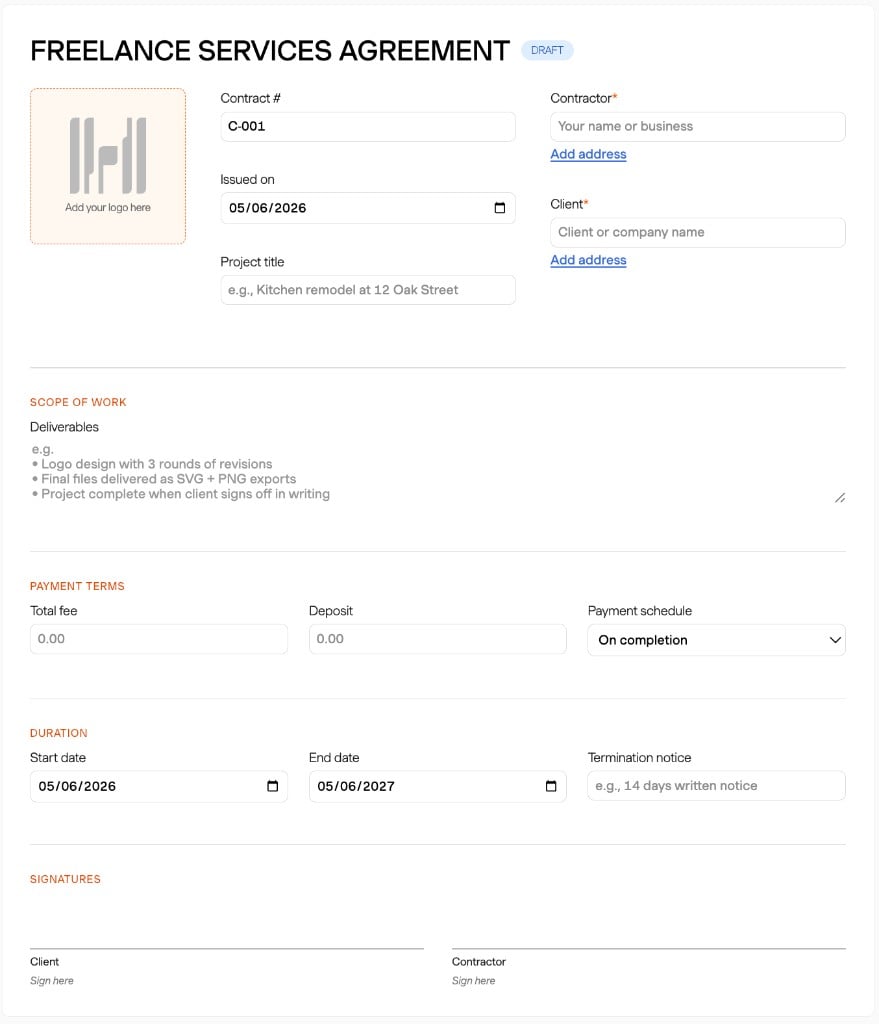
AGREEMENT DRAFT

Add your logo here

Scope of work

Payment terms

Duration

Signatures

Client

Sign here

Contractor

Sign here

Get paid via:
Credit card / Debit card
ACH
Wire transfer

Customize contract

Appearance

Add a logo
Show contract title

Contract settings

Include payment terms Total fee, deposit, and schedule
Include termination clause Notice required to end the contract
Include signature blocks Both parties sign at the bottom

Understanding Swedish Contract Requirements

In Sweden, employment contracts must adhere to specific legal requirements to ensure compliance and protect both parties. The foundation of Swedish contract law is based on the principle of "formlöshet" (informality), meaning a contract is valid if there is a mutual declaration of intent, regardless of whether it's verbal, written, or electronic. However, certain formalities are mandated for specific types of agreements, such as real estate transactions or wills, which require written documentation.

Key elements typically included in Swedish employment contracts are the job title, duties, salary, benefits, working hours, and termination conditions. Additionally, the agreement must comply with the Swedish Work Environment Authority's updated provisions, effective from January 1, 2025. Employers must ensure contracts are stored for at least seven years, aligning with the Swedish Accounting Act's digital archiving standards.

For businesses, using standardized contract templates can streamline the creation process, ensuring all necessary clauses are addressed while saving time and reducing legal costs. Legal experts recommend consulting professionals to customize these templates for specific needs, enhancing compliance and mitigating risks.

Digital Contract Solutions in Sweden

Sweden's robust digital infrastructure has facilitated the widespread adoption of electronic signatures, governed by the EU's eIDAS Regulation. This regulation recognizes three types of digital signatures: Simple Electronic Signatures (SES), Advanced Electronic Signatures (AES), and Qualified Electronic Signatures (QES). QES, which holds the same legal weight as handwritten signatures, is required for certain statutory documents.

The shift towards digital contracts offers significant time savings and efficiency. A recent survey highlighted that digital solutions could yield up to 60% time savings by 2026, a testament to the efficiency gains from adopting such technologies. Furthermore, digital contract management systems centralize agreements, automate reminders, and enhance collaboration, reducing administrative burdens and improving operational efficiency.

Businesses in Sweden are encouraged to adopt a "digital-first" mindset, integrating electronic signatures and digital contract management systems into their workflows. This not only ensures compliance with legal standards but also positions companies for future growth in a "digital-first" B2B environment.

Leveraging Pre-designed Contract Templates

For Swedish companies, leveraging pre-designed contract templates is a practical approach to streamline contract creation. These templates, often drafted by legal professionals, ensure that all essential elements are covered, thereby reducing errors and saving time. This approach is especially beneficial in the construction and cleaning industries, where standardized agreements help manage numerous subcontractors and standardize service offerings.

To customize a contract template effectively, businesses should follow a structured process. This includes selecting a reliable template, filling in relevant details, reviewing the document thoroughly, and seeking legal advice for any uncertainties. This step-by-step customization process ensures that the contract meets the specific needs of the business while remaining compliant with Swedish laws.

Moreover, digital contract management systems can further enhance this process by automating document workflows and integrating them into broader business operations. By doing so, companies can improve contract lifecycle management, from creation to execution and storage, ensuring all parties have access to the latest versions and reducing operational risks.

Legal and Compliance Considerations in Sweden

Swedish contract law emphasizes technology neutrality, meaning that electronic contracts hold the same legal validity as traditional paper ones, provided they meet the necessary legal standards. The eIDAS Regulation ensures that electronic signatures are legally recognized, facilitating a seamless transition to digital agreements.

However, there are exceptions where electronic signatures may not suffice, such as in wills or certain real estate transactions, which may require traditional signatures or notarization. Companies must be aware of these exceptions to maintain compliance.

Retention periods for contracts are also a critical compliance aspect. Swedish businesses are required to keep contracts for at least seven years, as per the Swedish Accounting Act, which supports digital archiving. This allows companies to store documents digitally, discarding physical copies once they're preserved electronically, aligning with modern digital practices.

Discover Harvest's Solutions

Explore how Harvest aids in managing Swedish contracts with time tracking and invoicing. Simplify compliance and efficiency with our tools.

Screenshot of Harvest platform showing Swedish contract template context.

Contract Template in Swedish FAQs

  • Essential elements in a Swedish employment contract include the job title, duties, salary, benefits, working hours, and termination conditions. These contracts must also adhere to the Swedish Work Environment Authority's updated provisions. Legal compliance and mutual intent are key.

  • Yes, electronic signatures are legally valid in Sweden under the EU's eIDAS Regulation. Qualified Electronic Signatures (QES) are equivalent to handwritten signatures and are required for certain statutory documents, ensuring legal compliance.

  • To customize a contract template for Swedish law, first select a reliable template, then fill in relevant details. Review the document thoroughly and consult legal professionals if needed. This ensures compliance and meets your specific business needs.

  • In Sweden, contracts must be retained for at least seven years according to the Swedish Accounting Act. This supports digital archiving, allowing companies to store documents electronically and discard physical copies once preserved.

  • Digital contract management offers significant time savings and efficiency, centralizing agreements, automating reminders, and enhancing collaboration. By adopting digital solutions, businesses can improve operational efficiency and ensure compliance with legal standards.

  • Yes, certain documents like wills or specific real estate transactions may require traditional signatures or notarization. It's important for companies to be aware of such exceptions to maintain compliance with Swedish laws.

  • The principle of "formlöshet" in Swedish contract law means that a contract is valid if there is a mutual declaration of intent, regardless of form. This allows flexibility, but specific legal requirements may mandate written agreements for certain transactions.