
Harvest
Contracts
Sign up

Contract Template in Danish

Navigating Danish contract law can be complex, but Harvest offers streamlined workflows for managing your invoicing and time tracking needs, ensuring compliance and efficiency.

Start from a template

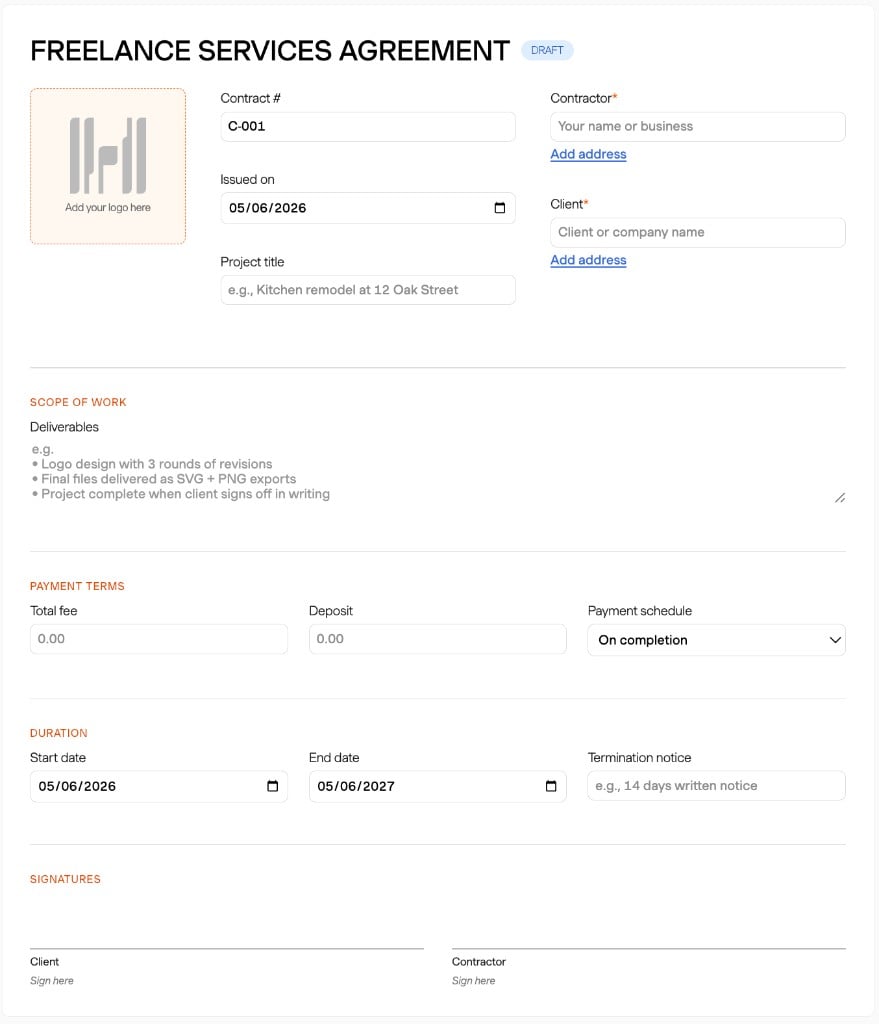
AGREEMENT DRAFT

Add your logo here

Scope of work

Payment terms

Duration

Signatures

Client

Sign here

Contractor

Sign here

Get paid via:
Credit card / Debit card
ACH
Wire transfer

Customize contract

Appearance

Add a logo
Show contract title

Contract settings

Include payment terms Total fee, deposit, and schedule
Include termination clause Notice required to end the contract
Include signature blocks Both parties sign at the bottom

Understanding Danish Contract Templates

Finding the right contract template in Danish is crucial for businesses and individuals operating in Denmark. The Danish contract law operates on the principle of "freedom of contract," allowing parties to negotiate terms freely, though some mandatory provisions, such as consumer protection laws, must be adhered to. The Danish Contracts Act (Aftaleloven), which has been in force since 1917, serves as the foundational legal framework for contracts, even as digital negotiations and agreements rise in popularity. This framework ensures contracts are fair, and digital signatures are legally recognized, equating them to traditional wet-ink signatures.

Pre-approved contract templates can significantly improve productivity and ensure compliance with regulatory standards. These templates not only streamline contract lifecycles but also help businesses scale efficiently by embedding compliance and enforcing transparency. For example, templates like the Industrial Co-operation Contract (ICC) are used in the defense sector for agreements exceeding DKK 50 million, ensuring compliance with Danish Business Authority guidelines.
Common Types of Danish Contracts

In Denmark, several standard contract types are widely used across various industries. For instance, the construction industry relies on standard form building contracts such as AB 18, ABT 18, and ABR 18, developed through collaboration among industry stakeholders. These documents are essential in both public and private construction projects. In the healthcare sector, the Trial Nation network facilitates the negotiation of contract templates for Clinical Trial Agreements (CTAs) that are pre-approved across all regions, expediting the contract process.

Within the IT industry, the Danish IT Industry Association provides a standard contract template for IT Operations, offering a balanced official version with alternative wordings for certain clauses. This template ensures that businesses adhere to industry standards while accommodating specific needs. Furthermore, employment contracts in Denmark must include essential elements such as names and addresses, job title, work schedule, compensation, and termination policies, especially for employees working more than eight hours per week.

Legal and Compliance Considerations

When using a contract template in Danish, it’s important to consider various legal and compliance factors. The Danish Contracts Act emphasizes that contracts need not be in written form to be valid; however, written agreements are highly recommended for evidentiary purposes. This is particularly crucial as poor contract management can cost companies up to 9% of their annual revenue. The Danish Supervisory Authority has also introduced Standard Contractual Clauses (SCCs) to aid in GDPR compliance, though these are not mandatory.

Consumer protection laws impose mandatory rules that limit contractual freedom, especially in consumer contracts where statutory provisions must be adhered to. Additionally, the "Contractor Stop" regime, effective from January 1, 2026, mandates that construction contracts explicitly address this regime, highlighting the importance of including specific clauses to address such requirements. Regularly reviewing and updating contract templates is essential to meet new regulatory demands, such as those from CSRD and NIS2.

Tips for Effective Contract Management

Effective contract management is vital for ensuring compliance and avoiding disputes. While Danish law does not always require written contracts, it is advisable to document all agreements in writing to reduce ambiguity. Clarity in language is crucial—contracts should use simple, precise wording to avoid misunderstandings and define terms that may be open to interpretation.

Parties should agree on key business terms such as scope, pricing, and responsibilities before drafting to prevent disagreements. Utilizing legal-approved templates and contract management software can help ensure comprehensive coverage, including essential clauses like dispute resolution and termination rights. Moreover, integrating contract templates with business processes for automation, real-time collaboration, and easy access can streamline operations and enhance efficiency.

Streamline Danish Contracts with Harvest

See how Harvest's invoicing tool helps manage Danish contracts efficiently. Ensure compliance with streamlined workflows.

Screenshot of Harvest's invoicing tool tailored for Danish contract management

Contract Template in Danish FAQs

  • Reliable contract templates in Danish can be found through industry associations, legal networks, or contract management platforms. These templates are often pre-approved and updated to comply with current laws and regulations.

  • Common contracts in Denmark include employment contracts, construction contracts like AB 18, and IT operations agreements. Each type has specific templates developed by industry experts to ensure compliance and clarity.

  • Yes, while Danish law emphasizes freedom of contract, there are mandatory provisions, especially in consumer contracts, that require clear language and prohibit unfair clauses. Written contracts are recommended for evidence.

  • While English contracts can be used, they must comply with Danish legal standards. It is advisable to have them reviewed by a legal expert to ensure they meet local regulations and are enforceable in Denmark.

  • Key elements include parties' names and addresses, scope, pricing, responsibilities, and termination policies. It's crucial to use precise language and ensure the contract complies with Danish laws.

  • Digital signatures are recognized under Danish law as equivalent to traditional signatures, facilitating the use of electronic contracts. This acceptance streamlines the contracting process for businesses.

  • Regularly updating contract templates ensures they reflect current business needs and regulatory changes, such as GDPR compliance. This practice helps avoid legal issues and enhances operational efficiency.