
Harvest
Contracts
Sign up

Freelance Contract Template in Danish

Freelancers in Denmark face unique challenges, such as managing taxes and maintaining independence. Harvest supports them with tools for time tracking and expense management.

Start from a template

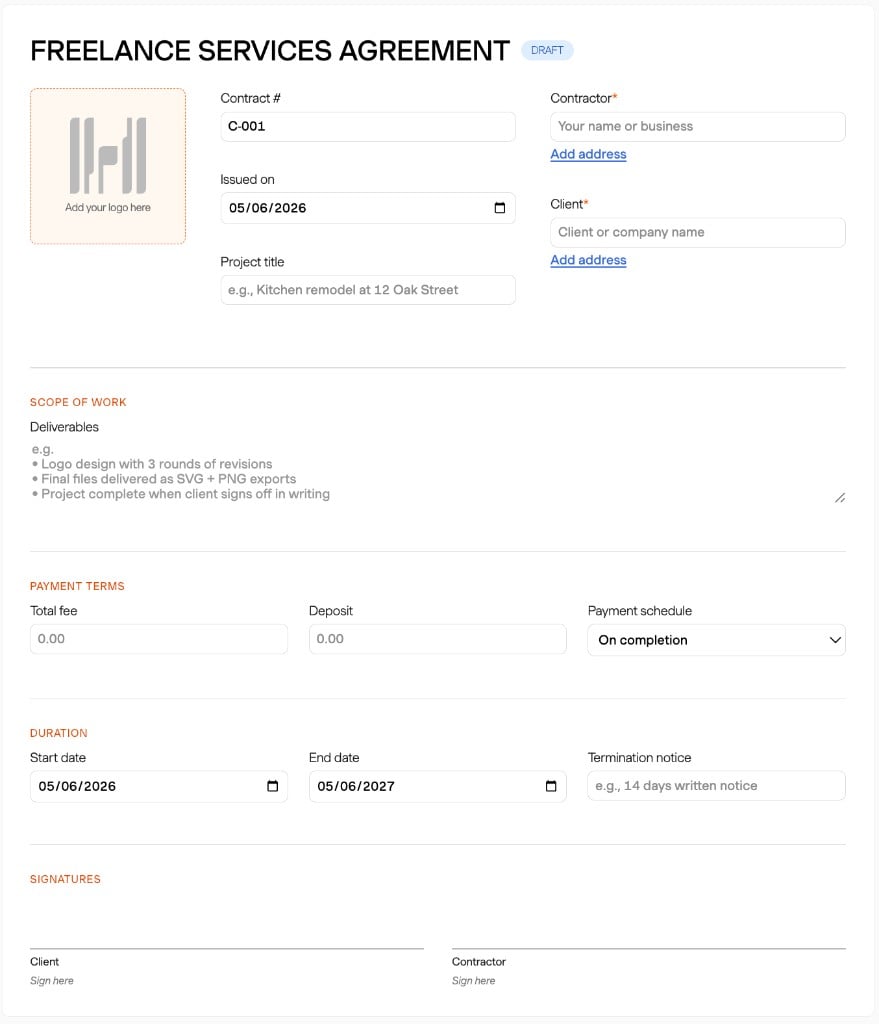
AGREEMENT DRAFT

Add your logo here

Scope of work

Payment terms

Duration

Signatures

Client

Sign here

Contractor

Sign here

Get paid via:
Credit card / Debit card
ACH
Wire transfer

Customize contract

Appearance

Add a logo
Show contract title

Contract settings

Include payment terms Total fee, deposit, and schedule
Include termination clause Notice required to end the contract
Include signature blocks Both parties sign at the bottom

Understanding Freelance Contracts in Denmark

Freelance contracts in Denmark play a crucial role in defining the terms of engagement between freelancers and their clients. These contracts ensure clarity and legal protection, covering essential elements such as payment terms, intellectual property rights, and scope of work. A well-drafted contract is especially important in Denmark, where the line between freelance and employee status can be blurred. This distinction is not defined by a general employment act but rather by the actual working relationship, focusing on factors like the independence of the freelancer and the lack of subordination to the client.

Key legal frameworks such as the Danish Contract Law and the Danish Business Act provide the foundation for these contracts, while the Danish Tax Law and VAT regulations govern financial obligations. Freelancers must also consider GDPR compliance for data protection. Industry-specific needs, such as the importance of clear deliverables and ownership rights in IT projects, further underscore the importance of a detailed contract.

Despite the complexities, Harvest supports freelancers by offering tools that complement the contract drafting process, such as expense management and invoicing solutions, although it does not provide legal contract templates.

Key Elements of a Danish Freelance Contract

Creating a comprehensive freelance contract in Denmark involves including several key elements that ensure both parties are protected. At the core, contracts should define the scope of work, duration, and compensation details. Intellectual property rights should be clearly outlined to avoid any future disputes over work ownership. It is also advisable to include clauses on liability and compensation limits, which can help manage risk in case of disagreements.

Legal experts emphasize the importance of maintaining independence in the working relationship, which can be achieved by drafting contracts that focus on deliverables rather than specific working hours or methods. This is crucial to avoid misclassification, which can have significant legal and financial implications, as seen in cases like the "Wolt case."

While Harvest does not offer contract templates or address specific legal clauses, it provides tools for tracking time and managing expenses, which can support freelancers in fulfilling contract requirements such as accurate billing and expense documentation.

Legal Considerations for Freelancers in Denmark

Freelancers in Denmark must navigate a complex legal landscape to ensure compliance and protect their business interests. One of the primary considerations is registering as a sole proprietorship and obtaining a CVR number, which is mandatory for issuing invoices and complying with Danish Business Act requirements. Additionally, freelancers must be mindful of the VAT registration threshold of DKK 50,000, beyond which VAT registration becomes necessary.

Danish tax law mandates that freelancers manage their own income tax and labor market contributions, placing the onus on them to accurately report earnings and expenses. Misclassification risks, where a freelance contract is deemed an employment relationship, highlight the need for carefully drafted contracts that emphasize independence and commercial freedom.

While Harvest does not provide legal advice or contract drafting, it offers robust solutions for tracking billable hours and expenses, aiding freelancers in maintaining accurate financial records to support their tax reporting obligations.

How Harvest Supports Danish Freelancers

Although Harvest does not provide legal contract templates or specific clauses for Danish freelance contracts, it plays a significant role in supporting freelancers with their operational needs. Harvest offers essential tools for time tracking, allowing freelancers to accurately log billable hours, ensuring they get paid for every hour worked. This is particularly beneficial in Denmark, where 60% of freelancers prioritize work-life balance and often work fewer hours per week.

Harvest's expense management capabilities allow freelancers to easily track and categorize expenses, which is crucial for accurate tax reporting and maintaining compliance with Danish VAT regulations. Invoicing tools from Harvest simplify the billing process, ensuring that freelancers can issue professional invoices that meet local legal requirements.

By providing these operational tools, Harvest helps freelancers focus on delivering quality work without getting bogged down by administrative tasks. This support is invaluable in an environment where digital bookkeeping is mandated by law, and freelancers must stay on top of their financial management.

Boost Your Freelance Workflow with Harvest

See how Harvest supports Danish freelancers with time tracking and expense management tools, simplifying contract obligations.

Harvest interface for freelance contract management in Denmark

Freelance Contract Template in Danish FAQs

  • A Danish freelance contract should include the scope of work, duration, payment terms, intellectual property rights, liability clauses, and termination conditions. Ensuring clarity in these areas helps prevent disputes and misclassification issues.

  • Freelancers in Denmark typically register their business as a sole proprietorship with the Danish Business Authority. This involves obtaining a CVR number, which is essential for invoicing and tax compliance.

  • Danish freelancers are responsible for paying their own income tax and labor market contributions. They must also register for VAT if their turnover exceeds DKK 50,000 annually. This requires accurate income and expense tracking.

  • Harvest provides invoicing tools that allow Danish freelancers to create professional invoices, track payments, and ensure they meet local legal requirements. This simplifies the billing process and improves financial management.

  • Independence is crucial to avoid misclassification as an employee. Freelancers should have the freedom to choose how they work, focus on deliverables, and use their own tools, which helps maintain a genuine business-to-business relationship.

  • Freelancers in Denmark must register for VAT if their taxable turnover exceeds DKK 50,000 within a 12-month period. The standard VAT rate is 25%, though some services like healthcare are exempt.

  • Harvest offers time tracking tools that allow freelancers to accurately log billable hours, ensuring they are compensated for all work performed. This is vital for maintaining transparency and ensuring accurate invoicing.