
Harvest
Contracts
Sign up

Contract Template in Dutch

Navigating Dutch contract law requires understanding local principles like "freedom of form." Harvest supports your contractual workflows by streamlining time tracking and invoicing.

Start from a template

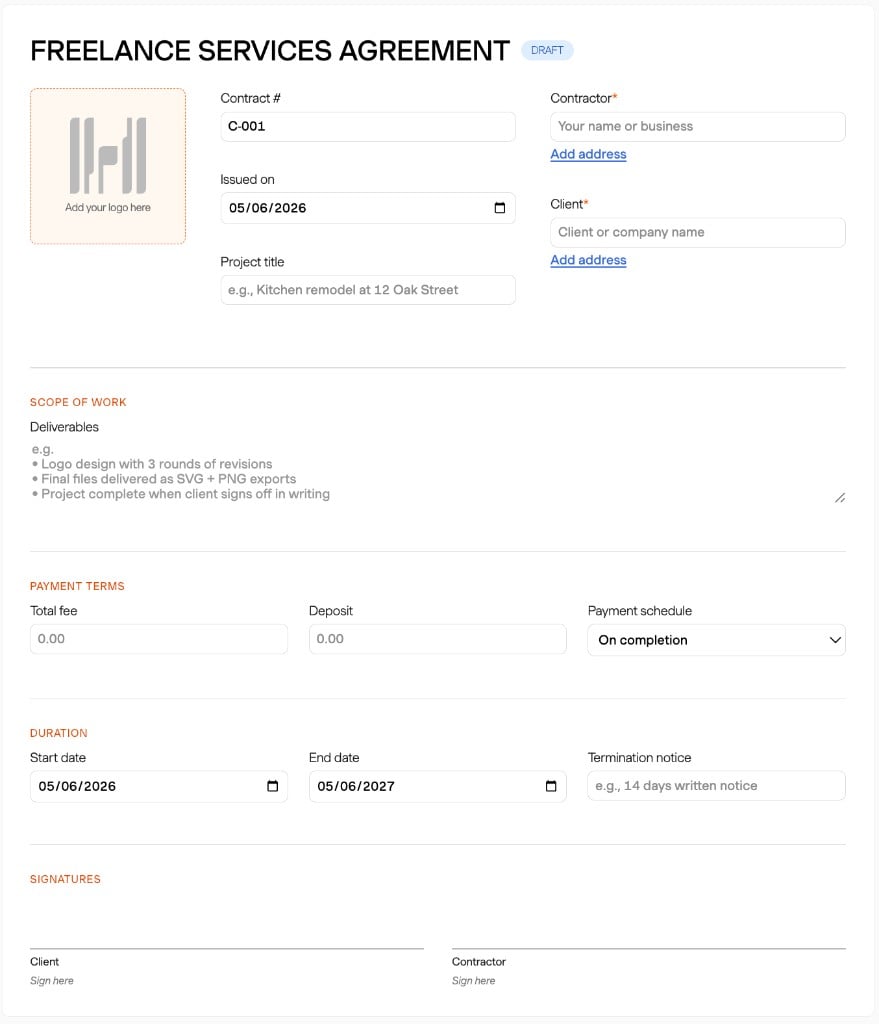
AGREEMENT DRAFT

Add your logo here

Scope of work

Payment terms

Duration

Signatures

Client

Sign here

Contractor

Sign here

Get paid via:
Credit card / Debit card
ACH
Wire transfer

Customize contract

Appearance

Add a logo
Show contract title

Contract settings

Include payment terms Total fee, deposit, and schedule
Include termination clause Notice required to end the contract
Include signature blocks Both parties sign at the bottom

Understanding Dutch Contract Templates

When creating a contract template in Dutch, it's essential to understand the principles of Dutch contract law, particularly the concept of "freedom of form" (vormvrijheid). This principle allows for flexibility, meaning most contracts in the Netherlands do not require formalities like notarization or registration to be valid, except where explicitly required by law, such as in real estate or certain employment contracts. This flexibility extends to oral and electronic contracts, which are generally enforceable provided authenticity can be verified. The Netherlands, known for its advanced digital economy, ranks third in the EU Digital Economy and Society Index, emphasizing the importance of digital solutions, including electronic contracts.

However, the legal landscape in the Netherlands is not without its complexities. For instance, recent reforms have introduced the "bandwidth contract," replacing on-call and zero-hours contracts. These changes require businesses to adapt their contract templates to comply with new employment laws, particularly under the Wet DBA framework, which affects contractor classification. Understanding these nuances is crucial when drafting or choosing a Dutch contract template.

Key Elements of a Dutch Contract Template

A well-drafted Dutch contract template should include several key elements to ensure compliance with local laws and effectiveness in various business contexts. Central to Dutch contracts is the principle of "reasonableness and fairness" (redelijkheid en billijkheid), which means that even explicitly written terms can be set aside if deemed unfair. This principle is reinforced by the Haviltex standard, which emphasizes mutual intentions and reasonable expectations over grammatical meanings.

Including clear general terms and conditions (algemene voorwaarden) is vital. These must be provided to the other party at the time of contracting, ensuring they have a reasonable opportunity to review them. Specific clauses, such as liability limitations and performance standards, should be carefully structured to avoid placing unreasonable burdens on one party. For electronic contracts, the EU's eIDAS regulation ensures that qualified electronic signatures have the same legal status as handwritten ones, a crucial detail for businesses engaging in digital transactions.

Practical Tips for Drafting Dutch Contracts

Drafting a contract in Dutch requires attention to detail and an understanding of legal requirements. Engaging a Dutch commercial contract lawyer early in the process is highly recommended. This can help identify specific legal requirements, spot potential risks, and ensure that the contract is enforceable. Clear and specific language should be prioritized over legal jargon, as ambiguous terms can lead to disputes.

It's also important to ensure that any general terms and conditions are clearly drafted and easily accessible. Whether provided in print or digitally, parties must have the opportunity to review these terms before finalizing the contract. Avoid relying on generic templates found online, as they may not meet Dutch legal standards and could omit crucial elements. Documenting all agreements, even oral ones, is essential, as written evidence is pivotal in resolving disputes, influencing 75% of court decisions in commercial cases.

Harvest's Role in Supporting Contractual Workflows

While Harvest does not provide contract templates, it plays a significant role in supporting the workflows associated with contractual obligations. Harvest helps teams and businesses track time, monitor project budgets, and manage expenses, which are critical components of fulfilling contract terms. Accurate time tracking and invoicing are integral to maintaining transparency and accountability in contractual relationships.

For businesses operating under Dutch contract law, Harvest's capabilities in managing expenses and invoicing can streamline processes and reduce administrative burdens. Although it is not a legal tool, Harvest supports efficient handling of project-related financial tasks, allowing businesses to focus on meeting their contractual obligations without getting bogged down by the complexities of financial management.

Streamline Dutch Contracts with Harvest

See how Harvest enhances contract workflows with precise time tracking and invoicing.

Screenshot of Harvest's time tracking tool, relevant for managing Dutch contracts.

Contract Template in Dutch FAQs

  • "Freedom of form" (vormvrijheid) in Dutch contract law means that most contracts do not require specific formalities to be valid, allowing for oral or electronic agreements. Exceptions include real estate and certain employment contracts, where specific legal requirements apply.

  • The principle of "reasonableness and fairness" (redelijkheid en billijkheid) ensures that even clearly written contractual terms can be overridden if deemed unfair by courts, emphasizing mutual intentions and reasonable expectations.

  • A Dutch contract template should include clear terms, conditions, liability limitations, and performance standards, all structured to comply with the principle of "reasonableness and fairness." Additionally, electronic signatures are legally recognized under EU regulations.

  • Involving a Dutch commercial contract lawyer early ensures that contracts meet legal standards, identify risks, and are enforceable, preventing potential disputes and ensuring compliance with Dutch law.

  • Under the EU's eIDAS regulation, electronic contracts are valid in the Netherlands if they include qualified electronic signatures, which have the same legal status as handwritten ones. This ensures authenticity and integrity.

  • Businesses should avoid using generic templates without checking for compliance with Dutch law. Such templates might lack necessary elements, creating a false sense of security and potential legal issues.