
Harvest
Contracts
Sign up

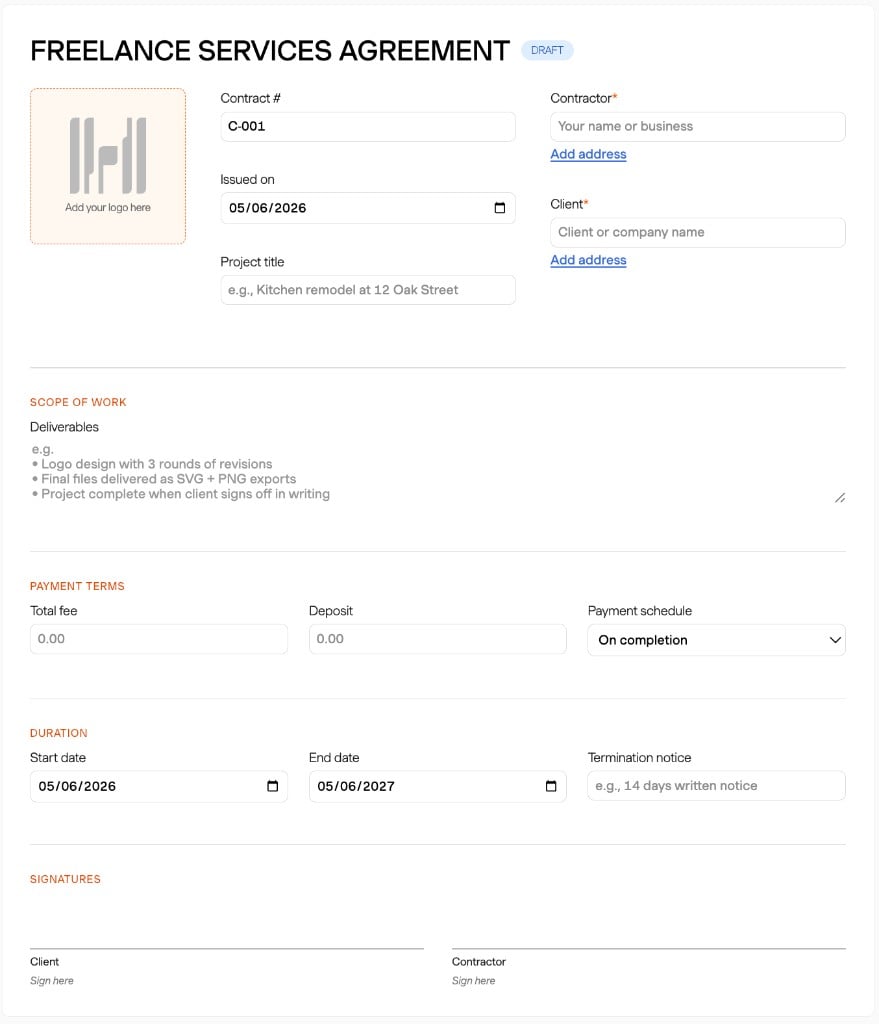
Freelance Contract Template in Dutch

Navigating the complexities of Dutch freelance contracts can be challenging, but Harvest helps freelancers manage time and expenses efficiently, supporting accurate invoicing and financial clarity.

Start from a template

AGREEMENT DRAFT

Add your logo here

Scope of work

Payment terms

Duration

Signatures

Client

Sign here

Contractor

Sign here

Get paid via:
Credit card / Debit card
ACH
Wire transfer

Customize contract

Appearance

Add a logo
Show contract title

Contract settings

Include payment terms Total fee, deposit, and schedule
Include termination clause Notice required to end the contract
Include signature blocks Both parties sign at the bottom

Understanding the Essentials of a Dutch Freelance Contract

Creating a freelance contract in the Netherlands requires careful attention to specific legal and regulatory requirements. For freelancers, or "zelfstandigen zonder personeel" (ZZP'ers), a well-drafted contract is crucial to establish independence and ensure compliance with Dutch laws. The contract should clearly outline the scope of services, deliverables, payment terms, and cancellation policies. Notably, the Dutch Tax Authority focuses on the "substance over form" principle—meaning the actual working relationship is scrutinized more than the written contract itself, especially to prevent false self-employment scenarios.

Freelancers should also ensure their contracts avoid language that implies direct supervision or control, as this could denote an employer-employee relationship, contrary to their independent status. Furthermore, it is advisable for freelancers to diversify their client base to avoid relying on a single client, which could raise red flags with the Dutch Tax Authority regarding misclassification. Consulting with legal professionals can provide additional assurance that all legal bases are covered.

Legal Compliance and the Wet DBA

Compliance with the Wet DBA (Deregulering Beoordeling Arbeidsrelaties) is a critical aspect of freelance contracts in the Netherlands. This legislation aims to prevent false self-employment by requiring parties to assess whether their contract represents genuine freelance work or an employment relationship. Since January 2026, the Dutch Tax Authority has been enforcing this law more strictly, which has significant implications for both clients and freelancers.

For clients, failure to comply might result in penalties, including retroactive social insurance contributions and fines. Freelancers risk losing tax benefits if misclassified. Therefore, it is essential for both parties to ensure that the agreement reflects a true independent contractor relationship, characterized by the absence of authority, the freedom to work for other clients, the right of substitution, and the freelancer bearing their own financial risk. Legal experts recommend using model agreements approved by the Belastingdienst, although these do not provide absolute certainty if the actual working conditions resemble employment.

Tax Obligations and Financial Management for Freelancers

Freelancers in the Netherlands must comply with tax obligations, including registration with the Dutch Tax Office (Belastingdienst) and the Chamber of Commerce (KVK). They are required to declare their income for both income tax and VAT (BTW), and must keep accurate financial records. Quarterly VAT declarations and annual income tax returns are mandatory, making financial management a critical part of freelance work.

While Harvest does not provide tax advice, it supports freelancers by offering tools to track time, manage expenses, and generate invoices, helping to streamline financial operations. By using Harvest, freelancers can maintain organized records of their billable hours and expenses, ensuring accurate invoicing and a clear financial overview, which is crucial for tax reporting.

Ensuring Contractual Clarity and Risk Management

Clear and comprehensive contracts are vital for freelancers to mitigate risks and ensure smooth operations. Contracts should explicitly detail all terms of engagement, including services, deadlines, and payment schedules. This clarity helps prevent misunderstandings and disputes, safeguarding both the freelancer and the client.

Although Harvest does not offer contract templates, it aids freelancers in managing their work efficiently by tracking project time, expenses, and payments. By keeping meticulous records, freelancers can substantiate their independent status and financial dealings, which is especially important under the scrutiny of the Wet DBA. Additionally, freelancers should consider obtaining relevant business insurances to cover liabilities and protect their interests in case of unforeseen issues.

Navigating Challenges in the Dutch Freelance Market

The Dutch freelance market presents unique challenges, particularly due to evolving regulations like the Wet DBA and the proposed minimum hourly rate for ZZP'ers. These measures aim to protect genuine freelancers and ensure fair labor practices but also require careful navigation to avoid misclassification and its consequences. Over 21,000 freelancers deregistered in late 2024 due to increased regulatory pressure, illustrating the impact of these changes.

To thrive in this environment, freelancers should stay informed about regulatory updates and seek professional advice when necessary. Harvest can assist by providing reliable tools for time and expense tracking, which are essential for demonstrating independent contractor status. By leveraging Harvest’s capabilities, freelancers can focus on their core services while maintaining compliance and efficient financial management.

Freelance Contract Tools with Harvest

Harvest helps Dutch freelancers track time, manage expenses, and streamline invoicing for efficient contract management.

Screenshot of Harvest interface for managing freelance contracts in Dutch.

Freelance Contract Template in Dutch FAQs

  • A Dutch freelance contract should include sections on the scope of services, deliverables, payment terms, deadlines, and cancellation policies. It's essential to avoid language that suggests an employer-employee relationship. Consulting with legal professionals is advisable to ensure compliance with Dutch laws.

  • The Wet DBA is a Dutch law aimed at preventing false self-employment. It requires freelancers and clients to assess their working relationship to ensure it does not resemble employment. Since 2026, the Dutch Tax Authority has strictly enforced this law, impacting both freelancers and clients with potential penalties for misclassification.

  • Harvest supports Dutch freelancers by providing tools to track time, manage expenses, and generate invoices. This helps maintain organized financial records and ensures accurate billing, which is crucial for tax reporting and demonstrating independent contractor status.

  • Freelancers must register with the Dutch Tax Office and Chamber of Commerce, declare income for income tax and VAT, and keep accurate financial records. They need to file quarterly VAT declarations and annual income tax returns.

  • To avoid false self-employment, freelancers should ensure their contracts emphasize autonomy and avoid employment-like terms. They should work for multiple clients and manage their own financial risks. Consulting legal experts can provide further guidance.

  • The Dutch government plans to introduce a minimum hourly rate of €38 for ZZP'ers by July 1, 2026. If earnings fall below this, there will be a presumption of employment, shifting the burden of proof to the client to demonstrate otherwise.

  • Diversifying the client base helps freelancers maintain their independent status and reduces the risk of being classified as employees. Relying on a single client for over 70% of income is considered risky by the Dutch Tax Authority.