
Harvest
Contracts
Sign up

Freelance Contract Template in Polish

Freelance contracts in Poland require careful structuring to comply with local regulations. Harvest supports freelancers with tools to track time, manage expenses, and invoice clients efficiently.

Start from a template

AGREEMENT DRAFT

Add your logo here

Scope of work

Payment terms

Duration

Signatures

Client

Sign here

Contractor

Sign here

Get paid via:
Credit card / Debit card
ACH
Wire transfer

Customize contract

Appearance

Add a logo
Show contract title

Contract settings

Include payment terms Total fee, deposit, and schedule
Include termination clause Notice required to end the contract
Include signature blocks Both parties sign at the bottom

Understanding Polish Freelance Contracts

Freelance contracts in Poland are primarily governed by civil law and can take several forms, each with distinct characteristics. The most common types include Umowa Zlecenie (Contract of Mandate), Umowa o Dzieło (Contract for a Specific Task), and B2B Contracts. These contracts offer varying levels of flexibility and protection. For instance, an Umowa Zlecenie is an "agreement of best effort" where payment is based on hours worked, while an Umowa o Dzieło involves payment for a specific outcome, not hours.

Understanding the nuances of each contract type is crucial for freelancers to ensure compliance and avoid penalties. Recent legal changes, effective from July 2026, empower Polish labor inspectors to reclassify civil-law contracts if actual working conditions resemble employment, potentially leading to severe consequences like back payments and fines up to PLN 90,000 per violation. This underscores the importance of maintaining genuine independence when using B2B contracts, which require freelancers to operate without direct client supervision.
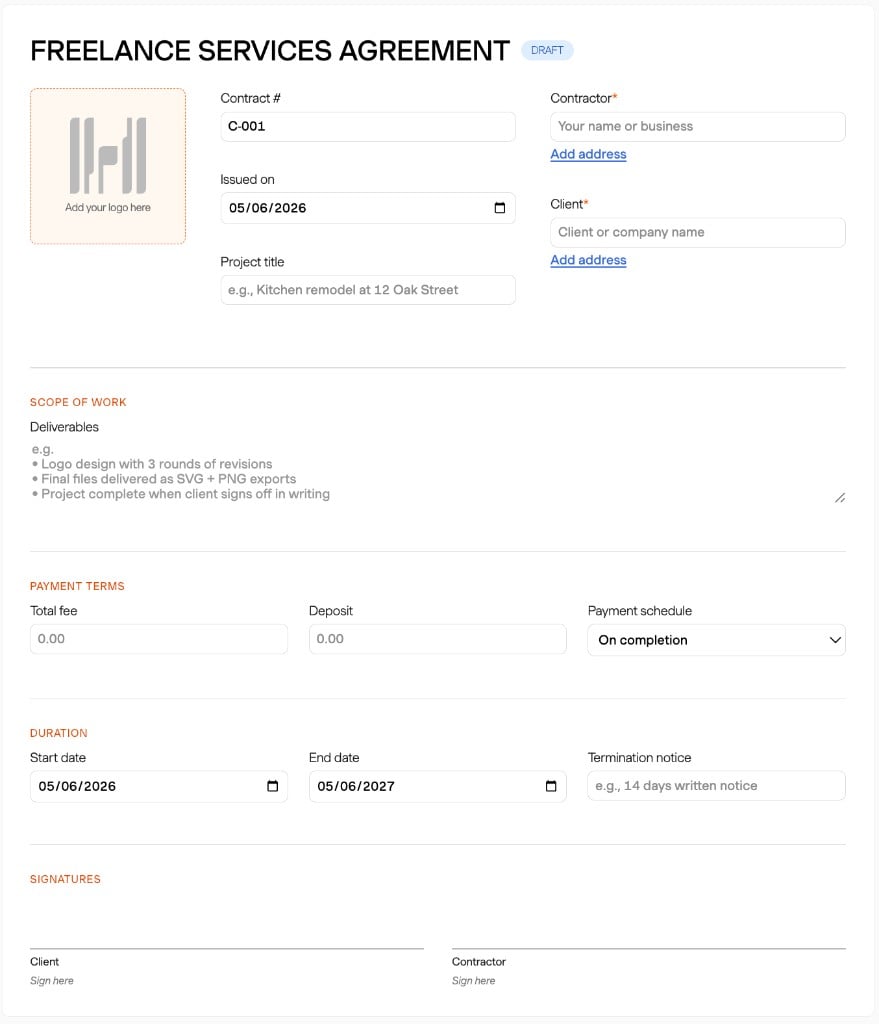

Key Clauses for Polish Freelance Contracts

To safeguard both parties, Polish freelance contracts should include specific clauses. Essential elements comprise scope of services, remuneration details, duration, termination conditions, and intellectual property rights. Clear definitions prevent misunderstandings and legal disputes. For instance, a well-defined scope of services ensures both parties agree on deliverables, while explicit termination clauses provide clarity on contract dissolution.

Clauses addressing confidentiality and non-compete agreements are also vital, particularly in sectors like IT and consulting where sensitive information is handled. Given the Polish legal context, it's advisable to consult legal experts to ensure contracts adhere to the latest regulations. Harvest can support freelancers in managing these projects by offering robust tools for tracking project budgets and client invoices, though it does not provide legal templates or advice.

Navigating Tax Implications for Polish Freelancers

Freelancers in Poland must navigate a complex tax landscape. They can choose from several taxation options, such as a lump sum tax (ryczałt) with fixed rates depending on the service type, a linear tax at a 19% flat rate, or the general scale with progressive rates. It's crucial to select the appropriate regime to optimize tax liabilities and ensure compliance. Additionally, freelancers must handle VAT registration and social insurance contributions (ZUS), with some reliefs available for new businesses.

While Harvest does not provide tax advice, it supports freelancers by allowing them to add VAT information to invoices, which helps streamline billing and client transactions. This enables freelancers to focus on their core work, knowing that their invoicing needs are efficiently managed.

Ensuring Compliance and Avoiding Misclassification

Compliance is a significant concern for freelancers and their clients in Poland. The "substance over form" principle means the actual working relationship determines contract classification. Misclassification, such as treating a contractor as an employee, can lead to serious financial repercussions. Freelancers should ensure their working conditions align with the chosen contract type, maintaining independence in their work schedule and methods.

Harvest aids in reducing these risks by providing tools to accurately track time and expenses. By maintaining clear records of work hours and project costs, freelancers can demonstrate their independence and professionalism, helping prevent misclassification issues. While Harvest does not offer legal advice on contract types, its solutions help freelancers manage their projects effectively.

Harvest for Polish Freelancers

Explore how Harvest helps Polish freelancers track time, manage expenses, and streamline invoices, supporting efficient project management.

Screenshot of Harvest's time tracking and invoicing tools for Polish freelancers.

Freelance Contract Template in Polish FAQs

  • Polish freelance contracts must adhere to civil law, with common types including Umowa Zlecenie and Umowa o Dzieło. These contracts should define scope, remuneration, and duration to prevent disputes. Consulting legal experts is recommended to ensure compliance.

  • Poland recognizes several freelance contract types, including Umowa Zlecenie, Umowa o Dzieło, and B2B contracts. Each type has specific conditions and uses, with varying levels of flexibility and protection for freelancers.

  • Key clauses in a Polish freelance contract include the scope of services, remuneration, duration, termination conditions, and intellectual property rights. These clauses help protect both parties and ensure clarity in the agreement.

  • Freelancers in Poland must choose a suitable taxation regime, such as lump sum tax, linear tax, or the general scale. They should also handle VAT registration and social insurance contributions (ZUS), considering available reliefs for new businesses.

  • To ensure compliance, freelancers should consult legal experts and include essential clauses like scope of services and remuneration details. Harvest aids in managing project details but does not provide legal advice.

  • B2B contracts offer freelancers flexibility and independence, allowing them to operate as business entities. They are beneficial for structuring work arrangements that avoid the constraints of traditional employment contracts.

  • Harvest helps Polish freelancers by providing tools to track time, manage project budgets, and streamline invoicing. While it doesn't offer legal advice, it supports efficient project management and financial tracking.