
Harvest
Contracts
Sign up

Statement of Work Template in Polish

Harvest helps streamline project management for Polish businesses by supporting time tracking and invoicing, ensuring projects stay on schedule and within budget.

Start from a template

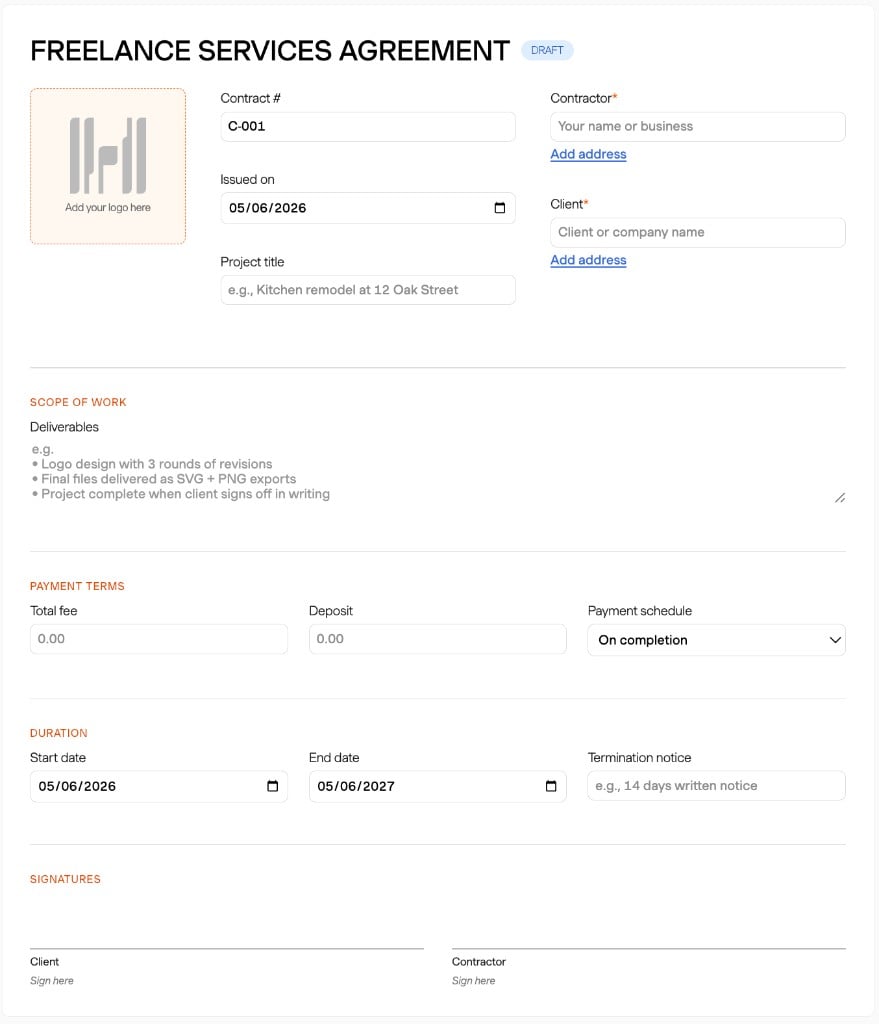
AGREEMENT DRAFT

Add your logo here

Scope of work

Payment terms

Duration

Signatures

Client

Sign here

Contractor

Sign here

Get paid via:
Credit card / Debit card
ACH
Wire transfer

Customize contract

Appearance

Add a logo
Show contract title

Contract settings

Include payment terms Total fee, deposit, and schedule
Include termination clause Notice required to end the contract
Include signature blocks Both parties sign at the bottom

Understanding the Importance of a Statement of Work in Poland

A Statement of Work (SOW) is a critical document in project management, especially in Poland where it is increasingly utilized for its strategic benefits. With 90% of Polish employers shifting towards skills-based talent models, the SOW has become an essential tool for delineating specific project requirements, timelines, and deliverables. This document helps businesses manage projects efficiently, ensuring tasks are completed on time and within budget by clearly defining roles and responsibilities.

The growing trend of using SOWs in Poland is driven by the need for flexible and cost-effective project solutions. By employing SOWs, companies can access specialized skills without the long-term commitment of hiring full-time employees. This is particularly beneficial in sectors like IT and technology, where projects often involve complex deliverables and strict timelines. SOWs also play a crucial role in public procurement processes, such as the "Specyfikacja Warunków Zamówienia" (SWZ), ensuring transparency and compliance with legal requirements.

Key Elements of an Effective Polish Statement of Work

An effective SOW in Poland should include several key elements to ensure clarity and compliance. First, it must define the project objectives and scope in unambiguous terms. This helps prevent scope creep, a common issue where project requirements expand beyond the original agreement. By clearly stating what is in-scope and out-of-scope, businesses can manage changes efficiently and control costs.

Additionally, the SOW should detail specific deliverables and tasks, assign roles and responsibilities, and establish a realistic timeline with milestones. Transparent payment terms and schedules are also essential, often tied to the completion of key deliverables. Moreover, it is important to include measurable acceptance criteria for deliverables and a change management process to handle any modifications.

In Poland, legal compliance is crucial, particularly concerning worker classification and payment structures. The SOW must adhere to local labor laws to avoid potential legal issues. For public procurement, the SWZ must meet specific legal criteria, including a description of the order, execution deadline, and criteria for evaluating offers.

Best Practices for Drafting a Polish SOW

Experts emphasize the importance of clarity and precision when drafting an SOW in Poland. Using simple, direct language helps prevent misunderstandings and aligns expectations among all parties involved. The document should focus on outcomes and performance standards, without being overly prescriptive about the methods unless necessary.

Involving key stakeholders early in the drafting process is crucial. This includes internal teams, clients, and legal counsel to ensure buy-in and identify potential issues. Legal review is recommended to confirm the SOW is contractually sound, especially regarding terms, conditions, liabilities, and intellectual property.

Another best practice is to integrate visuals like Gantt charts or workflow diagrams to enhance understanding and clarity. Additionally, integrating SOWs into centralized technology platforms like Vendor Management Systems (VMS) can provide visibility, reporting, and compliance controls across outsourced projects.

Avoiding Common Mistakes in SOW Management

One of the most common mistakes in SOW management is a lack of specificity, which leads to ambiguity and potential disputes. To avoid this, use clear, action-oriented language and break down complex tasks into manageable components. Explicitly define what is included and excluded from the project scope.

Aligning payment schedules with project progress is another critical aspect. Payments should be tied to measurable milestones rather than arbitrary dates. This ensures that financial transactions reflect actual work completed, providing a fair and transparent process for all parties involved.

Finally, a well-drafted SOW serves as a primary tool to prevent scope creep. Including a formal change request process is essential, where any proposed modifications are documented, assessed for impact, and formally approved before implementation. This approach helps maintain project focus and prevents cost overruns.

Streamline Your Polish SOW with Harvest

Harvest supports Polish projects with efficient time tracking and invoicing tools, keeping your SOWs on track and within budget.

Screenshot of Harvest's time tracking tool tailored for Polish SOW projects.

Statement of Work Template in Polish FAQs

  • A Statement of Work (SOW) in Poland is a detailed document that outlines the scope, objectives, and deliverables of a project. It is used to manage projects efficiently, ensuring tasks are completed on time and within budget by clearly defining roles and responsibilities.

  • To customize a SOW template, start by clearly defining your project objectives and scope. List specific deliverables and tasks, assign roles, and set a realistic timeline. Ensure all elements align with local regulations and include measurable acceptance criteria.

  • A Polish SOW should include project objectives, scope, deliverables, timelines, roles and responsibilities, payment terms, and acceptance criteria. Compliance with local labor laws and regulations is also crucial to avoid potential legal issues.

  • A well-drafted SOW prevents scope creep by clearly defining what is in-scope and out-of-scope, and including a formal change request process. This helps manage changes efficiently and prevents cost overruns.

  • In Poland, a SOW must comply with local labor laws and regulations concerning worker classification and payment structures. For public procurement, specific criteria must be met, including the description of the order and evaluation criteria.

  • Clarity in a SOW is crucial to prevent misunderstandings and align expectations. Using simple, direct language and clear, measurable terms ensures all parties work towards the same goals, reducing the risk of disputes.

  • Harvest supports Polish SOW projects by offering time tracking and invoicing solutions. These tools help ensure projects stay on schedule and within budget, providing a streamlined approach to project management.