
Harvest
Contracts
Sign up

Independent Contractor Agreement Template in Polish

The rise of self-employment in Poland, now at 3.2 million, underscores the need for efficient tools. Harvest helps contractors streamline time tracking, expenses, and invoicing.

Start from a template

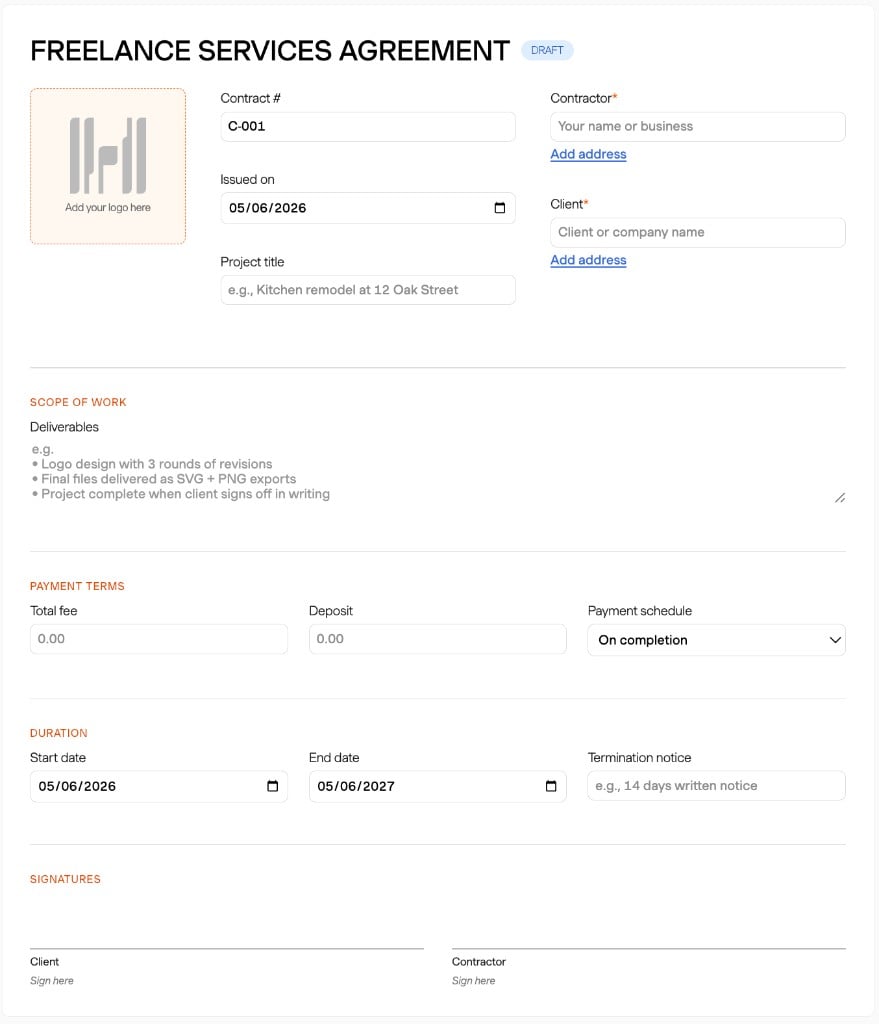
AGREEMENT DRAFT

Add your logo here

Scope of work

Payment terms

Duration

Signatures

Client

Sign here

Contractor

Sign here

Get paid via:
Credit card / Debit card
ACH
Wire transfer

Customize contract

Appearance

Add a logo
Show contract title

Contract settings

Include payment terms Total fee, deposit, and schedule
Include termination clause Notice required to end the contract
Include signature blocks Both parties sign at the bottom

Understanding Contractor Agreements in Poland

In Poland, independent contractor agreements are typically governed by civil law contracts, such as "umowa zlecenie" (contract of mandate) and "umowa o dzieło" (contract for specific work). These agreements are distinct from employment contracts, as they emphasize the contractor's autonomy and lack of entitlement to employee benefits. It's crucial to ensure that these agreements clearly define the scope of work, parties involved, and remuneration, focusing on deliverables rather than fixed working hours or hierarchical supervision.

Misclassification of workers is a significant concern, with potential financial penalties reaching PLN 30,000 per worker if a contractor is found to be functioning essentially as an employee. To mitigate these risks, businesses should conduct thorough audits of contractor engagements and avoid practices that suggest an employment relationship, such as providing equipment or imposing fixed hours. From July 2026, the Polish State Labour Inspectorate will have the authority to reclassify civil-law contracts as employment contracts, making compliance even more critical.

Legal and Tax Considerations for Contractors

Independent contractors in Poland must manage their own tax obligations and social security contributions. Contractors can choose from various taxation forms, including a progressive tax scale (12% or 32%), a flat tax of 19%, or a lump-sum tax on registered revenue (ryczałt), depending on their business activity. Additionally, they are responsible for their own ZUS contributions, which cover retirement, disability, and health insurance. These contributions can amount to approximately PLN 1,788 per month for established businesses.

With the implementation of the National e-Invoicing System (KSeF) from April 2026, VAT-registered entities must conduct all B2B transactions through this platform. This digital reporting obligation requires businesses to integrate the system into their invoicing processes to remain compliant. While Harvest does not offer tax or legal advice, it supports contractors by providing tools for managing invoices and expenses efficiently.

Drafting a Compliant Contractor Agreement

To draft a compliant independent contractor agreement in Poland, it's essential to clearly outline the contractor's responsibilities and the project's scope. The contract should emphasize the contractor's independence, focusing on deliverables and allowing flexibility in work hours and methods. Key terms to include are payment terms, intellectual property rights, confidentiality clauses, and conditions for contract termination.

Given the absence of specific contractor laws in Poland, these agreements fall under general civil law. Therefore, legal review by a professional is advisable to ensure compliance and mitigate risks of misclassification. Harvest, while not providing contract templates, aids contractors in managing the financial aspects of their engagements through its invoicing and expense tracking features.

The Role of Harvest in Contractor Management

While Harvest does not provide legal templates for independent contractor agreements, it plays a vital role in managing the financial and administrative aspects of contractor work. With its tools for time tracking, expense management, and invoicing, Harvest helps contractors streamline their operations, ensuring efficient management of billable hours and expenses.

Harvest's platform allows contractors to focus on their core business activities by simplifying the financial management process. This efficiency is crucial for maintaining profitability and compliance, especially as the gig economy continues to grow in Poland, with projections indicating that gig workers will constitute up to 20% of the workforce by 2025.

Manage Contracts with Harvest

Harvest aids contractors with time tracking, expense management, and invoicing for compliant contracts in Poland.

Harvest dashboard showing contractor agreement tools

Independent Contractor Agreement Template in Polish FAQs

  • An independent contractor agreement in Poland should clearly define the scope of work, parties involved, payment terms, and deliverables. It should emphasize contractor independence and include clauses on confidentiality, intellectual property rights, and contract termination. Seeking legal advice is recommended to ensure compliance with Polish civil law.

  • Independent contractors in Poland can choose between a progressive tax scale (12% or 32%), a flat tax of 19%, or a lump-sum tax on registered revenue (ryczałt) ranging from 3% to 17%. They are responsible for their own tax filings and ZUS contributions, which amount to about PLN 1,788 per month for established businesses.

  • Misclassifying a contractor as an employee can result in financial penalties, including retroactive demands for unpaid social insurance, taxes, and fines up to PLN 30,000 per worker. To avoid these risks, ensure that the working relationship reflects true contractor independence.

  • Harvest helps independent contractors manage their financial operations through tools for tracking time, managing expenses, and creating invoices. This support allows contractors to focus on their core business activities, enhancing efficiency and profitability.

  • From April 2026, VAT-registered entities in Poland must conduct all B2B transactions via the National e-Invoicing System (KSeF). This change requires businesses to integrate the system into their invoicing processes to ensure compliance. Harvest can aid in managing these invoicing transitions.

  • In Poland's IT industry, B2B contracts are preferred due to their fiscal efficiency and flexibility. Around 80% of IT professionals choose these contracts over traditional employment to benefit from tax advantages and greater autonomy in their work arrangements.

  • The gig economy in Poland is expected to grow significantly, with projections that gig workers will make up 20% of the workforce by 2025. This growth highlights the increasing shift towards flexible, autonomous work arrangements.