
Harvest
Contracts
Sign up

Service Agreement Template in Polish

Harvest helps contractors track time and invoice clients efficiently, addressing the common challenge of managing service agreements in Poland.

Start from a template

AGREEMENT DRAFT

Add your logo here

Scope of work

Payment terms

Duration

Signatures

Client

Sign here

Contractor

Sign here

Get paid via:
Credit card / Debit card
ACH
Wire transfer

Customize contract

Appearance

Add a logo
Show contract title

Contract settings

Include payment terms Total fee, deposit, and schedule
Include termination clause Notice required to end the contract
Include signature blocks Both parties sign at the bottom

Key Elements of a Service Agreement in Poland

Creating a comprehensive service agreement in Poland requires attention to detail and adherence to specific legal standards. A service agreement, known as "umowa o świadczenie usług" in Polish, must clearly define the parties involved, the scope of services, and the terms of execution. This clarity is critical to avoid disputes, particularly in a civil law system like Poland's, where contracts must adhere to codified statutes rather than precedents.

Key elements include identifying the contracting parties with full legal names and addresses, and precisely defining the service scope. Avoid vague descriptions; specify deliverables, quantities, and timelines. Additionally, while written agreements are not mandatory, they are highly recommended for clarity and legal evidence in disputes.

Including essential clauses such as termination conditions, liability limitations, and confidentiality agreements further protects all parties involved. For instance, specifying "payment within 14 days from the invoice date" can prevent disputes over payment timing, which is a common issue with generic templates.

Customizing a Service Agreement for Your Needs

Tailoring a service agreement to your specific needs in Poland involves more than just translating a template. Legal professionals emphasize the importance of defining "who, to whom, what, when, and for how much". This approach ensures legal certainty and minimizes ambiguity.

Customization should extend to include crucial clauses for termination, liability, and confidentiality. For example, a clause specifying that "termination requires a 30-day notice" can provide a clear exit strategy. Additionally, payment terms should be explicitly defined, such as "payment within 30 days of invoice receipt", to avoid common pitfalls.

Consulting with legal experts or using digital contract management tools can streamline this process. These tools often offer templates that can be adjusted to meet specific business contexts, ensuring compliance with Polish laws and minimizing the risk of disputes.

Legal Requirements and Compliance for Polish Service Agreements

While Polish law does not generally require service agreements to be written, doing so is advisable to provide evidence in disputes. Article 750 of the Civil Code applies mandate contract provisions to service agreements, highlighting the need for detailed terms.

Contracts must include terms related to consumer protection, such as warranties and dispute resolution mechanisms. Given Poland's emphasis on consumer rights, contracts favoring consumers in disputes are common. Additionally, while agreements can be in any language, bilingual contracts are prudent, as Polish courts may require translations.

Public sector entities must also comply with additional requirements, such as maintaining a contract register for agreements over 500 PLN. This register includes extensive details, ensuring transparency and compliance with public finance laws.

Avoiding Common Pitfalls in Polish Service Agreements

Common pitfalls in Polish service agreements include using overly simplistic templates and failing to tailor contracts to specific needs. Such practices often result in disputes over payments, deadlines, and service scope.

Avoid these issues by meticulously drafting agreements with clear definitions and terms. Including essential clauses like penalty terms for non-compliance can secure both parties' interests. For example, specifying "a penalty of 1% of the contract value for each day of delay" provides clear expectations.

Integrating contract management with business processes using digital platforms can also enhance efficiency and compliance. Automation tools offer centralized tracking and e-signatures, reducing manual errors and ensuring all parties operate with up-to-date information.

Strategic Dispute Resolution and Legal Consultation

Specifying dispute resolution methods in a service agreement can streamline conflict management. Options include designating specific courts or opting for arbitration, such as through the Arbitration Court at the Polish Chamber of Commerce.

For international agreements, clearly establish the governing law and language of proceedings. Legal consultation is strongly recommended to tailor contracts to specific business contexts, minimizing costly errors and ensuring compliance with all necessary legal standards.

Employing digital solutions for contract management can further enhance these processes. By integrating service agreements with business workflows, companies can ensure consistency and improve decision-making efficiency.

Service Agreement Template with Harvest

Explore Harvest's service agreement template in Polish, designed to help you customize contracts with ease and compliance in mind.

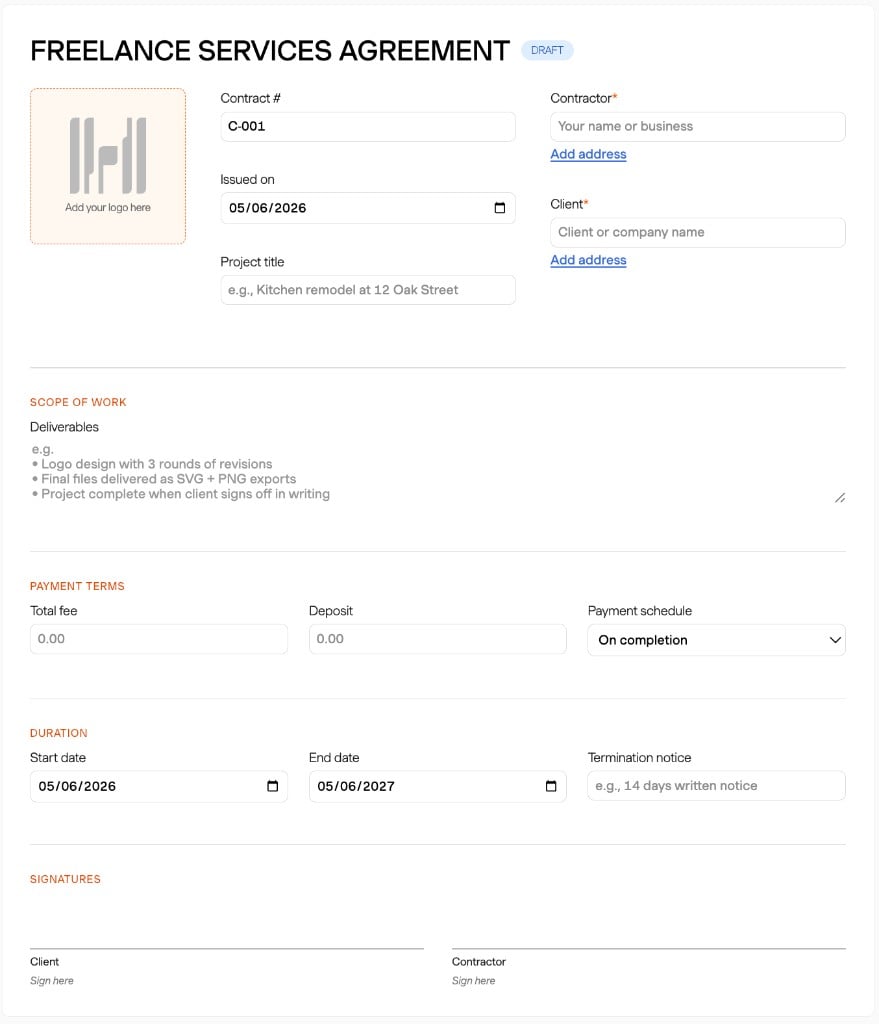
Harvest service agreement template in Polish screenshot.

Service Agreement Template in Polish FAQs

  • A service agreement in Poland should clearly define the contracting parties, service scope, and terms of execution. Key elements include full legal names, service specifications, and payment terms. Written agreements, while not mandatory, are strongly recommended for legal clarity.

  • Customization involves defining "who, to whom, what, when, and for how much." Include clauses for termination, liability, and confidentiality. Legal consultation and digital contract management tools can help tailor agreements to specific contexts.

  • While not mandatory, written service agreements in Poland should adhere to Article 750 of the Civil Code, which applies mandate contract provisions. Contracts must also include consumer protection terms and, for public sector entities, be recorded in a contract register if over 500 PLN.

  • Common pitfalls include using generic templates and vague terms. Avoid disputes over payments and deadlines by drafting detailed agreements with clear definitions and essential clauses like penalty terms for non-compliance.

  • Digital platforms offer centralized contract tracking, e-signatures, and integration with business processes, enhancing efficiency and compliance. Automation reduces manual errors and ensures all parties have up-to-date information.

  • To ensure compliance, include terms for consumer protection, clear payment dates, and specific termination conditions. Bilingual contracts are advisable as Polish courts may require translations in disputes.

  • Legal consultation helps tailor agreements to specific business needs, ensuring compliance with Polish legal standards and minimizing costly errors. It is especially beneficial for international agreements to establish governing law and dispute resolution methods.