
Harvest
Contracts
Sign up

Statement of Work Template in Arabic

Harvest helps contractors and service businesses streamline project management by providing tools like time tracking and invoicing, making it easier to manage tasks and budgets in Arabic-speaking regions.

Start from a template

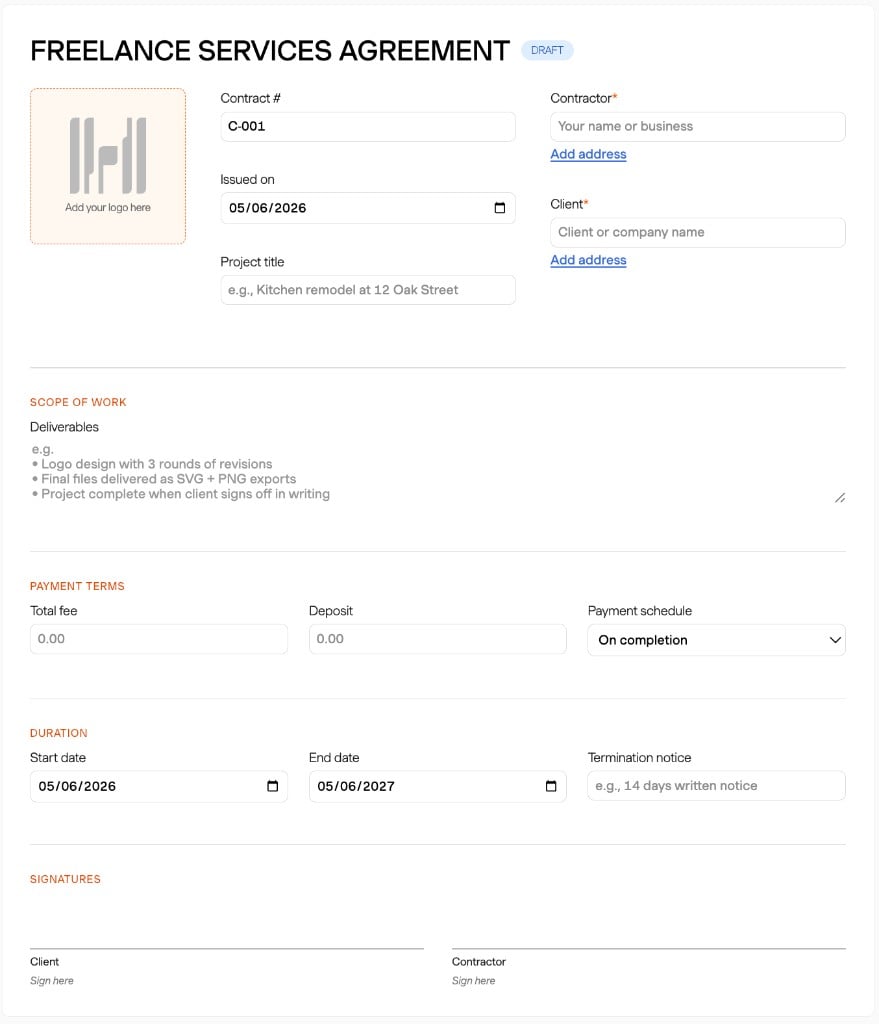
AGREEMENT DRAFT

Add your logo here

Scope of work

Payment terms

Duration

Signatures

Client

Sign here

Contractor

Sign here

Get paid via:
Credit card / Debit card
ACH
Wire transfer

Customize contract

Appearance

Add a logo
Show contract title

Contract settings

Include payment terms Total fee, deposit, and schedule
Include termination clause Notice required to end the contract
Include signature blocks Both parties sign at the bottom

Understanding the Importance of a Statement of Work in Arabic

A Statement of Work (SOW) is a crucial document for project management, especially in Arabic-speaking regions. It serves as an "operational blueprint" that translates business agreements into clear, actionable tasks, ensuring all stakeholders are aligned on deliverables, timelines, and responsibilities. In the Middle East and North Africa (MENA) region, a well-structured SOW can prevent scope creep, set clear expectations, and provide legal protection, which is critical for project success (source_domain). This document is not a mere formality; it's a strategic tool that facilitates smooth project execution and mitigates potential disputes.

When drafting an SOW in Arabic, it is essential to incorporate local legal frameworks and cultural nuances. For instance, SOWs in Saudi Arabia must align with Sharia principles and local commercial regulations, while those in the United Arab Emirates need to comply with UAE Federal Laws, such as the Civil Code and Commercial Transactions Law. This localization ensures that the document is both legally sound and culturally appropriate.
Key Components of an Arabic SOW Template

Creating a comprehensive SOW in Arabic involves several key components to ensure clarity and effectiveness. First, it should define the scope of work, outlining the tasks, deliverables, and timelines involved. This section prevents scope creep by clearly stating what is and isn't included in the project. Additionally, specifying payment terms and milestones is vital, as these elements establish a clear financial framework and help manage cash flow effectively.

Another critical component is the roles and responsibilities section, which assigns specific duties to each stakeholder involved in the project. This clarity reduces ambiguity and enhances accountability. Moreover, an effective SOW includes a change management process, detailing how alterations to the project scope will be handled, thus minimizing disruptions and maintaining project alignment.

Finally, it's important to incorporate acceptance criteria, which defines the standards and conditions that deliverables must meet for approval. This ensures that the end product aligns with client expectations and reduces the likelihood of disputes over project outcomes.

Cultural Considerations in Drafting an Arabic SOW

When drafting an SOW for Arabic-speaking clients, understanding cultural nuances is crucial. For instance, in Saudi Arabian business culture, the absence of a direct "no" should not be interpreted as agreement. Often, silence indicates evaluation rather than commitment, emphasizing the need for explicit communication in contracts. Additionally, a generic contract template is often insufficient, as it may overlook critical project-specific risk points (source_domain).

Another important cultural consideration is language. In countries like Egypt, formal contracts must be written in Arabic, highlighting the importance of providing an SOW in the local language. This not only ensures compliance with legal standards but also fosters better understanding and cooperation among stakeholders.

Incorporating cultural elements into the SOW, such as respect for local customs and business practices, can enhance the document's effectiveness. This approach not only addresses legal and regulatory requirements but also builds trust and rapport with Arabic-speaking clients, facilitating smoother project execution.

Best Practices for Creating an Arabic SOW

To create an effective Arabic SOW, it's essential to follow best practices that ensure clarity and compliance. Start by gathering detailed requirements from all stakeholders and selecting the appropriate SOW type, such as design-based or performance-based. This groundwork ensures that the SOW addresses all necessary elements and aligns with project goals.

Next, draft the document using clear, specific, and measurable language. Avoid vague terms like "reasonable effort," which can lead to disputes due to multiple interpretations. Instead, focus on objective criteria for scope, deliverables, timelines, and acceptance to ensure all parties have a shared understanding (source_domain).

Customization is key. Rather than relying on generic templates, tailor the SOW to fit the unique aspects of each project, including scope, deliverables, and payment milestones. This approach not only enhances the document's relevance but also mitigates potential risks. Finally, always review the SOW with legal counsel to ensure it meets all regulatory requirements and safeguards your interests.

Streamline Your SOW with Harvest

Harvest provides tools to manage tasks and budgets, streamlining your Statement of Work process in Arabic-speaking regions.

Statement of Work Template in Arabic in Harvest interface

Statement of Work Template in Arabic FAQs

  • A Statement of Work (SOW) is a comprehensive document that outlines the tasks, deliverables, timelines, and responsibilities involved in a project. It serves as a contract between parties to ensure clear expectations and prevent scope creep.

  • In Arabic-speaking regions, an SOW is crucial for ensuring legal compliance and addressing cultural nuances. It helps prevent misunderstandings, aligns project expectations, and reduces the risk of disputes.

  • An Arabic SOW template should include the scope of work, payment terms, roles and responsibilities, change management process, and acceptance criteria. These elements ensure clarity and effectiveness in project management.

  • To ensure legal compliance, incorporate local legal frameworks into your SOW. For example, in the UAE, align with Federal Laws, and in Saudi Arabia, adhere to Sharia principles and local commercial regulations.

  • Common mistakes include using vague language like "reasonable effort" and relying on generic templates. Instead, use specific, measurable language and customize the SOW to fit the project's unique requirements.

  • Cultural nuances, such as the interpretation of silence in Saudi Arabia, can significantly affect negotiations. Understanding these nuances ensures clearer communication and stronger agreements.

  • While Harvest is not specifically designed for SOW creation, it supports project management by offering time tracking and invoicing tools, which can complement the SOW process in Arabic-speaking regions.