
Harvest
Contracts
Sign up

Contract Template for Mechanical Contractors

Mechanical contractors face complex regulatory and project demands. Harvest offers customizable contract templates to streamline contract management and align with industry standards.

Start from a template

AGREEMENT DRAFT

Add your logo here

Scope of work

Payment terms

Duration

Signatures

Client

Sign here

Contractor

Sign here

Get paid via:
Credit card / Debit card
ACH
Wire transfer

Customize contract

Appearance

Add a logo
Show contract title

Contract settings

Include payment terms Total fee, deposit, and schedule
Include termination clause Notice required to end the contract
Include signature blocks Both parties sign at the bottom

Key Clauses in Mechanical Contractor Contracts

A comprehensive contract for mechanical contractors must include several key clauses to ensure clarity and compliance with industry standards. Scope of work is paramount, detailing each task and deliverable to avoid disputes. This section should cover specific technical requirements, drawings, and any exclusions to set clear expectations. According to industry experts, relying on verbal agreements or vague descriptions often leads to misunderstandings and legal issues.

Payment terms are another critical element. Contracts should specify the price, payment schedule, and conditions for milestone-based payments. Clear terms on retainage—the percentage of payment withheld until project completion—are vital. Many contractors face payment delays, with terms tied to project milestones rather than dates helping mitigate this risk.

In addition to scope and payment, change order procedures should be clearly defined. Given the dynamic nature of mechanical contracting, changes in scope or materials are common. A structured process for handling changes, including documentation and authorization, helps prevent disputes and keeps projects on track.

Customizing Contract Templates for Mechanical Contractors

Customizing a contract template to fit the unique needs of a mechanical contractor is essential for successful project execution. While standard templates offer a starting point, they must be tailored to address specific project variables. This customization should include detailed descriptions of work, timelines, and stakeholder responsibilities, ensuring all parties understand their commitments.

Experts advise avoiding "one-size-fits-all" contracts, as these often lack the specificity needed for complex projects. Instead, contractors should focus on integrating precise terms that reflect the unique requirements of each job. This includes adapting sections for compliance with local regulations, such as the Fair Labor Standards Act in the U.S., which governs wage laws.

Mechanical contractors should also consider the integration of technology in their contracts. With increasing reliance on AI-driven tools for estimating and planning, contracts can specify the use of such technologies to enhance accuracy and efficiency. This approach not only modernizes workflows but also aligns with industry trends towards greater technological integration.

Avoiding Common Pitfalls in Mechanical Contracting

Mechanical contractors often encounter common pitfalls that can lead to costly disputes and project delays. A significant error is failing to clearly define the scope of work, which can result in unmet expectations and disagreements. Including detailed descriptions and technical documents in contracts helps prevent such issues.

Another frequent mistake is neglecting to specify payment terms clearly. Contractors should ensure that terms around progress payments, retainage, and penalties for late payments are explicitly stated. This clarity can reduce the risk of late payments, which remain a challenge for many contractors.

Additionally, not having a structured process for change orders can derail projects. As mechanical projects often face unforeseen changes, having a clear procedure for documenting and approving changes is crucial. This helps manage costs and timelines more effectively, minimizing the impact of disruptions.

Legal Considerations for Mechanical Contractor Contracts

Legal considerations are a crucial component of mechanical contractor contracts. Compliance with federal and state regulations is essential to avoid penalties, which can range from fines to contract voidability. For example, the Davis-Bacon Act requires certain wage standards on federal projects, and violations can lead to severe consequences.

Mechanical contractors must ensure that their contracts address these compliance requirements, including provisions for adherence to licensing laws. Penalties for non-compliance, such as those under OSHA's regulations, can be significant, with fines reaching up to $145,027 per violation for willful infractions.

Furthermore, contractors should incorporate dispute resolution methods in their contracts. Clear terms for arbitration or mediation can provide a framework for resolving disagreements without lengthy court battles. By including these legal safeguards, contractors can protect their interests and maintain smooth project execution.

The Role of Professional Associations and Resources

Professional associations like the Mechanical Contractors Association of America (MCAA) play a vital role in supporting mechanical contractors. These organizations offer resources, advocacy, and education to help contractors navigate the complexities of their industry. They provide best practices for contract management and project execution, which can enhance contractor performance and profitability.

Membership in such associations can also offer networking opportunities and access to industry insights that keep contractors informed about regulatory changes and technological advancements. This support is invaluable, especially as the industry faces increased regulatory pressures and shifts towards more integrated workflows.

By leveraging the resources and expertise of professional associations, mechanical contractors can stay competitive and informed, ensuring their contracts and projects are aligned with current industry standards and practices.

Tailored Contract Templates with Harvest

Harvest provides mechanical contractors with customizable contract templates tailored to industry standards.

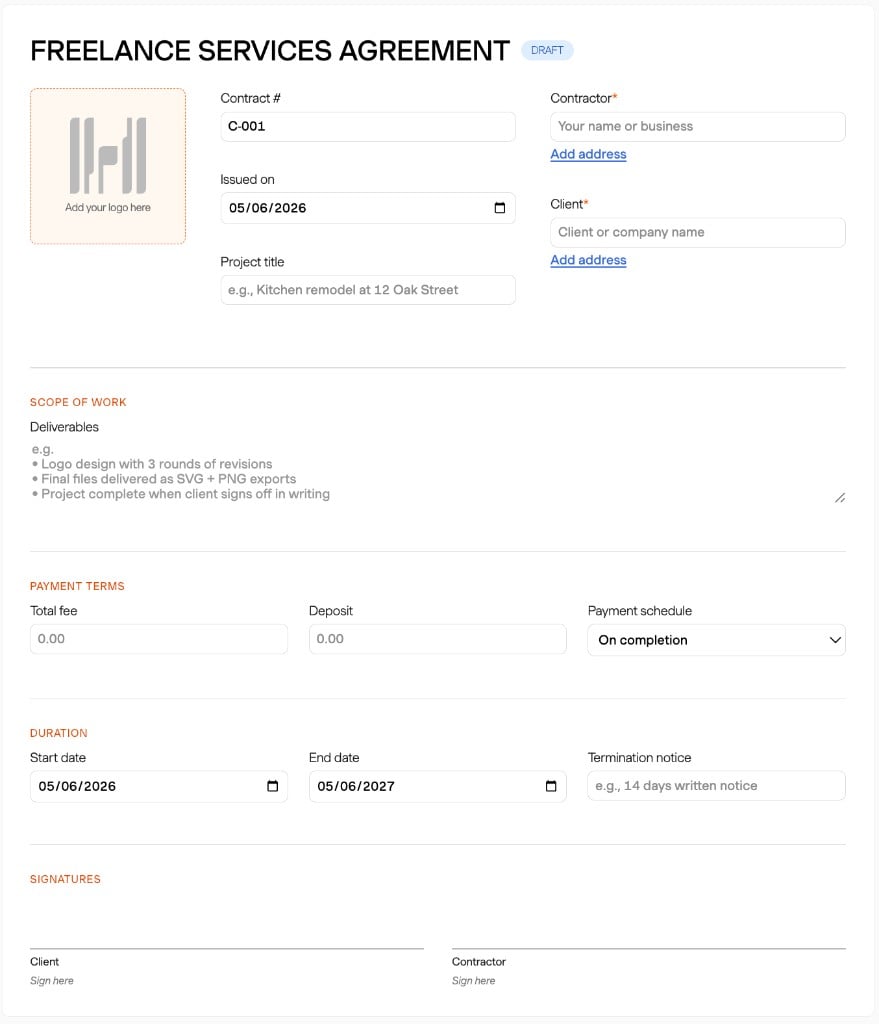
Harvest contract template for mechanical contractors on the screen.

Contract Template for Mechanical Contractors FAQs

  • A mechanical contractor contract should include a detailed scope of work, payment terms, change order processes, project timelines, warranty details, and dispute resolution methods. Specific technical requirements and drawings should also be included to avoid misunderstandings.

  • Compliance can be ensured by including clauses that adhere to federal and state regulations, such as the Davis-Bacon Act for wage standards. Contractors should also stay informed on local licensing laws and integrate compliance checks into their contract management processes.

  • A clear scope of work prevents disputes by setting precise expectations for deliverables and responsibilities. It should include technical specifications and exclusions, reducing the risk of misunderstandings and disagreements.

  • Common payment terms include milestone-based payments, retainage percentages, and penalties for late payments. Clearly defined terms help manage cash flow and reduce payment-related disputes.

  • Contractors can manage change orders by establishing a structured process for documentation and approval. This should be clearly outlined in the contract to handle scope changes efficiently and minimize project disruptions.

  • Professional associations offer resources, advocacy, and education to help contractors improve their practices. They provide access to industry insights, best practices, and networking opportunities, which are vital for staying competitive.

  • Technology, such as AI-driven tools, enhances precision in planning and management. It helps contractors improve efficiency and accuracy in estimating, scheduling, and project execution, aligning with industry trends.