
Harvest
Contracts
Sign up

Cost Plus Contract Template

Managing costs in cost plus contracts can be challenging, but Harvest simplifies this with robust time and expense tracking, ensuring transparency and control.

Start from a template

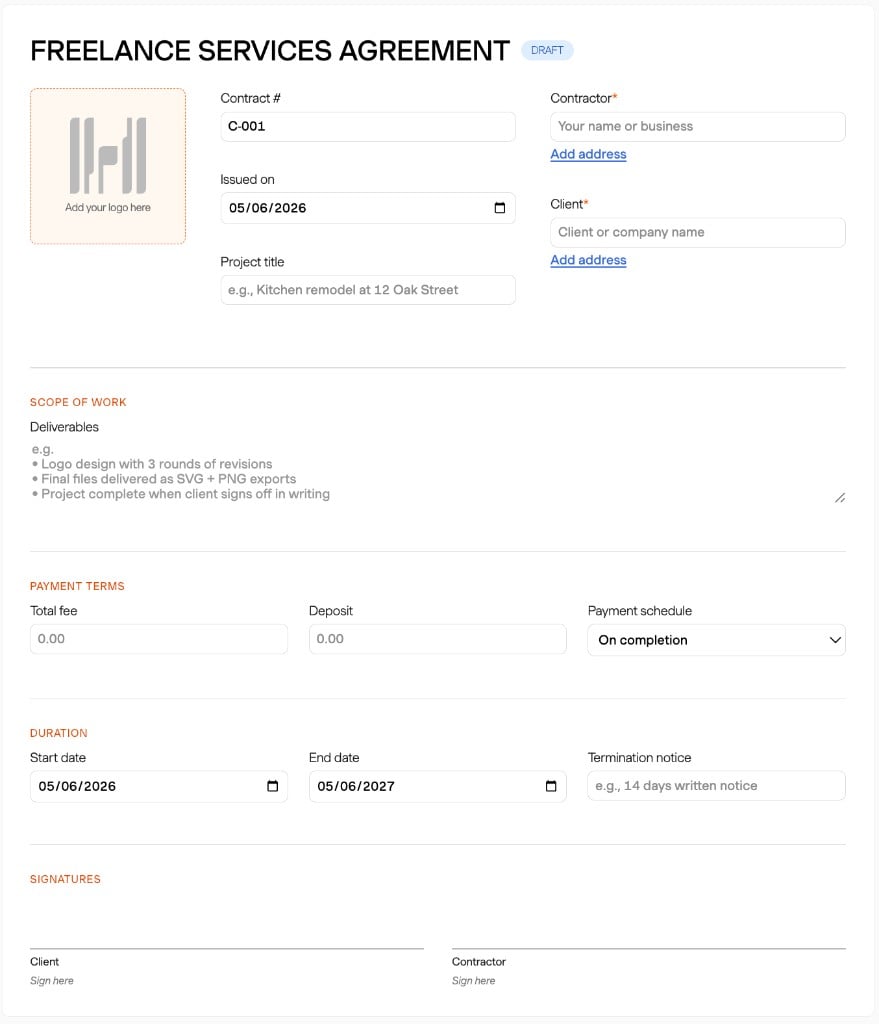
AGREEMENT DRAFT

Add your logo here

Scope of work

Payment terms

Duration

Signatures

Client

Sign here

Contractor

Sign here

Get paid via:
Credit card / Debit card
ACH
Wire transfer

Customize contract

Appearance

Add a logo
Show contract title

Contract settings

Include payment terms Total fee, deposit, and schedule
Include termination clause Notice required to end the contract
Include signature blocks Both parties sign at the bottom

Understanding Cost Plus Contracts

Cost plus contracts are commonly used in industries like construction, defense, and research, where project costs are unpredictable. These contracts allow a client to reimburse a contractor for all allowable expenses incurred during a project, plus an additional fee for profit and overhead. This type of contract is especially useful when the scope of work is uncertain or costs are difficult to estimate upfront. Historically, cost plus contracts were first extensively used during World War I to incentivize production when market conditions were volatile. Today, they remain prevalent in scenarios where financial risk needs to be managed effectively, such as large-scale construction projects.

Despite their advantages, managing a cost plus contract can present challenges. According to the Project Management Institute, 38% of projects using such contracts experienced budget overruns exceeding 15% due to inadequate early-stage cost estimation. This underscores the importance of rigorous cost tracking and documentation. With Harvest, contractors can track and invoice for labor, materials, and equipment as billable expenses, providing a detailed breakdown for clients. This feature helps maintain transparency and control over project expenses.

Key Components of a Cost Plus Contract

A cost plus contract must clearly outline several critical components to ensure clarity and compliance. These include the definition of allowable costs, reimbursement processes, and contractor's fees. It's essential to differentiate between direct expenses, such as materials and labor, and indirect costs, like office space and insurance. Ambiguities in these definitions can lead to disputes, as seen in court cases where inadequate cost documentation resulted in legal challenges.

Another vital aspect is the fee structure. Contractors can choose between a flat fee or a percentage of total costs. Industry experts recommend a cost-plus-fixed-fee structure for better cost control and to incentivize cost-saving measures. Harvest supports this by offering robust time and expense tracking capabilities, allowing contractors to tie payment procedures to project milestones, enhancing transparency and financial management.

Customizing Your Cost Plus Contract Template

When customizing a cost plus contract template, it's crucial to tailor it to specific project needs and regional regulations. For instance, U.S. federal contracts are governed by the Federal Acquisition Regulation, which prohibits cost-plus-percentage-of-cost arrangements. State laws may also impose additional requirements, such as detailed cost documentation in Florida or limitations on certain contract types in California.

Harvest can assist in customizing contract financials by meticulously tracking expenses and labor costs, providing a clear financial picture. While it doesn't handle legal clauses directly, its expense tracking helps ensure that all costs are documented accurately, aiding in compliance with regulatory requirements. This capability can alleviate some of the administrative burdens associated with cost-plus contracts.

Advantages and Challenges of Cost Plus Contracts

Cost plus contracts offer several advantages, including flexibility and transparency, which are crucial for projects with uncertain scopes. These contracts alleviate the pressure to cut costs, allowing contractors to focus on quality and innovation. However, they also pose challenges, such as potential budget overruns and the need for meticulous cost documentation.

According to a 2023 survey, 42% of contractors cited inadequate cost tracking as a primary cause of payment delays in cost plus projects. This highlights the need for efficient tracking systems, such as those offered by Harvest, which provide detailed expense breakdowns and support invoicing based on project milestones. By using Harvest, contractors can manage their financials more effectively, reducing the risk of disputes and ensuring smoother project execution.

Cost Plus Contract Solutions with Harvest

Explore how Harvest provides detailed expense tracking for cost plus contracts, ensuring transparency and control over project costs.

Screenshot of Harvest's cost tracking interface for cost plus contracts.

Cost Plus Contract Template FAQs

  • A cost plus contract is an agreement where a client reimburses a contractor for all allowable project expenses plus an additional fee for profit and overhead. This contract type is ideal for projects with uncertain costs or scopes.

  • Customizing a cost plus contract involves defining project-specific allowable costs, reimbursement processes, and fee structures. Consider regional regulations and use tools like Harvest for detailed expense tracking to aid compliance.

  • Cost plus contracts offer flexibility and transparency, allowing for quality-focused work without strict budget constraints. They are ideal for complex projects with uncertain scopes, enabling effective financial risk management.

  • Challenges include potential budget overruns and the need for meticulous cost documentation. Effective cost tracking systems, like those offered by Harvest, can help mitigate these challenges by providing detailed expense breakdowns.

  • Harvest helps by tracking and invoicing for labor, materials, and equipment as billable expenses, providing transparency and control over project financials. It supports invoicing based on project milestones, enhancing financial management.

  • Yes, legal considerations vary by region. In the U.S., federal contracts must comply with the Federal Acquisition Regulation. State laws may impose additional documentation requirements. It's essential to define allowable costs clearly to prevent disputes.

  • Cost plus contracts reimburse for actual expenses and include a profit fee, offering flexibility in projects with uncertain scopes. Fixed-price contracts, meanwhile, set a predetermined price, incentivizing cost control but limiting flexibility.