
Harvest
Contracts
Sign up

Service Agreement Template in Dutch

Navigating Dutch service agreements can be complex due to legal requirements and digitalization trends. Harvest offers resources to streamline agreements and compliance.

Start from a template

AGREEMENT DRAFT

Add your logo here

Scope of work

Payment terms

Duration

Signatures

Client

Sign here

Contractor

Sign here

Get paid via:
Credit card / Debit card
ACH
Wire transfer

Customize contract

Appearance

Add a logo
Show contract title

Contract settings

Include payment terms Total fee, deposit, and schedule
Include termination clause Notice required to end the contract
Include signature blocks Both parties sign at the bottom

Understanding the Essentials of a Dutch Service Agreement

Creating a service agreement in Dutch law requires careful attention to several key elements to ensure legal compliance and clarity. The essential components of a valid service agreement include clear identification of the parties involved, a precisely defined scope of services, and specific terms regarding duration and payment. Under Articles 7:400 and following of the Dutch Civil Code, these agreements establish an independent contractor relationship, distinct from employment contracts by the absence of subordination. Properly distinguishing between a contractor and an employee is critical, particularly given recent reforms increasing scrutiny on contractor status. Misclassification can lead to costly reclassifications and unexpected liabilities.

Additionally, the agreement must address termination rights, typically allowing principals to end the contract at any time under Article 7:408, provided specific notice periods or compensation arrangements are included. Dutch law emphasizes mutual consent and fairness, making it vital for all parties to understand their rights and obligations. Ensuring these elements are meticulously documented can prevent disputes and streamline business operations.

Legal Compliance and Digitalization in Dutch Agreements

In the Netherlands, the digitalization of contracts has become the norm, with electronic signatures being legally recognized since 2003 and standardized across Europe through the eIDAS Regulation. This digital acceptance facilitates the contracting process, allowing service providers to efficiently manage agreements in a digital environment. However, care must be taken to ensure that all digital agreements comply with Dutch law, particularly concerning consumer protection and data privacy.

The Copyright Contracts Act, effective from January 2026, further impacts service agreements, especially for creative services. It requires explicit deed-form assignments or licenses for copyright transfers, alongside mechanisms for equitable remuneration. Given the complexity, it's advisable to consult with legal experts when drafting these agreements, particularly for high-value or intricate contracts. This ensures compliance with evolving laws and mitigates risks of potential disputes.

Common Challenges and Best Practices in Drafting Service Agreements

Drafting a service agreement in Dutch law involves navigating several common challenges, such as ensuring the representation authority is clear to avoid disputes. Research indicates that 23% of contractual disagreements arise from ambiguity in this area, emphasizing the need for clarity in identifying and verifying the legal capacity of all parties involved. Additionally, it's crucial to clearly define the scope of services, deliverables, and performance standards to prevent misunderstandings.

To avoid pitfalls, consider incorporating best practices such as maintaining regular communication, documenting all transactions related to the agreement, and ensuring transparency in terms of rights and obligations. For IT contracts, this means addressing data portability, intellectual property rights, and compliance with data protection laws to prevent vendor lock-in and ensure legal compliance. These steps can significantly reduce the likelihood of disputes and facilitate smoother business operations.

The Role of Legal Counsel and Localization in Service Agreements

While using a template can be a practical starting point for drafting a service agreement, it's essential to tailor it to Dutch legal standards. Legal experts strongly advise against relying solely on generic templates, as these often fail to meet the specific requirements of Dutch law. Instead, engaging with a Dutch lawyer can provide invaluable guidance in navigating complex regulations and ensuring that the agreement aligns with local legal expectations.

Localization is another critical aspect, particularly for businesses operating across borders. The Rome I Regulation provides a framework for determining applicable law in international contracts, enhancing predictability. However, care must be taken when drafting English-language contracts governed by Dutch law to avoid legal terms that may not have direct equivalents. Specifying currency, tax responsibilities, and compliance obligations for each jurisdiction is crucial to prevent ambiguities and ensure enforceability.

Streamline Dutch Service Agreements with Harvest

Explore how Harvest helps manage Dutch service agreements efficiently, ensuring compliance and clarity with digital tools.

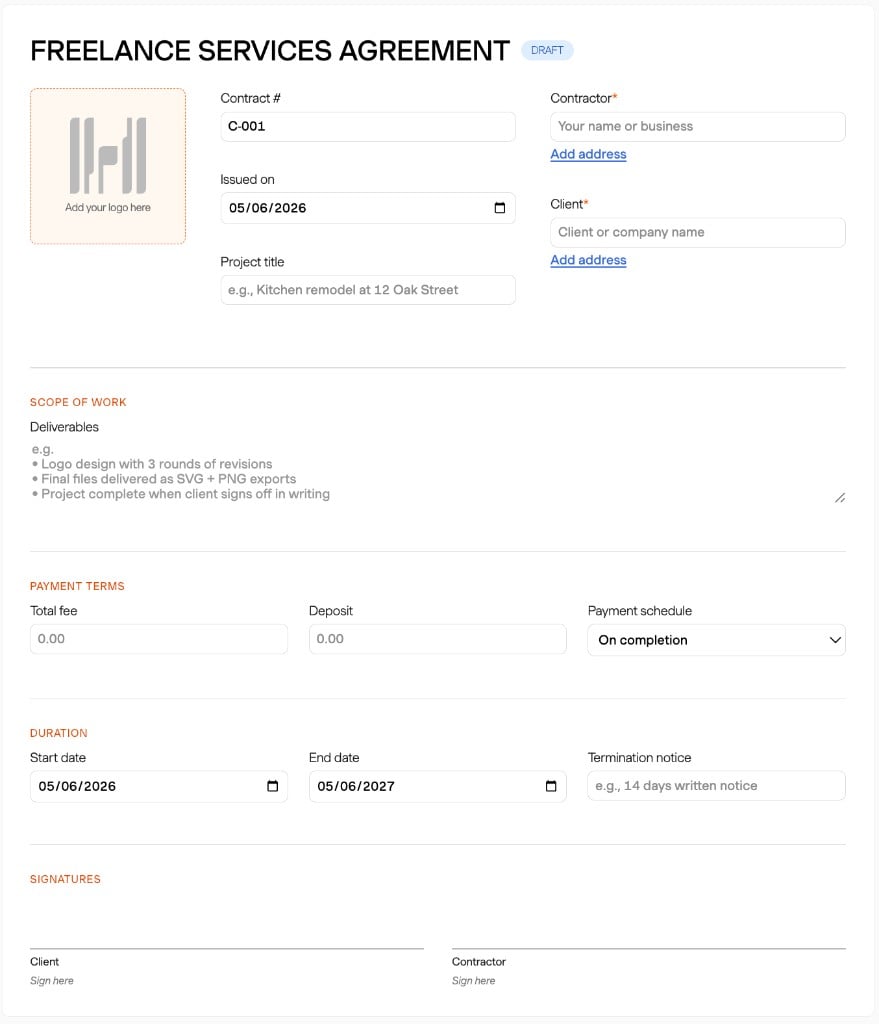
Harvest service agreement template in Dutch preview

Service Agreement Template in Dutch FAQs

  • A Dutch service agreement must include the identification of the parties, a defined scope of services, the duration, payment terms, and mutual consent. These elements ensure the contract is legally valid and enforceable.

  • Unlike employment contracts, Dutch service agreements establish an independent contractor relationship, characterized by the absence of subordination, organizational integration, and entrepreneurial independence. Contractors bear their own business risks.

  • Yes, electronic signatures have been legally recognized in the Netherlands since 2003. The eIDAS Regulation standardizes electronic signatures across Europe, making them valid for Dutch service agreements.

  • Consulting a Dutch lawyer is advised for complex or high-value agreements to navigate intricate regulations and ensure compliance with local laws. This mitigates risks of disputes and misclassification.

  • Generic templates often fail to meet specific Dutch legal standards, leading to unenforceable terms or costly litigation. Localization and legal expertise are crucial for compliance and risk reduction.

  • Ensuring compliance involves including essential elements like clear service scopes, termination rights, and payment terms. Consulting legal experts and localizing templates to Dutch law are also vital.

  • Digitalization facilitates the contracting process in the Netherlands with electronic signatures and online management. It's vital to ensure digital agreements comply with local legal standards for validity.