
Harvest
Contracts
Sign up

Contract Template in Russian

Harness the power of Harvest to streamline contract-related tasks with precise time tracking and invoicing, ensuring compliance with Russian legal standards.

Start from a template

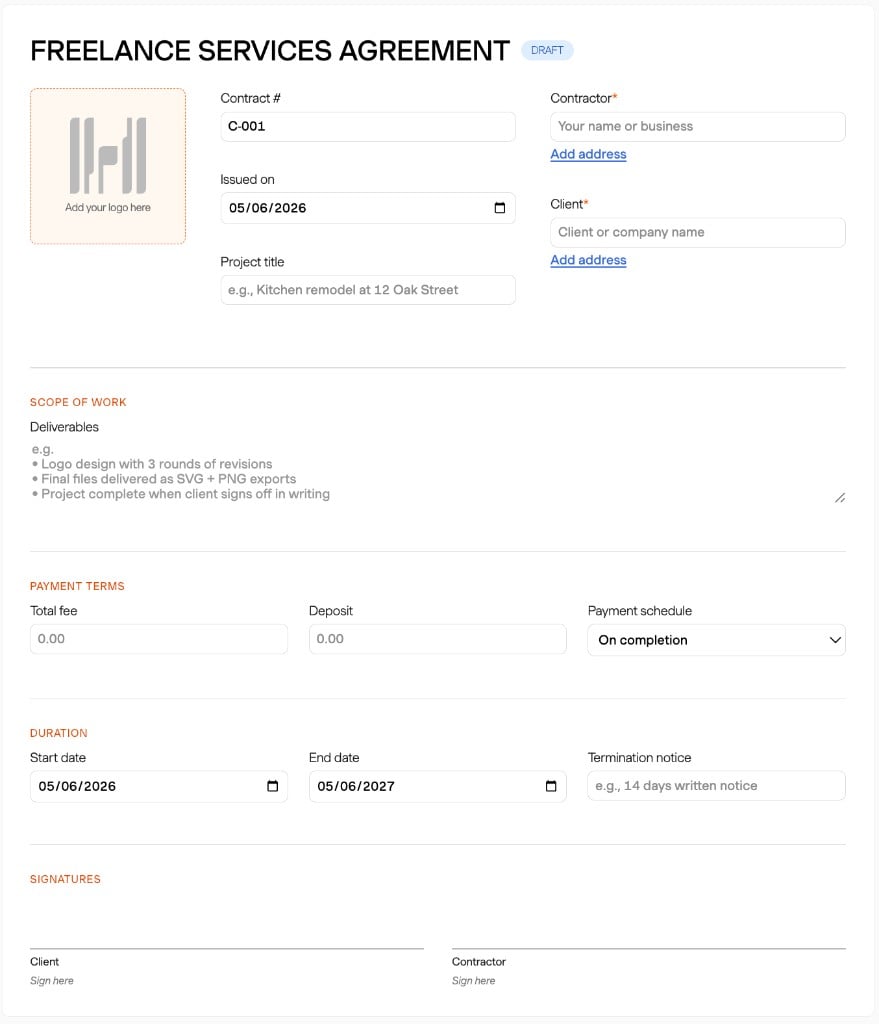
AGREEMENT DRAFT

Add your logo here

Scope of work

Payment terms

Duration

Signatures

Client

Sign here

Contractor

Sign here

Get paid via:
Credit card / Debit card
ACH
Wire transfer

Customize contract

Appearance

Add a logo
Show contract title

Contract settings

Include payment terms Total fee, deposit, and schedule
Include termination clause Notice required to end the contract
Include signature blocks Both parties sign at the bottom

Understanding Russian Contract Requirements

Creating a contract template in Russian necessitates understanding the legal framework and language requirements specific to Russia. The Russian Civil Code governs contract law, outlining mandatory elements such as the parties involved, subject matter, terms of payment, and dispute resolution mechanisms. It’s crucial to adhere to these elements to ensure the contract's enforceability. Additionally, contracts must be drafted in Russian, with the Russian version typically taking precedence in legal interpretations. For cross-border agreements, it is advisable to include a clause specifying which language version will prevail to avoid potential disputes.

Electronic signatures have been legally recognized in Russia since 2011, with Qualified Electronic Signatures (QES) holding the same legal standing as a handwritten signature. This allows for a more seamless integration of digital contract management, reducing the need for physical documentation. However, it is essential to ensure that all contracts surpassing ten thousand Roubles or involving legal entities are in a written form to comply with Russian law.

Leveraging Technology for Contract Management

The shift towards digital contract management in Russia is underscored by increasing internet penetration, projected to reach 94.4% by 2025. This digital adoption facilitates the use of electronic document flow, which grew by 22% in 2022. Utilizing digital tools for contract management can streamline processes and reduce administrative overhead. For instance, the issuance of over 2 million electronic signatures in early 2023 highlights the growing acceptance of digital solutions in legal processes.

While Harvest does not directly offer contract management solutions, its capabilities in time tracking and invoicing can indirectly support businesses managing contracts. By efficiently tracking time and expenses related to contract execution, businesses can maintain accurate records and streamline invoicing processes. This is particularly beneficial for service providers and freelancers who need to ensure that their contractual obligations are met and appropriately billed.

Mitigating Language and Compliance Challenges

Drafting contracts in Russian and managing dual-language agreements can present challenges, especially in cross-border transactions. To mitigate potential disputes, it is crucial to specify in the contract which language version takes precedence. This is a common practice among businesses operating internationally, as it helps clarify interpretive hierarchies and reduce misunderstandings.

Moreover, businesses should ensure that their contracts are comprehensive, including all mandatory clauses and definitions to prevent them from being deemed void or unenforceable. This includes specifying the subject matter, obligations, and payment terms clearly. Additionally, having a robust set of internal policies covering aspects like labor regulations and data protection is essential, as these documents are subject to review by Russian labor inspectors.

Practical Tips for Effective Contract Drafting

To draft effective contracts in Russia, it is important to clearly define contractual relations, especially in mixed contracts that combine different types of agreements. This clarity helps prevent the application of disparate legal rules that could lead to disputes or additional costs. Including explicit confidentiality clauses is also critical, as Russian courts may interpret such terms narrowly.

Incorporating a strategic approach to electronic correspondence can enhance contract enforceability. Parties should agree to accept emails or other electronic communications as valid forms of evidence. For businesses using Harvest for time tracking and invoicing, maintaining organized records of time spent and expenses incurred can aid in fulfilling contractual obligations and ensuring accurate billing.

Explore Harvest for Russian Contracts

See how Harvest's time tracking and invoicing can simplify managing Russian contracts, ensuring compliance and efficiency.

Screenshot of Harvest's time tracking and invoicing interface for contract management.

Contract Template in Russian FAQs

  • In Russia, contracts must include key elements such as the parties involved, subject matter, terms of payment, and dispute resolution mechanisms. Compliance with these elements ensures the contract's validity under the Russian Civil Code.

  • To ensure compliance, draft the contract in Russian, include all mandatory elements, and adhere to the prescribed written form. For certain transactions, using a Qualified Electronic Signature (QES) is also advisable.

  • Dual-language contracts help manage cross-border transactions by specifying which language version prevails in case of disputes, thus reducing potential misunderstandings and legal challenges.

  • With over 94% internet penetration expected by 2025, digital adoption supports the use of electronic documents and signatures, making contract management more efficient and reducing reliance on physical paperwork.

  • While Harvest doesn't directly manage contracts, it aids in tracking time and expenses related to contract execution, ensuring accurate billing and streamlined invoicing processes for businesses.

  • Yes, electronic signatures, particularly Qualified Electronic Signatures (QES), are legally recognized in Russia and hold the same validity as handwritten signatures. They streamline the process of contract execution.

  • Confidentiality clauses should be explicit and comprehensive, as Russian courts may interpret them narrowly. Consider drafting detailed confidentiality agreements for major transactions to ensure protection.