
Harvest
Contracts
Sign up

Master Services Agreement Template

Master Services Agreements streamline business relationships by setting clear terms for ongoing projects. Harvest aids contractors by supporting project tracking and invoicing within these frameworks.

Start from a template

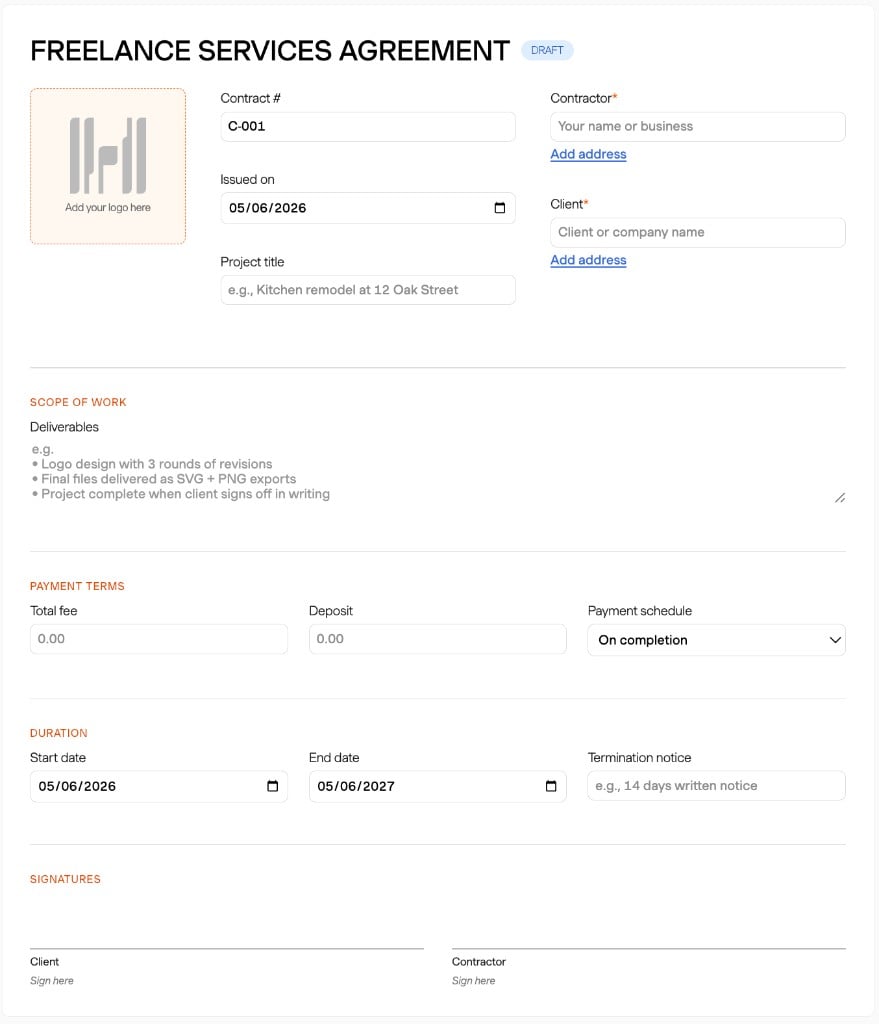
AGREEMENT DRAFT

Add your logo here

Scope of work

Payment terms

Duration

Signatures

Client

Sign here

Contractor

Sign here

Get paid via:
Credit card / Debit card
ACH
Wire transfer

Customize contract

Appearance

Add a logo
Show contract title

Contract settings

Include payment terms Total fee, deposit, and schedule
Include termination clause Notice required to end the contract
Include signature blocks Both parties sign at the bottom

Understanding the Purpose of a Master Services Agreement

A Master Services Agreement (MSA) serves as a foundational contract that outlines the general terms and conditions for ongoing business relationships. It is widely used across industries like IT, telecommunications, and marketing to streamline future projects by setting consistent expectations. Unlike individual Statements of Work (SOWs), which detail specific project deliverables, timelines, and costs, MSAs provide a framework for managing multiple engagements efficiently.

Organizations that implement MSAs often experience increased efficiency and cost savings. For example, companies using advanced agreement management systems with MSAs report 29% fewer deal delays. This efficiency is due in part to the elimination of the need to renegotiate basic terms for every new project, which can significantly reduce legal costs and strengthen vendor relationships.

While Harvest does not draft MSAs, it supports project management by enabling detailed tracking and invoicing based on specific tasks and expenses. This allows businesses to maintain control over financial and operational outcomes within the MSA framework.

Key Clauses to Include in Your MSA

When drafting a Master Services Agreement, it is crucial to include several key clauses to protect your business interests. These clauses typically cover aspects such as service scope, payment terms, performance expectations, and intellectual property rights. Each of these elements should be clearly defined to avoid disputes and ensure a smooth working relationship.

For instance, in industries like technology, explicitly distinguishing between Background IP (pre-existing tools) and Foreground IP (new work) can prevent accidental IP transfer. Similarly, defining measurable acceptance criteria for deliverables can avoid "infinite revisions" and ensure predictable cash flow. Legal experts emphasize the importance of separating indemnity from liability cap clauses, ensuring the liability cap acts as a "hard ceiling" for claims.

While Harvest does not offer legal drafting capabilities, it facilitates project management and invoicing, helping businesses track and manage tasks effectively within the MSA's scope.

Common Mistakes to Avoid in MSAs

Drafting a Master Services Agreement can be complex, and common mistakes can lead to financial and operational setbacks. One major pitfall is using a generic template without customization. Each MSA should be treated as a living document that addresses specific operational needs like insurance and tax responsibilities.

Another frequent issue is a vague scope of work, which can cause conflict. Attaching a detailed Statement of Work (SOW) for each project and cross-referencing it in the MSA can mitigate this risk. It is also crucial to define deliverables, exclusions, and acceptance criteria precisely to avoid disputes.

While Harvest does not draft MSAs, it aids in managing project specifics and changes through its project tracking and invoicing features. This support ensures that businesses can maintain clarity and control over their projects even if the MSA terms are complex.

How to Customize an MSA for Your Business

Customizing a Master Services Agreement to fit your business needs is essential for maximizing its effectiveness. Start by defining key terms to avoid confusion and ensure that the MSA aligns with your operational and strategic objectives. This includes clearly explaining the scope of work, payment terms, and any performance expectations.

For dynamic industries, such as healthcare and IT, it is important to address regulatory compliance within the MSA. Data privacy regulations like GDPR and CCPA necessitate specific clauses to avoid compliance gaps. Regular reviews of the MSA are recommended to keep it aligned with evolving business and regulatory landscapes.

While Harvest does not manage regulatory compliance, it provides tools for detailed project tracking and invoicing, which are crucial for maintaining operational consistency under an MSA. This support allows businesses to focus on strategic objectives while ensuring accurate project execution and financial management.

Master Services Agreement with Harvest

See how Harvest supports project tracking and invoicing under a Master Services Agreement to streamline your business processes.

Harvest project tracking and invoicing with Master Services Agreement context.

Master Services Agreement Template FAQs

  • A Master Services Agreement (MSA) is a contract that outlines the general terms and conditions for ongoing business relationships. It helps streamline future projects by setting consistent expectations, reducing the need to renegotiate terms for each new project.

  • Key clauses in an MSA include service scope, payment terms, performance expectations, and intellectual property rights. These elements should be clearly defined to avoid disputes and ensure a smooth working relationship.

  • To customize an MSA, define key terms and ensure alignment with your business objectives. Address regulatory compliance if necessary and regularly review the MSA to keep it updated with evolving business needs.

  • Common mistakes include using a generic template without customization and leaving the scope of work vague. Ensure you attach a detailed SOW for each project and clearly define deliverables and acceptance criteria.

  • MSAs improve efficiency by eliminating the need to renegotiate basic terms for each project, reducing legal costs, and minimizing deal delays. For instance, companies using MSAs report 29% fewer deal delays.

  • Harvest supports project management by enabling detailed tracking and invoicing based on specific tasks and expenses, helping maintain control within the MSA framework.

  • Defining intellectual property rights prevents accidental IP transfer. Clearly distinguish between pre-existing tools and new work, and specify when ownership transfers occur to protect your business interests.