
Harvest
Contracts
Sign up

Independent Contractor Agreement Template in Vietnamese

Harvest supports contractors in managing their time, expenses, and invoicing, which is crucial in Vietnam's expanding gig economy. Ensure compliance and financial clarity with Harvest's tools.

Start from a template

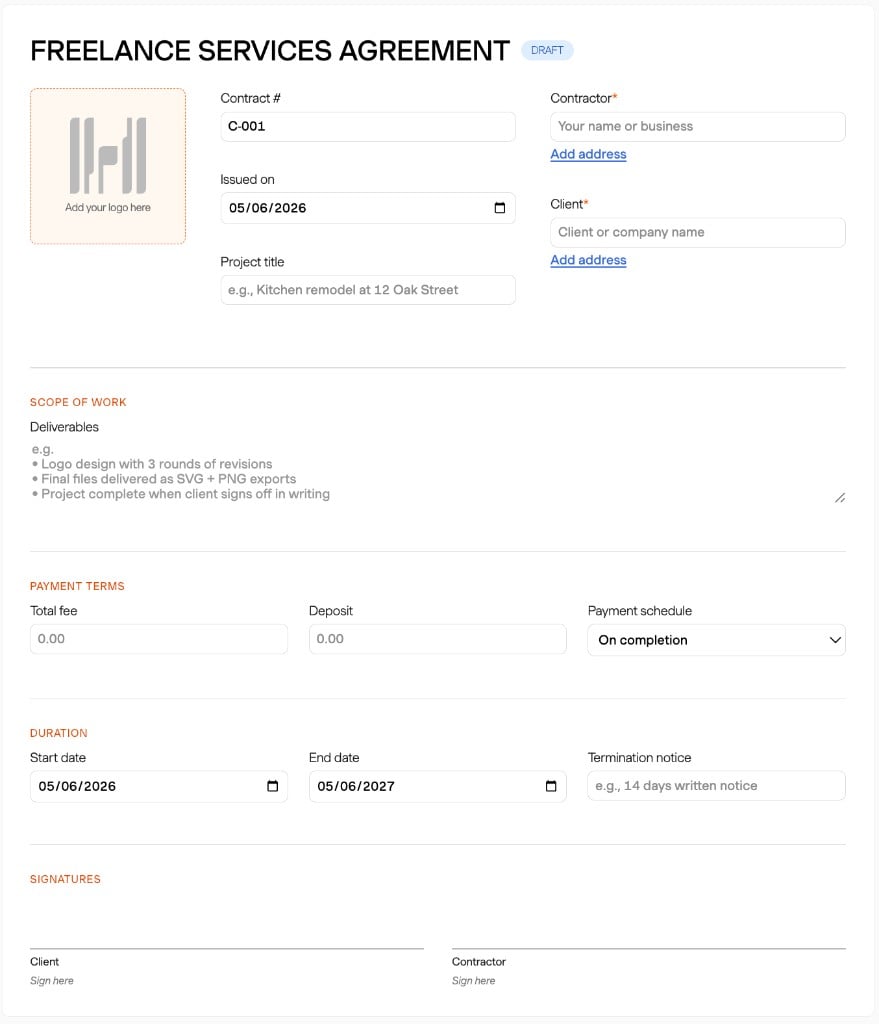
AGREEMENT DRAFT

Add your logo here

Scope of work

Payment terms

Duration

Signatures

Client

Sign here

Contractor

Sign here

Get paid via:
Credit card / Debit card
ACH
Wire transfer

Customize contract

Appearance

Add a logo
Show contract title

Contract settings

Include payment terms Total fee, deposit, and schedule
Include termination clause Notice required to end the contract
Include signature blocks Both parties sign at the bottom

Understanding Independent Contractor Agreements in Vietnam

Independent contractor agreements in Vietnam are essential for businesses engaging freelancers and contractors. These agreements, governed by the Civil Code of 2015, are distinct from employment contracts. This distinction is crucial to avoid misclassification, which can lead to significant financial penalties. For instance, if a contractor is reclassified as an employee, businesses may face fines ranging from VND 3,000,000 to VND 7,500,000 per worker, plus retroactive Social, Health, and Unemployment Insurance (SHUI) contributions amounting to 21.5% of the worker's gross remuneration.

The rapid growth of Vietnam's gig economy, driven by technological advancements and global integration, underscores the importance of these agreements. A survey in 2022 showed that up to 53% of Vietnam’s intellectual workforce participates in the gig economy, highlighting the increasing demand for structured agreements. However, businesses must ensure their contracts comply with local laws to prevent legal and financial repercussions.

Key Components of a Compliant Contractor Agreement

Drafting a compliant independent contractor agreement in Vietnam requires attention to several critical components. Firstly, it's essential to define the scope and deliverables of the project clearly. This helps in structuring the agreement as a service contract, which is governed by the Civil Code 2015, rather than a labor contract under the Labor Code 2019.

Payment terms should be linked to project milestones or deliverables, avoiding regular salaries that suggest an employment relationship. It's also important to grant contractors autonomy over their work methods and schedule, minimizing clauses that imply direct supervision.

Additionally, the agreement should explicitly state that the contractor is responsible for their own tax and insurance obligations. This not only aligns with Vietnamese regulations but also mitigates the risk of misclassification, which can result in penalties and retroactive SHUI contributions.

Common Pitfalls and How to Avoid Them

When drafting independent contractor agreements in Vietnam, businesses often fall into common pitfalls, such as misclassification and overlooking tax obligations. Misclassification occurs when a contractor is treated like an employee, leading to substantial financial penalties. For example, a German fintech company faced EUR 60,000 in penalties for misclassifying contractors as employees.

To avoid such pitfalls, focus on the substance of the working relationship rather than the contract title. Ensure that the roles designated as contractor positions truly reflect project-based, temporary tasks rather than full-time employment.

Additionally, clearly outline tax and social security responsibilities in the agreement. Contractors should be made aware that they are responsible for their own filings and contributions. This clarity helps companies avoid unexpected liabilities, such as penalties for failing to withhold Personal Income Tax (PIT), which can incur a 20% penalty on underpaid amounts.

Leveraging Technology for Effective Contractor Management

While Harvest does not provide legal templates specific to Vietnamese contractor agreements, it offers robust tools that support contractors in managing their time, expenses, and invoicing. These tools are invaluable in maintaining clear records and ensuring accurate payments, which are crucial for compliance and financial management.

Harvest’s time tracking features help contractors log billable hours with precision, essential for project-based payment structures. Expense management tools allow for accurate tracking of costs, ensuring contractors can effectively manage their financial obligations, including taxes.

By streamlining invoicing and payment processes, Harvest aids contractors in maintaining organized financial records, reducing the risk of disputes and misunderstandings. This capability is particularly beneficial in a rapidly growing gig economy like Vietnam's, where clear financial documentation is key to successful contractor management.

Manage Contractor Agreements with Harvest

Harvest helps Vietnamese contractors manage time, expenses, and invoicing, ensuring compliance and financial clarity.

Harvest interface for contractor agreement management

Independent Contractor Agreement Template in Vietnamese FAQs

  • An independent contractor agreement in Vietnam should include the project scope, deliverables, payment terms linked to milestones, and a statement that the contractor is responsible for their own taxes. This helps ensure compliance with local laws.

  • Vietnam's gig economy is rapidly expanding, with up to 53% of the intellectual workforce participating. This trend increases the demand for structured contractor agreements to manage freelance and gig work effectively.

  • Misclassifying contractors as employees can lead to fines ranging from VND 3,000,000 to VND 7,500,000 per worker and retroactive insurance contributions. Ensuring correct classification is crucial to avoid financial penalties.

  • Payment terms should be linked to project milestones or deliverables to avoid suggesting an employment relationship. Regular salaries may imply employee status, risking misclassification penalties.

  • Independent contractors in Vietnam are responsible for their own taxes, with Personal Income Tax rates ranging from 5% to 35% for residents. Non-residents face a flat 20% tax on Vietnam-sourced income.

  • Harvest provides tools for time tracking, expense management, and invoicing, supporting contractors in maintaining clear financial records and ensuring accurate payments, crucial for compliance in Vietnam's gig economy.

  • Best practices include clearly defining project scope, structuring agreements as service contracts, linking payments to milestones, and specifying tax responsibilities. These steps help prevent misclassification and ensure compliance.