
Harvest
Contracts
Sign up

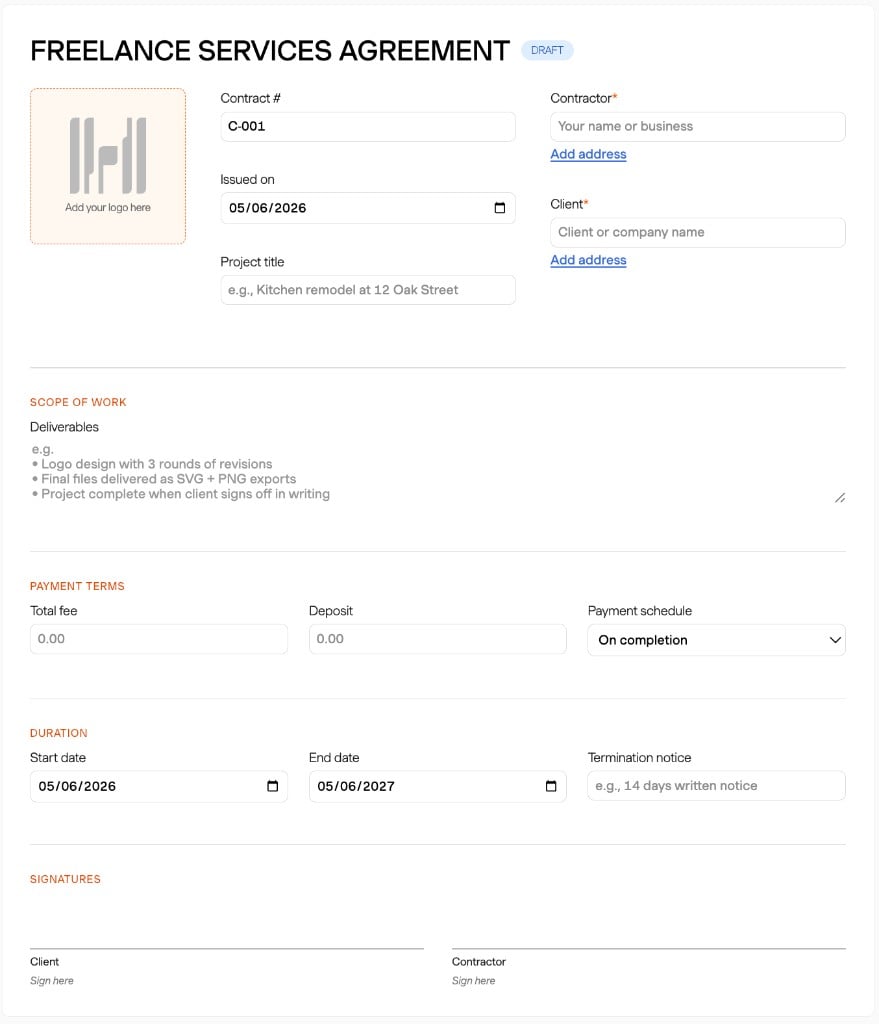
Create an Independent Contractor Agreement

Independent contractors are on the rise, with 36% of the U.S. workforce working independently. Harvest simplifies managing contractor workflows with tools for time tracking and invoicing.

Start from a template

AGREEMENT DRAFT

Add your logo here

Scope of work

Payment terms

Duration

Signatures

Client

Sign here

Contractor

Sign here

Get paid via:
Credit card / Debit card
ACH
Wire transfer

Customize contract

Appearance

Add a logo
Show contract title

Contract settings

Include payment terms Total fee, deposit, and schedule
Include termination clause Notice required to end the contract
Include signature blocks Both parties sign at the bottom

Essential Components of an Independent Contractor Agreement

Creating a comprehensive independent contractor agreement is vital for ensuring clear expectations and compliance with legal standards. Key components include defining the scope of work, which sets the foundation for all contractual engagements. This should detail the services to be provided, deliverables, and deadlines. For example, in the tech industry, agreements often need to address intellectual property rights and include "work for hire" clauses to prevent disputes over ownership of digital creations.

Additionally, compensation terms must be explicitly outlined. This includes payment rates, whether hourly or project-based, invoicing processes, and payment schedules. It's crucial to manage these financial aspects efficiently to avoid conflicts and ensure timely payments. Confidentiality and NDA language are also essential, especially in sectors like tech and marketing, to protect sensitive information. Finally, termination conditions should be clearly stated, specifying how either party can end the relationship legally. However, it's important to note that Harvest does not provide these legal features but supports contractor workflows with features like time tracking and invoicing.

Avoiding Common Pitfalls in Contractor Agreements

One of the most significant challenges in drafting independent contractor agreements is avoiding common pitfalls that can lead to legal disputes. A frequent mistake is using generic agreements that fail to address specific industry needs or local laws. This oversight can leave businesses exposed to compliance risks. Instead, agreements should be tailored to reflect the unique demands of the industry, whether that involves detailed scope of work or compliance with specific regulations like California's AB5.

Another common issue is treating contractors like employees, which can lead to misclassification. Businesses should focus on controlling the outcome of the work rather than the process, letting contractors decide how to achieve the results. Harvest aids in managing this aspect by allowing businesses to define project scopes and budget management, ensuring clarity without overstepping into employment-like controls. Finally, neglecting to include intellectual property ownership clauses can cause significant issues in industries where creative output is involved. While Harvest doesn't offer legal drafting features, it supports project management to keep work organized and aligned with business goals.

Industry-Specific Considerations for Contractor Agreements

Different industries have specific considerations when drafting independent contractor agreements. For example, in the construction industry, ensuring that contractors have the necessary insurance coverage is crucial. Agreements often include indemnification clauses and require proof of insurance to mitigate risks. In the tech sector, agreements need to address intellectual property rights and confidentiality due to the sensitive nature of the work.

In healthcare and logistics, where regulatory scrutiny is high, documenting the classification logic and ensuring compliance with laws like the IRS Form SS-8 is essential. Harvest, while not providing industry-specific clauses, helps manage contractor workflows, including time tracking and invoicing, allowing businesses to focus on compliance and project efficiency. By using tools like Harvest, companies can better manage the operational side of contractor engagements, even as they navigate the legal complexities of different industries.

Leveraging Harvest for Contractor Workflow Management

While Harvest does not create legal documents, it plays a crucial role in managing contractor workflows, offering tools that streamline time tracking, invoicing, and expense management. These features are essential for defining project scopes and managing budgets effectively, helping to avoid disputes over deliverables and payment terms.

Harvest supports various payment terms and conditions, adaptable to different industries. For example, milestone payments in construction or hourly rates in tech can be efficiently set and tracked through Harvest's invoicing features. This ensures that contractors are paid accurately and on time, reducing the risk of disputes over financial terms.

Moreover, Harvest's project management capabilities provide visibility into project progress, allowing businesses to monitor budgets and timelines. This information is invaluable for making informed decisions about contract adjustments or terminations. By integrating Harvest's tools into their workflow, businesses can manage contractor engagements more efficiently, focusing on achieving their project goals rather than getting bogged down in administrative details.

Ensuring Compliance and Clarity in Contractor Agreements

Compliance and clarity are paramount in crafting effective independent contractor agreements. Legal frameworks like the Fair Labor Standards Act (FLSA) in the US or the IR35 legislation in the UK require businesses to clearly distinguish between employees and independent contractors. Harvest aids in this distinction by enabling businesses to manage projects without imposing employee-like controls.

Understanding regional laws, such as California's AB5 or the EU's Platform Work Directive, is critical to ensuring compliance. These laws dictate stringent criteria for classifying workers and require businesses to be diligent in maintaining proper documentation. While Harvest does not provide compliance-specific features, its tools help businesses manage operational aspects efficiently, supporting adherence to these legal requirements.

By leveraging Harvest's capabilities in time tracking and invoicing, businesses can maintain clarity in contractor engagements, reducing the risk of misclassification and associated penalties. This operational efficiency allows companies to focus on strategic growth while ensuring that all legal and compliance aspects are properly addressed.

Manage Contractor Workflows with Harvest

Harvest offers tools for time tracking and invoicing, helping contractors manage project scopes and ensure timely payments.

Screenshot showing Harvest contractor workflow management tools.

Create an Independent Contractor Agreement FAQs

  • An independent contractor agreement should include components like the scope of work, payment terms, confidentiality clauses, and termination conditions. These elements ensure clarity and help prevent disputes. Harvest aids in managing these aspects through its project tracking and invoicing features.

  • In the tech industry, clauses regarding intellectual property rights and confidentiality are vital due to the nature of work. Harvest doesn't manage these clauses directly but supports project management to keep work organized.

  • Harvest simplifies managing contractor workflows by providing tools for time tracking, invoicing, and expense management. These features help businesses define project scopes and manage budgets efficiently.

  • Defining the scope of work is crucial to set clear expectations and avoid misunderstandings. Harvest supports this by allowing detailed project tracking and budget management, ensuring both parties are aligned on deliverables.

  • Yes, Harvest allows you to set and manage various payment terms through its invoicing features, ensuring contractors are paid accurately and on time, which reduces the risk of financial disputes.

  • Common mistakes include using generic agreements, treating contractors like employees, and neglecting IP ownership clauses. These can lead to legal disputes and compliance issues. Harvest aids in preventing such errors by supporting clear project scope management.

  • Harvest facilitates project management by providing visibility into project progress and budget tracking, allowing businesses to monitor timelines and financials effectively. This ensures informed decision-making in contractor engagements.