
Harvest
Contracts
Sign up

Service Agreement Template in Vietnamese

Harvest supports contractors in managing time tracking and invoicing efficiently, helping ensure service agreements align with business operations.

Start from a template

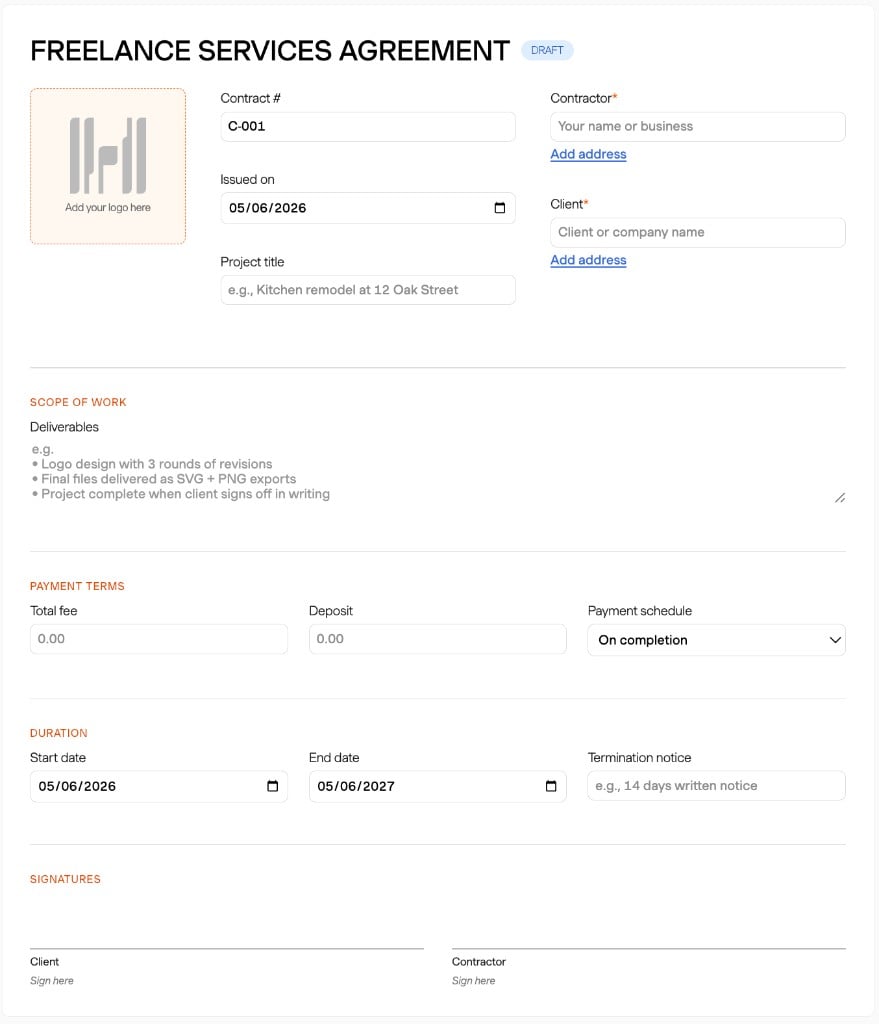
AGREEMENT DRAFT

Add your logo here

Scope of work

Payment terms

Duration

Signatures

Client

Sign here

Contractor

Sign here

Get paid via:
Credit card / Debit card
ACH
Wire transfer

Customize contract

Appearance

Add a logo
Show contract title

Contract settings

Include payment terms Total fee, deposit, and schedule
Include termination clause Notice required to end the contract
Include signature blocks Both parties sign at the bottom

Understanding Legal Requirements for Service Agreements in Vietnam

When drafting a service agreement in Vietnam, understanding the legal framework is crucial to ensure enforceability and compliance. Service agreements are primarily governed by the Civil Code 2015 and the Law on Commerce 2005. These laws outline the principles of contract formation, obligations of the parties, and remedies available in case of a breach. Ensuring that the agreement is compliant with these laws is essential, especially if disputes arise. For instance, penalty clauses in commercial contracts are capped at a maximum of 8% of the contract value as per the Commercial Law 2005. Clauses exceeding this limit may be rendered invalid.

Additionally, service agreements must be drafted in Vietnamese to be enforceable in local courts, although bilingual contracts are common in international transactions. The Vietnamese version typically takes precedence in legal disputes, highlighting the importance of accurate translation and legal review. Given that over 60% of disputes in foreign business operations involve contract disagreements, clarity and precision in language are paramount.

Key Clauses for Vietnamese Service Agreements

Crafting a robust service agreement requires attention to several key clauses that ensure both parties' interests are protected. One fundamental aspect is the scope of services, which must be clearly defined to prevent ambiguities leading to disputes. This includes specifying tasks, deliverables, performance standards, and timelines. For example, a Vietnamese marketing firm might detail deliverables such as social media campaigns and SEO services in their agreements.

Payment terms are another critical component. Agreements should detail payment methods, currency, deadlines, and penalties for late payments. For cross-border contracts, it's important to consider exchange rates and tax liabilities. The inclusion of robust dispute resolution mechanisms is also advisable, with arbitration through the Vietnam International Arbitration Centre (VIAC) often recommended as a more efficient alternative to litigation.

Drafting a Service Agreement Template in Vietnamese

Creating a service agreement template in Vietnamese involves several strategic steps. First, it is essential to ensure all necessary legal elements are in place, including offer, acceptance, and consideration, as outlined in the Law on Commerce 2005. Legal experts emphasize the importance of not relying on generic templates but rather customizing the agreement to reflect the specific context and requirements of the transaction.

Engaging local legal counsel to review and advise on contract drafts is highly recommended. This helps ensure the agreement's legal soundness, compliance with Vietnamese laws, and protection of commercial interests. As noted, the Vietnamese business culture often emphasizes relationship-building, so ensuring both parties are comfortable with the terms is crucial.

Ensuring Compliance and Avoiding Common Pitfalls

Ensuring compliance with Vietnamese law when drafting service agreements is crucial for preventing disputes and legal issues. One common pitfall is the potential misclassification of a service agreement as a labor contract if it includes provisions on paid work, management, or regular payment. This misclassification can lead to retroactive social insurance contributions and penalties.

To avoid such pitfalls, it is essential to clearly differentiate the nature of the contractual relationship and ensure all clauses comply with the relevant laws. Termination clauses, for example, must comply with Vietnamese law, clearly outlining conditions for termination, notice periods, and associated obligations to ensure fair exit conditions. Seeking a local legal review can help identify and rectify potential compliance issues before the agreement is finalized.

Explore Harvest's Tools

See how Harvest helps manage time tracking and invoicing alongside drafting service agreements in Vietnamese.

Screenshot showing Harvest's interface for service agreement management.

Service Agreement Template in Vietnamese FAQs

  • In Vietnam, service agreements must comply with the Civil Code 2015 and the Law on Commerce 2005, covering contract formation principles, obligations, and breach remedies. Drafting in Vietnamese is required for enforceability in courts.

  • To ensure compliance, clearly define the scope of services, payment terms, and dispute resolution mechanisms. Engaging a local legal counsel can help verify the agreement’s legal soundness and adherence to Vietnamese laws.

  • Key clauses include scope of services, payment terms, dispute resolution, and termination conditions. For cross-border contracts, consider exchange rates and tax liabilities.

  • Avoid misclassification as a labor contract by clearly defining the nature of the relationship. Ensure termination clauses comply with local laws and seek a local legal review to rectify compliance issues.

  • The Vietnam International Arbitration Centre (VIAC) provides arbitration services as an efficient alternative to litigation, often preferred by foreign businesses for resolving disputes swiftly.

  • Drafting in Vietnamese is crucial for enforceability in local courts, as the Vietnamese version usually takes precedence in legal disputes, ensuring clarity and precision in contractual language.

  • Harvest aids contractors by streamlining time tracking and invoicing, ensuring that service agreements reflect accurate billing and project timelines, enhancing operational efficiency.