
Harvest
Contracts
Sign up

Freelance Contract Template in Italian

Navigating freelance contracts in Italy can be complex, but Harvest supports freelancers with tools for efficient time tracking and invoicing, ensuring smooth project management.

Start from a template

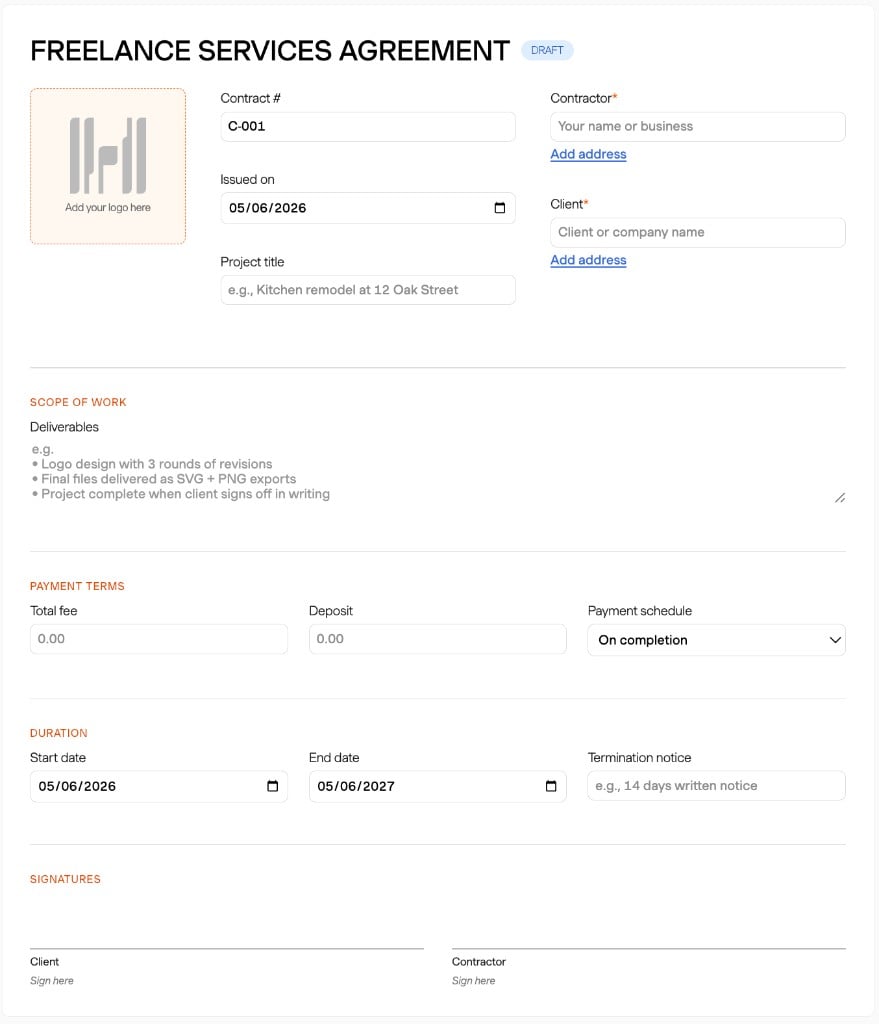
AGREEMENT DRAFT

Add your logo here

Scope of work

Payment terms

Duration

Signatures

Client

Sign here

Contractor

Sign here

Get paid via:
Credit card / Debit card
ACH
Wire transfer

Customize contract

Appearance

Add a logo
Show contract title

Contract settings

Include payment terms Total fee, deposit, and schedule
Include termination clause Notice required to end the contract
Include signature blocks Both parties sign at the bottom

Understanding Freelance Contracts in Italy

Freelance contracts in Italy are governed by specific legal frameworks, most notably the "contratto d'opera" as outlined in Articles 2222 and subsequent articles of the Italian Civil Code. These contracts define a self-employed worker undertaking a task or service for a fee, operating independently from any subordination to the client. This independence is crucial to avoid misclassification as an employee, which could result in significant penalties, including mandatory contributions to INPS and potential tax liabilities.

Essential elements of a freelance contract include clear identification of the parties involved, detailed descriptions of the service or project, payment terms, and intellectual property rights. For instance, contracts for graphic designers or content creators must address the transfer or retention of rights to avoid future disputes. Additionally, clauses related to GDPR compliance are critical, especially for digital freelancers handling personal data, who may need to specify their role as a data processor or controller.

Key Elements of a Strong Freelance Contract

To ensure a legally sound freelance contract in Italy, certain elements are non-negotiable. These include comprehensive details of both parties (such as name, VAT number, and contact information), a thorough description of the work to be completed, and explicit payment terms outlining gross/net amounts and schedules. It's also vital to specify what falls outside the scope of the contract to prevent scope creep.

Freelancers should also include clauses for confidentiality, intellectual property, and early termination. In industries like tech or creative services, these contracts might require additional provisions for software ownership or content rights. Industry experts advise using clear language to avoid misunderstandings, emphasizing that a well-drafted contract not only formalizes agreements but also protects against potential legal disputes and operational challenges.

Challenges and Legal Considerations for Italian Freelancers

Italian freelancers face unique challenges, including the risk of contract reclassification as employment, which can lead to significant legal and financial repercussions. To mitigate this, contracts must clearly state the autonomy of the freelancer, indicating that the client only controls the outcome, not the process.

Understanding tax obligations is another critical aspect. For instance, occasional collaborations without a VAT number are limited to a maximum of 30 days per client annually, with compensation capped at €5,000. Exceeding this requires registration with INPS for contributions. Legal experts recommend seeking professional guidance to navigate these complexities, ensuring compliance with Italian laws and protecting against reclassification risks.

How Harvest Supports Freelancers Beyond Contracts

While Harvest does not provide legal contract templates, it offers invaluable support to freelancers through its suite of tools designed for efficient time tracking, expense management, and invoicing. These features are crucial for freelancers who need to manage their time and expenses accurately, ensuring they get paid promptly and maintain financial stability.

Harvest's platform allows freelancers to track billable hours and project budgets efficiently, helping them organize work and anticipate potential overages. This ensures that freelancers can focus on their projects without worrying about administrative burdens, making Harvest an essential tool for managing freelance work seamlessly.

Leveraging Technology for Freelance Success

In the digital age, integrating technology into freelance work processes can significantly enhance productivity and client management. Tools like Harvest streamline operations by linking time tracking and invoicing, providing freelancers with a comprehensive overview of their business activities.

By using such tools, freelancers can attach contracts directly to proposals, ensuring that work commences only upon formal agreement. This integration not only simplifies workflow but also aids in maintaining transparency and avoiding disputes over payment and deliverables. As the freelance market continues to grow, leveraging technology becomes increasingly important for maintaining competitive advantage and operational efficiency.

Freelance Contracts with Harvest

Explore how Harvest assists freelancers with time tracking and invoicing, complementing your contract needs in Italy.

Harvest interface showing freelance contract template features.

Freelance Contract Template in Italian FAQs

  • Essential clauses include party identification, work description, payment terms, intellectual property rights, and confidentiality. Contracts must also detail scope exclusions to prevent disputes.

  • Customize by including detailed descriptions of services, payment terms, and specific clauses like intellectual property rights. Ensure it aligns with Italian legal frameworks, such as the "contratto d'opera."

  • Understand the "contratto d'opera" framework, GDPR compliance, and the risk of misclassification as employment. Seek legal advice to ensure contracts meet Italian laws and protect against reclassification.

  • Yes, occasional work without a VAT number is limited to €5,000 annually per client. Exceeding this requires INPS registration for contributions. Tax obligations can vary, so professional advice is recommended.

  • Harvest offers tools for time tracking, expense management, and invoicing, helping freelancers manage projects efficiently and ensure timely payments.

  • Freelancers face risks like contract reclassification and tax obligations. Clear contracts and understanding legal frameworks are essential to mitigate these challenges.

  • Technology streamlines operations, with tools like Harvest offering integrated time tracking and invoicing, improving workflow efficiency and client management.

  • A written contract prevents legal and operational issues, formalizes agreements, and protects against disputes, making it essential for freelancers.

  • Common mistakes include starting work without a contract or advance payment, and relying heavily on one client. These can lead to financial instability and disputes.