
Harvest
Contracts
Sign up

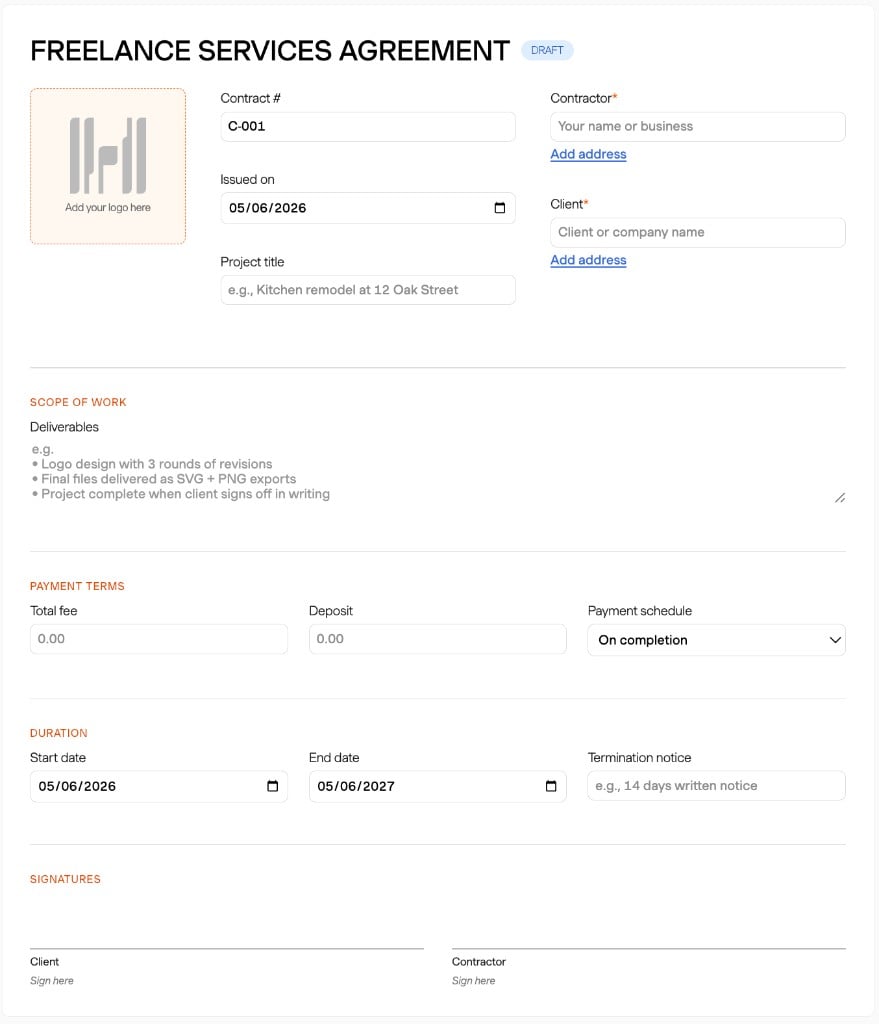
Contract Template for Home Improvement Contractors

Many homeowners face disputes due to vague contracts. Harvest helps contractors streamline time tracking and invoicing, supporting clear, structured workflows.

Start from a template

AGREEMENT DRAFT

Add your logo here

Scope of work

Payment terms

Duration

Signatures

Client

Sign here

Contractor

Sign here

Get paid via:
Credit card / Debit card
ACH
Wire transfer

Customize contract

Appearance

Add a logo
Show contract title

Contract settings

Include payment terms Total fee, deposit, and schedule
Include termination clause Notice required to end the contract
Include signature blocks Both parties sign at the bottom

Essential Clauses in Home Improvement Contracts

Home improvement contracts must include specific clauses to ensure legal compliance and clarity between contractors and clients. These agreements typically cover payment terms, scope of work, and warranty details. One of the most critical components is a clear scope of work, which explicitly outlines what the contractor will and will not do. This prevents misunderstandings and disputes, which can arise from vague descriptions. Additionally, payment terms should be tied to project milestones to maintain cash flow and reduce the risk of disputes over payments.

Another key element is the inclusion of a cancellation policy. For example, the Federal Trade Commission's Cooling-Off Rule grants a 3-business-day right to cancel contracts signed at a consumer's residence. State-specific regulations, such as those in California, further require detailed contractor information, project descriptions, and capped down payments. By addressing these legal requirements, contractors can create robust contracts that protect both parties and ensure a smooth project execution.

Avoiding Common Pitfalls in Contract Drafting

Many home improvement contractors fall into common pitfalls when drafting contracts, often leading to costly disputes and project delays. A frequent mistake is proceeding with work not explicitly detailed in the contract. This can be avoided by clearly stating all tasks, responsibilities, and exclusions within the contract. It's equally important to document any changes in scope, cost, or timeline through written change orders, ensuring that all parties are on the same page.

Another pitfall is failing to integrate contract management with other business processes. Utilizing digital tools can streamline this process, offering automated alerts and notifications that accelerate contract execution and approval. By integrating these features, contractors can enhance compliance, reduce operational risks, and improve overall project outcomes. Industry experts emphasize revising standard templates to fit specific business needs, ensuring the contract reflects the unique aspects of each project.

State-Specific Compliance for Home Improvement Contracts

Compliance with state-specific regulations is crucial for home improvement contracts. For instance, California law mandates written contracts for projects exceeding $500, including detailed project descriptions and capped down payments. Similarly, Pennsylvania requires contracts for work over $500 to be in writing and include the contractor's registration number. These laws aim to protect consumers and provide clarity to contractors.

Understanding and adhering to these requirements prevents legal issues and enhances the trust between contractors and clients. Contractors should familiarize themselves with the regulations in their operating states and ensure their contracts meet all necessary criteria. By doing so, they can avoid legal pitfalls and foster successful project relationships.

Streamlining Contract Management with Digital Solutions

Adopting digital contract management solutions can significantly streamline the contract process for home improvement contractors. These solutions help in reducing legal and operational risks by automating contract reviews, enhancing compliance, and preventing missed renewals. Digital tools can also provide comprehensive contract reviews, detect anomalies, and facilitate pre-payment audits, achieving substantial savings and improving cash flow management.

For example, some companies have reported up to 0.8% savings on project costs by implementing digital contract management systems. Integrating these solutions ensures that payment schedules are tied to actual project milestones, rather than vague terms, thus reducing payment disputes and maintaining project momentum. By leveraging these tools, contractors can improve their efficiency and project outcomes.

The Importance of Detailed Contracts in Home Improvement

Having a detailed contract is essential for home improvement projects to avoid disputes and ensure project success. Industry experts warn against relying on verbal agreements or vague written contracts, as these can lead to misunderstandings and costly disputes. A written contract detailing the project scope, timeline, costs, and responsibilities is crucial.

Homeowners and contractors should ensure their contracts include all necessary details, such as license numbers, project descriptions, and payment schedules. By doing so, they protect themselves legally and financially, fostering a transparent and cooperative project environment. Standardized contracts have been shown to lead to better project results, as seen in over 25 case studies, highlighting their importance in the construction industry.

Explore Harvest's Contract Solutions

Discover how Harvest supports contractors with time tracking and invoicing, ensuring clear and compliant project workflows.

Home improvement contract template screenshot for contractors

Contract Template for Home Improvement Contractors FAQs

  • A home improvement contract should include a detailed scope of work, payment terms linked to project milestones, and a cancellation policy. It's essential to specify what the contractor will and won't do to avoid misunderstandings.

  • Yes, states like California and Pennsylvania have specific requirements. For example, California mandates written contracts for projects over $500, including detailed descriptions and capped down payments.

  • To ensure legal compliance, familiarize yourself with state-specific regulations, include all required details in your contract, and consider consulting a legal professional for review.

  • Common pitfalls include vague scopes of work and proceeding without written change orders. It's crucial to document all changes and integrate contract management with digital tools for efficiency.

  • Digital tools streamline contract management by automating reviews, enhancing compliance, and preventing missed renewals. They help tie payment schedules to project milestones, reducing disputes.

  • A detailed contract prevents disputes by clearly outlining project scope, responsibilities, and costs. It provides legal and financial protection for both homeowners and contractors.

  • While verbal agreements are possible, they often lead to misunderstandings. Written contracts are crucial to clearly define project details and avoid disputes.

  • The FTC Cooling-Off Rule grants consumers a 3-business-day right to cancel contracts signed at their residence, ensuring protection for home improvement agreements.