
Harvest
Contracts
Sign up

Contract Template in Spanish

Harvest supports contractors in managing their time and invoicing needs, providing efficient solutions for tracking work hours and billing clients accurately.

Start from a template

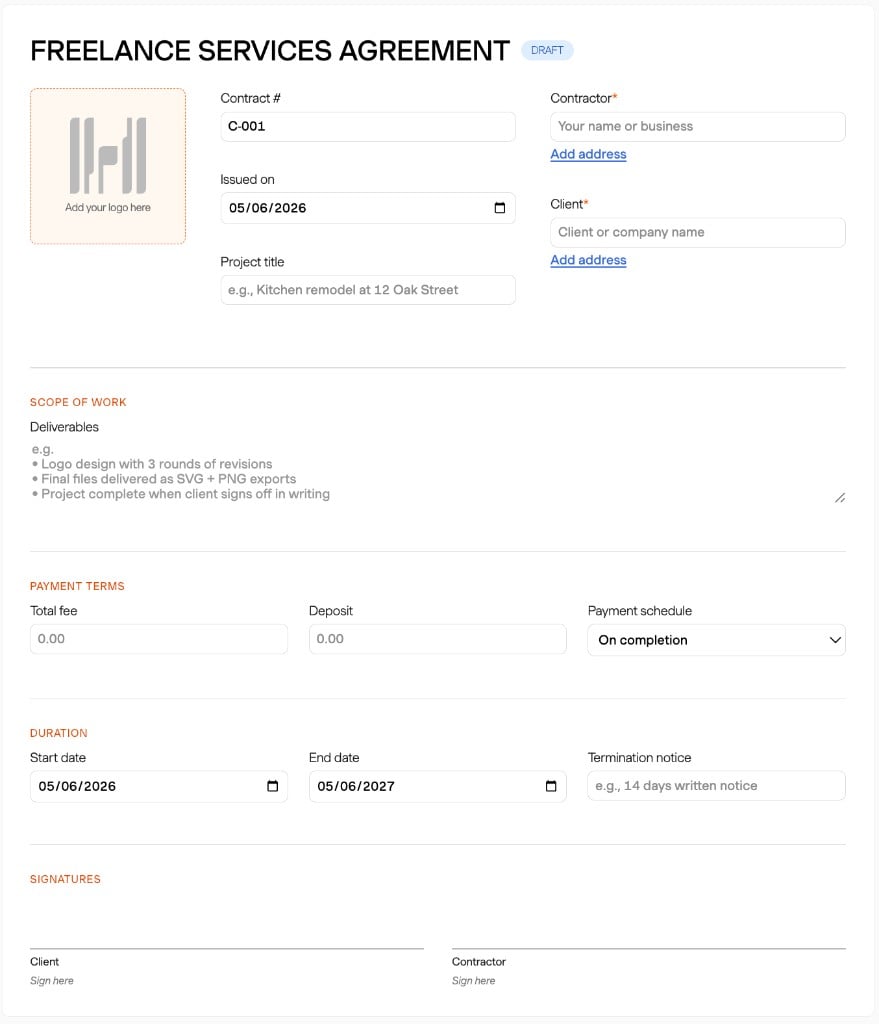
AGREEMENT DRAFT

Add your logo here

Scope of work

Payment terms

Duration

Signatures

Client

Sign here

Contractor

Sign here

Get paid via:
Credit card / Debit card
ACH
Wire transfer

Customize contract

Appearance

Add a logo
Show contract title

Contract settings

Include payment terms Total fee, deposit, and schedule
Include termination clause Notice required to end the contract
Include signature blocks Both parties sign at the bottom

Understanding Spanish Rental Contracts

Spanish rental contracts are crucial documents that outline the terms and conditions of a rental agreement. They are essential for ensuring both parties understand their rights and obligations, thereby reducing potential conflicts. In Spain, the legal framework governing rental agreements is based on the Civil Code, which emphasizes the principle of "freedom of form" (libertad de forma). This means that contracts can be verbal or written, as long as they meet the essential requirements of consent, object, and cause. However, written contracts are preferred for clarity and enforceability, particularly in legal disputes.

The importance of having a well-drafted rental contract cannot be overstated. Industry research highlights that approximately 80% of B2B revenue is governed by contracts, underscoring their critical role in business operations. Furthermore, the adoption of digital contracts and electronic signatures has become increasingly popular in Spain, facilitated by the eIDAS Regulation and Spanish Law 6/2020, which ensure their legal validity. This shift not only enhances efficiency but also aligns with the growing trend of digitalization across various sectors.

Key Clauses in Spanish Rental Agreements

When drafting a Spanish rental contract, certain clauses are fundamental to ensure legal compliance and protect the interests of both parties. These include details about the property, the duration of the lease, rental payment terms, and maintenance responsibilities. It is also vital to include clauses regarding the security deposit, tenant obligations, and conditions for contract termination. Within the context of Spanish law, incorporating clauses that specify the governing law and jurisdiction, such as opting for Spanish courts in case of disputes, is crucial.

Incorporating a "prevailing language" clause can prevent misunderstandings in bilingual contracts, ensuring that the Spanish version takes precedence in case of discrepancies. Additionally, electronic signatures, governed by the eIDAS Regulation, are legally recognized and can simplify the signing process. These signatures provide the same legal assurance as a handwritten signature, making them a practical choice for modern contract management.

Customizing Rental Contracts for Specific Needs

Customizing a rental contract template to suit specific needs is a practical way to address unique circumstances in a rental agreement. This involves adjusting clauses to reflect the nature of the tenancy, whether short-term or long-term, and including any special conditions agreed upon by both parties. Standardized templates offer a starting point, allowing for modifications to suit particular requirements while maintaining a consistent structure.

Standardization in contracts is beneficial for saving time and reducing the likelihood of errors. By starting from a template that is 50-70% complete, legal professionals can focus on tailoring the contract to address specific needs rather than drafting from scratch. This approach not only enhances efficiency but also ensures that all necessary legal elements are included, aligning with best practices for contract management.

Legal Considerations in Spanish Rental Contracts

Legal considerations are paramount when drafting and executing rental contracts in Spain. It's critical to ensure that the contract complies with local laws, including the Spanish Civil Code, which governs contract formation. Electronic signatures, which are legally valid under the eIDAS Regulation, provide a convenient option for executing contracts, offering the same legal assurance as traditional signatures.

For rental contracts involving foreign parties, it might be necessary to provide a certified translation to ensure all parties fully understand the terms. This is especially relevant in cross-border agreements, where language barriers could lead to misunderstandings. Legal translation requires a deep understanding of both the source and target legal systems to prevent inaccuracies and ensure the contract's enforceability.

Streamline Contracts with Harvest

Harvest offers tools to manage contracts, time, and invoicing efficiently, ensuring smooth operations for contractors.

Harvest platform showcasing contract management in Spanish context.

Contract Template in Spanish FAQs

  • A Spanish rental contract should include details about the property, lease duration, rent terms, maintenance responsibilities, and security deposit. It's also important to specify governing law and jurisdiction.

  • Yes, electronic signatures are legally valid in Spain, governed by the eIDAS Regulation. They provide the same legal assurance as handwritten signatures, simplifying contract execution.

  • To customize a rental contract template, adjust clauses to reflect the tenancy type and include any special conditions agreed upon. Standardized templates offer a starting point for customization.

  • Rental contracts in Spain must comply with the Civil Code. They should include essential elements like consent, object, and cause. Written contracts are preferred for clarity and enforceability.

  • Bilingual contracts ensure clarity and enforceability in cross-border agreements. Use a "prevailing language" clause to specify which version governs in case of conflicts.

  • Harvest aids in time tracking and invoicing, crucial for contractors managing multiple projects. While it doesn't provide contract templates, it supports efficient project management workflows.

  • A "prevailing language" clause specifies which language version of a contract takes precedence, preventing disputes over interpretations in bilingual agreements.