
Harvest
Contracts
Sign up

Create a Master Services Agreement

Master Services Agreements can prevent 9% revenue loss due to contract leakage. Harvest helps manage project budgets and time once your MSA is set.

Start from a template

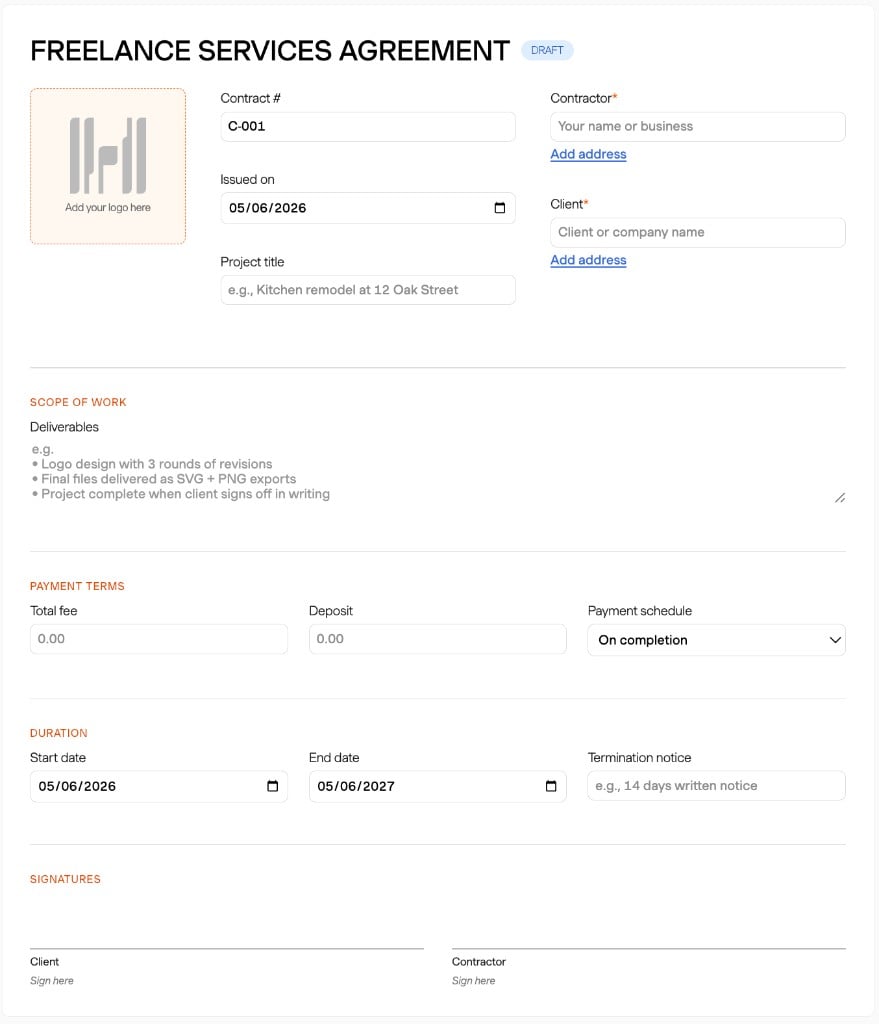
AGREEMENT DRAFT

Add your logo here

Scope of work

Payment terms

Duration

Signatures

Client

Sign here

Contractor

Sign here

Get paid via:
Credit card / Debit card
ACH
Wire transfer

Customize contract

Appearance

Add a logo
Show contract title

Contract settings

Include payment terms Total fee, deposit, and schedule
Include termination clause Notice required to end the contract
Include signature blocks Both parties sign at the bottom

Understanding Master Services Agreements

A Master Services Agreement (MSA) is a foundational document that outlines the terms and conditions of a long-term business relationship, typically used across industries like IT, telecommunications, consulting, and marketing. MSAs streamline contract administration by setting a comprehensive framework for ongoing projects, significantly reducing contract negotiation time. On average, companies lose 9% of their annual revenue due to contract leakage and renegotiations, but a well-crafted MSA can prevent these issues. Subsequent Statements of Work (SOWs) under an MSA can see up to 90% fewer negotiation cycles, allowing businesses to focus on delivery rather than repetitive legal discussions.

The importance of MSAs has only grown with the rise of digital transformation and remote work, necessitating clear terms around data protection and cybersecurity. For example, with a 6000% surge in cyberattacks via email during the pandemic, MSAs now frequently include clauses addressing data security and compliance with regulations like GDPR or HIPAA. This shift ensures that both parties are protected and that business operations can continue smoothly.

Key Clauses in a Master Services Agreement

An effective MSA should include several essential clauses to protect both parties and clarify the scope of the business relationship. Key areas include payment terms, intellectual property rights, confidentiality, indemnification, limitation of liability, and termination conditions. For instance, clearly defining intellectual property ownership and usage rights is critical, especially in creative industries, to avoid disputes over work products.

Data protection and privacy have become pivotal, with MSAs needing to cover compliance with GDPR, HIPAA, and other relevant regulations. They should specify how data is stored, transferred, and protected, including any cross-border data transfer obligations. Failing to include these can result in significant legal and financial risks. Furthermore, liability and indemnification clauses must clearly delineate financial caps and responsibilities, preventing unforeseen disputes and financial losses.

Creating a Master Services Agreement

To create a comprehensive MSA, businesses should follow a structured framework that includes defining the scope of services, payment terms, intellectual property, confidentiality, indemnification, liability limits, and termination conditions. This framework ensures that all critical aspects are covered, minimizing risks and misunderstandings. Modern MSAs are often complemented by SOWs and SLAs, which handle specific project details and performance standards, respectively.

Professional associations recommend keeping MSAs flexible to accommodate evolving project requirements. This can be achieved by updating the MSA periodically and using separate SOWs for project-specific terms. Moreover, leveraging technology such as Contract Lifecycle Management (CLM) systems can enhance MSA management by automating compliance monitoring and performance tracking, providing centralized visibility of all contractual obligations.

The Role of Harvest in Managing Projects

While Harvest doesn't create Master Services Agreements, it plays a crucial role in managing project budgets, time, and expenses once an agreement is in place. Harvest offers flexibility in service scope, allowing businesses to adapt to evolving project requirements by adjusting time tracking, budget allocations, and invoicing. This capability is invaluable for contractors and service businesses aiming to maintain efficiency and control over project execution.

For industries where MSAs are prevalent, Harvest supports the operational side by tracking hours and expenses, thus ensuring that projects remain within budget and that billing is accurate. By providing insights into project profitability and resource allocation, Harvest helps businesses focus on delivery and client satisfaction, aligning with the strategic goals set out in their MSAs.

Avoiding Common Pitfalls in MSAs

One common pitfall in drafting MSAs is using outdated templates that do not address current issues such as data privacy and remote work. This oversight can lead to compliance gaps and stalled deals. Businesses can avoid these pitfalls by regularly updating their MSAs and ensuring they include modern clauses for data handling and cybersecurity.

Another frequent mistake is intermingling dynamic elements like deliverables or performance metrics directly into the MSA. Instead, these should be outlined in separate SOWs to prevent constant renegotiation of the master agreement. By clearly defining acceptance criteria and feedback timelines, businesses can minimize disputes and improve cash flow predictability. Maintaining a modular MSA structure also allows for greater agility, enabling businesses to adapt to changing circumstances without compromising the core agreement.

Master Services Agreement with Harvest

See how Harvest tracks project budgets and time, complementing your Master Services Agreement for efficient project management.

Harvest project management interface for Master Services Agreement.

Create a Master Services Agreement FAQs

  • A Master Services Agreement (MSA) is a contract that outlines the terms and conditions of a long-term business relationship. It helps streamline future project negotiations by setting a comprehensive framework.

  • MSAs are crucial as they significantly reduce negotiation cycles and contract administration costs. They are widely used in industries like IT, consulting, and marketing to establish clear terms and protect business interests.

  • An effective MSA should include clauses for payment terms, intellectual property rights, confidentiality, indemnification, liability limits, and termination conditions to ensure clarity and minimize risks.

  • While Harvest doesn't create MSAs, it helps manage project budgets, time, and expenses, ensuring projects under an MSA remain on track and within budget.

  • MSAs must include provisions for data security and compliance with regulations like GDPR. They should specify data handling, storage, and transfer to mitigate legal risks.

  • Common mistakes include using outdated templates and embedding dynamic elements within the MSA. It's important to update MSAs regularly and outline specific terms in separate SOWs.

  • An MSA establishes the overall legal framework for a relationship, while a Statement of Work (SOW) addresses specific project details like deliverables, timelines, and performance standards.