
Harvest
Contracts
Sign up

Create a Retainer Agreement

Retainer agreements often lead to financial issues, with 40% of businesses encountering problems. Harvest supports consultants by tracking billable hours and expenses, ensuring accurate invoicing.

Start from a template

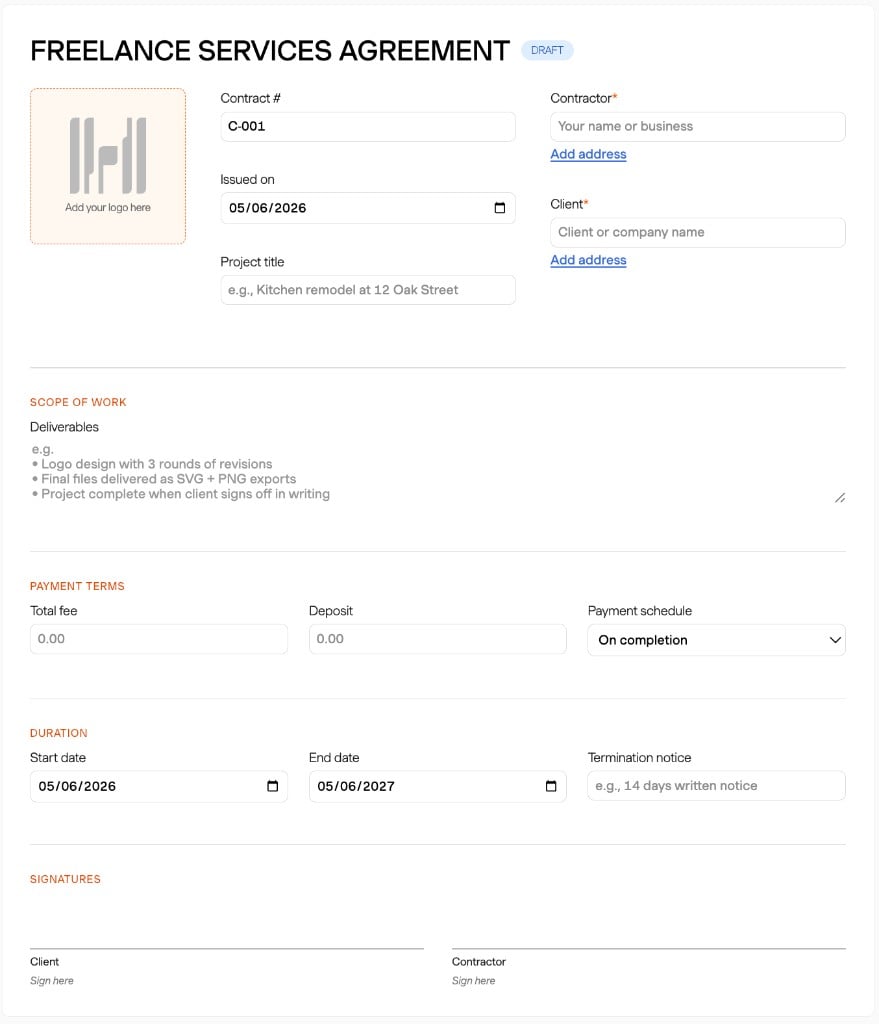
AGREEMENT DRAFT

Add your logo here

Scope of work

Payment terms

Duration

Signatures

Client

Sign here

Contractor

Sign here

Get paid via:
Credit card / Debit card
ACH
Wire transfer

Customize contract

Appearance

Add a logo
Show contract title

Contract settings

Include payment terms Total fee, deposit, and schedule
Include termination clause Notice required to end the contract
Include signature blocks Both parties sign at the bottom

Understanding Retainer Agreements: Key Components and Challenges

Retainer agreements are crucial for service-based businesses to secure predictable revenue and build long-term client relationships. However, industry research shows that 40% of these businesses face significant issues with their retainer contracts within the first year, leading to financial losses and strained client interactions. A well-structured retainer agreement should clearly define the scope of services, payment terms, and client and provider responsibilities. This clarity helps prevent scope creep, where additional requests can expand the project beyond the initial agreement, causing unexpected costs and delays.

Legal experts emphasize the importance of having a written retainer agreement, especially when fees exceed a certain threshold. Although not legally required in every jurisdiction, a clear, detailed agreement is considered best practice. This is particularly important in fields like legal services, where ethical obligations demand transparent fee structures and potential conflict disclosures. Despite these complexities, many businesses overlook critical elements such as scope definitions, risking misinterpretations and disagreements.

Structuring a Retainer Agreement for Success

Creating a successful retainer agreement involves several strategic steps. Initially, businesses should outline the scope of services, including what is and isn't covered under the retainer. This clarity is vital to manage expectations and avoid disputes. Payment terms should also be optimized to support cash flow. For example, splitting a $12,000 monthly retainer into two payments of $6,000 each can help maintain financial stability. Furthermore, incorporating automatic payment systems can prevent cash flow issues commonly associated with "Net 30" billing terms.

Another crucial aspect is addressing client and provider responsibilities. Retainer agreements should specify not only the services provided but also how communication will be managed, including response times and designated contact points. This helps to set realistic expectations and avoid the misconception that retainers provide unlimited access to services. Regularly reviewing and updating the agreement can also prevent small issues from escalating into significant problems.

Best Practices for Managing Retainers with Harvest

While Harvest does not provide legal templates for retainer agreements, it plays a vital role in managing their financial aspects. Harvest helps ensure client satisfaction by accurately tracking billable hours and expenses, which is essential for transparent invoicing. This capability is particularly beneficial in managing out-of-scope work by allowing you to create separate tasks with different billing rates, ensuring that all services are accounted for and billed correctly.

Moreover, Harvest integrates seamlessly with tools like Google Calendar and Trello, facilitating effective communication and project management. This integration supports businesses in maintaining open communication lines, although it does not replace detailed contract clauses regarding collaboration or communication expectations. By leveraging Harvest's tracking capabilities, businesses can focus on delivering exceptional service while maintaining financial control over their retainer agreements.

Avoiding Common Pitfalls in Retainer Agreements

Many service-based businesses face challenges with their retainer agreements due to vague scope definitions and poor communication protocols. To avoid these pitfalls, it is essential to outline a detailed scope of work, including specific services, exclusions, and formal change management processes. These measures help manage scope creep and ensure that both parties have a clear understanding of their responsibilities.

Additionally, integrating retainer management with contract lifecycle management (CLM) software can automate processes like drafting, tracking negotiations, and monitoring obligations. This integration helps prevent delays and compliance risks. While Harvest doesn't manage contract clauses, it supports project management with recurring invoice templates, ensuring consistent billing practices. By combining these tools and strategies, businesses can create robust retainer agreements that foster long-term client relationships.

The Role of Harvest in Financial Management of Retainers

Harvest plays a crucial role in the financial management of retainer agreements by providing tools to track billable hours and expenses effectively. This capability supports transparent invoicing, which is critical for client satisfaction and maintaining a stable cash flow. For instance, by tracking out-of-scope work separately, Harvest ensures that additional services are billed appropriately, preventing potential disputes over fees.

Furthermore, Harvest's integration with other project management tools enhances communication and coordination, allowing businesses to focus on delivering quality services. Although Harvest does not handle the legal structuring of retainer agreements, its financial tracking features provide a reliable foundation for managing the economic aspects of such contracts. This functionality is particularly valuable for consultants and service providers seeking to optimize their retainer agreements for better client relationships and financial outcomes.

Create Retainer Agreements with Harvest

Harvest tracks billable hours and expenses, ensuring transparent invoicing for your retainer agreements.

Screenshot of Harvest's retainer agreement management for consultants.

Create a Retainer Agreement FAQs

  • A retainer agreement should clearly define the scope of services, payment terms, and responsibilities of both parties. This helps prevent misunderstandings and disputes. Successful agreements also include clauses for duration, termination, and adjustments for out-of-scope work.

  • Out-of-scope work should be clearly defined and billed separately. Harvest helps by allowing you to create separate tasks with different billing rates, ensuring all additional services are tracked and invoiced properly.

  • While not always legally required, a written retainer agreement is crucial for clarity and legal protection. It outlines the agreed terms, helping to avoid disputes and ensuring both parties understand their obligations.

  • Harvest supports the financial management of retainer agreements by tracking billable hours and expenses, ensuring accurate and transparent invoicing. This helps maintain client satisfaction and stable cash flow.

  • Payment terms should be structured to support cash flow, such as splitting payments or using automatic billing systems. This prevents cash flow issues commonly associated with "Net 30" terms.

  • Retainer agreements provide predictable revenue and help stabilize cash flow. They also foster long-term client relationships, often leading to cost savings for clients compared to one-off projects.

  • Common pitfalls include vague scope definitions and poor communication protocols. To avoid these, clearly outline services, responsibilities, and formal change management processes within the agreement.