
Harvest
Contracts
Sign up

Write a Contract

Drafting a legally binding contract requires clarity and precision. Harvest supports contractors by managing the financial aspects of agreements, ensuring accountability and accuracy.

Start from a template

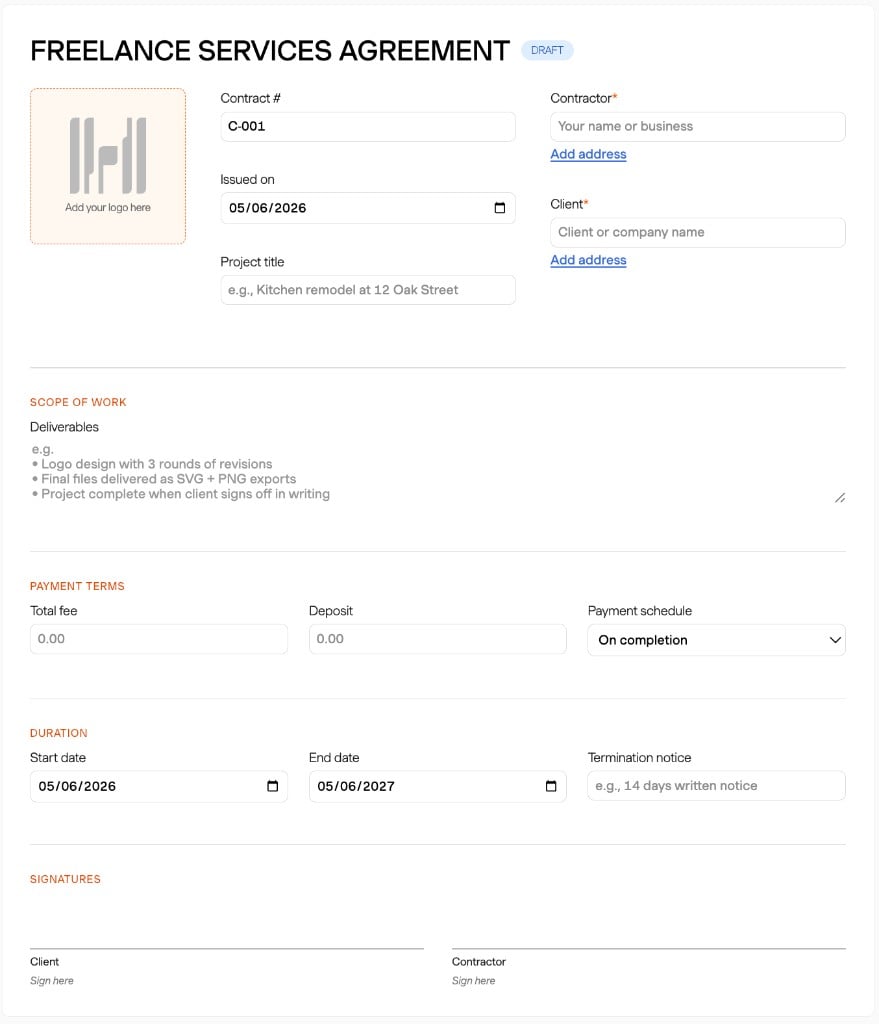
AGREEMENT DRAFT

Add your logo here

Scope of work

Payment terms

Duration

Signatures

Client

Sign here

Contractor

Sign here

Get paid via:
Credit card / Debit card
ACH
Wire transfer

Customize contract

Appearance

Add a logo
Show contract title

Contract settings

Include payment terms Total fee, deposit, and schedule
Include termination clause Notice required to end the contract
Include signature blocks Both parties sign at the bottom

Understanding the Essentials of a Legally Binding Contract

Creating a legally binding contract involves several key elements that ensure the agreement is enforceable by law. These include capable parties, a clear offer and acceptance, consideration (an exchange of value), mutual consent, a lawful purpose, and signatures from all involved parties. Without these elements, a contract may fail to hold up in a legal setting. For instance, contracts without clear terms often lead to disputes, as ambiguity can be interpreted in various ways, potentially leading to significant misunderstandings.

Industry experts emphasize the importance of writing contracts in plain language to avoid misinterpretations. Clarity over complexity is crucial, as contracts filled with unnecessary "legalese" can create confusion. Instead, using precise terms and definitions can help prevent disputes. For example, replacing vague terms like "reasonable efforts" with "all commercially reasonable efforts" can eliminate ambiguity. This focus on clarity not only aids in understanding but also ensures that all parties are on the same page regarding their obligations and rights.

Steps to Drafting an Effective Contract

Drafting an effective contract involves a structured process that ensures all necessary elements are included. Initially, identify all parties involved and clearly define the contract's purpose and scope. It is essential to list specific rights, duties, and deliverables for each party, as well as detail payment terms and deadlines. This meticulous approach helps in avoiding future disputes that often arise from misunderstood obligations or payment expectations.

Incorporating standard clauses like confidentiality and termination, while tailoring them to the specific context of the agreement, is also vital. Specify governing law and jurisdiction to preempt legal challenges. Finally, thoroughly review and revise the document before finalization. Avoid over-reliance on boilerplate templates, as they may not address unique needs, leading to critical gaps. While Harvest doesn't provide contract templates, it supports contractors by managing the financial aspects of agreements through time tracking and invoicing, ensuring financial clarity and accountability.

Integrating Technology in Contract Management

Leveraging technology in contract management can significantly enhance efficiency and accuracy. Automated contract management systems can boost compliance by up to 55% and reduce errors by 40%. By integrating contract writing with business processes, organizations can streamline workflows and minimize manual errors. This integration often involves connecting contract management tools with ERP systems to handle repetitive tasks such as approvals and compliance checks.

While Harvest does not offer contract drafting tools, it supports the financial management of contracts through features like time tracking and invoicing. This allows contractors to invoice accurately based on tracked time and expenses, complementing the broader contract lifecycle management. The use of technology not only saves time but also ensures that all financial transactions align with contract terms, reducing the risk of discrepancies and enhancing overall contract effectiveness.

Common Mistakes to Avoid When Writing a Contract

When writing a contract, avoiding ambiguous language is paramount. Vague terms can lead to significant misunderstandings and disputes, so using clear, precise language is essential. For example, instead of "timely manner," specifying "within 30 days" removes ambiguity. Additionally, contracts should be specific and detailed, outlining contingencies for various scenarios, such as a partner's inability to fulfill obligations.

Another common pitfall is over-reliance on standard templates or boilerplate clauses without customization. These may not fit the specific context of the agreement, leading to misapplication and potential gaps in coverage. While Harvest doesn't provide contract templates, it ensures financial clarity through its time tracking and invoicing features, which can help in aligning financial agreements with contract terms. By focusing on these areas, businesses can avoid common contract pitfalls and enhance the enforceability of their agreements.

Create Clear Contracts with Harvest

Explore Harvest's features for managing financial aspects of contracts, including time tracking and invoicing.

Screenshot of Harvest's time tracking and invoicing features for contract management.

Write a Contract FAQs

  • A legally binding contract must include capable parties, a clear offer and acceptance, consideration (an exchange of value), mutual consent, a lawful purpose, and signatures from all involved parties. These elements ensure the contract is enforceable by law.

  • Use plain language and define any potentially ambiguous terms. Specify details like timelines, deliverables, and payment terms clearly. Avoid unnecessary "legalese" and tailor the contract to the specific agreement to prevent misunderstandings.

  • Avoid vague language and over-reliance on standard templates. Ensure the contract is specific, detailed, and tailored to the particular agreement. Specify contingencies for various scenarios to prevent disputes.

  • Technology can automate compliance checks and approval processes, reducing errors and enhancing efficiency. It aligns financial transactions with contract terms, minimizing discrepancies and ensuring clear, enforceable agreements.

  • Harvest supports the financial aspects of contract management by tracking time and expenses, ensuring accurate invoicing and financial clarity in agreements.

  • Customization ensures that the contract addresses specific needs and contexts, reducing the risk of misapplication and gaps that standard templates might not cover.