
Harvest
Contracts
Sign up

Draft a Contract

Drafting contracts can be time-consuming and error-prone, but Harvest helps streamline the process by enabling efficient time tracking and invoicing, allowing you to focus on key contract elements.

Start from a template

AGREEMENT DRAFT

Add your logo here

Scope of work

Payment terms

Duration

Signatures

Client

Sign here

Contractor

Sign here

Get paid via:
Credit card / Debit card
ACH
Wire transfer

Customize contract

Appearance

Add a logo
Show contract title

Contract settings

Include payment terms Total fee, deposit, and schedule
Include termination clause Notice required to end the contract
Include signature blocks Both parties sign at the bottom

Essential Elements of a Contract

Drafting a legally sound contract requires attention to several key elements. Each contract must include an offer, acceptance, consideration, intent to create legal relations, capacity of the parties, and legality of purpose. Missing any of these elements can render a contract void and unenforceable, especially in jurisdictions like the UK where these are legally mandated components.

Incorporating essential provisions such as termination clauses, confidentiality agreements, dispute resolution mechanisms, liability limitations, and force majeure clauses ensures comprehensive coverage. For example, ambiguous phrases like "reasonable efforts" should be avoided in favor of precise language, with all key terms clearly defined in a dedicated section.

Organizations that effectively manage their contracts can save up to 2% in annual costs. However, poor contracting practices can result in revenue leakage of 8-9%, with top performers limiting this to just 3%. It's crucial to balance the terms to protect your interests while remaining commercially acceptable, and to avoid over-reliance on boilerplate clauses without customization.

Steps to Draft a Contract

Drafting a contract involves a structured, step-by-step process to ensure legal enforceability and clarity. Begin by understanding the client's needs and defining the scope, parties, deliverables, deadlines, and payment terms. This foundation is crucial for a sound agreement.

Next, include essential provisions such as termination, confidentiality, dispute resolution, and liability clauses. Draft with enforceability in mind, using clear and precise language. Ambiguities can lead to disputes, so it's imperative to review and revise for consistency and accuracy.

The final stages involve obtaining agreement and signatures, followed by proper storage and monitoring of the contract. This process can be time-consuming; the average turnaround time for drafting a business contract is about 7 working days. To streamline, many organizations use technology and AI, which can reduce manual review times by up to 82%.

Avoiding Common Contract Drafting Mistakes

Common mistakes in contract drafting include using vague language, missing key clauses, and relying on one-sided or boilerplate terms without customization. These missteps can lead to misunderstandings and potential legal challenges.

To avoid these pitfalls, ensure that all terms are clearly defined and that essential clauses like dispute resolution, governing law, and consideration are included. Balanced terms are critical to prevent slowing down negotiations and to protect all parties involved.

Moreover, thorough review and proofreading are essential steps. Legal oversight is crucial, as neglecting these can lead to errors and inconsistencies. By integrating automation and templates, organizations can reduce drafting time and improve accuracy, with automation potentially accelerating negotiation cycles by 50%.

The Role of Technology in Contract Drafting

Technology plays a pivotal role in enhancing the efficiency and accuracy of contract drafting. With 81% of organizations planning to implement contract automation, tools like AI have become indispensable. AI can drastically reduce contract review times, from 92 minutes by a human to just 26 seconds, with accuracy rates as high as 94%.

This efficiency allows legal teams to save up to 82% of time on routine tasks, freeing them to focus on strategic legal work. By 2025, it's expected that manual efforts for reviewing and drafting contracts will be reduced by 50%, significantly improving contract lifecycle management.

Despite these advancements, it's essential to maintain clarity over "legalese". Contracts should be written in plain language to be accessible and understandable to all parties involved. This approach not only reduces friction but also enhances compliance and reduces the risk of post-signature disputes.

The Importance of Early Legal Input

Involving legal teams early in the contract drafting process is crucial for ensuring compliance and reducing costly rework. When sales teams draft key terms without early legal input, it often leads to friction and inefficiencies. Collaborative drafting tools can help bridge this gap.

These tools allow for real-time input from legal professionals, ensuring that contracts are drafted with both legal and commercial considerations in mind. This proactive approach not only enhances the quality of the contract but also expedites the negotiation process.

Industry experts emphasize that contracts should be viewed as strategic assets. With modern systems and automation, organizations can operate faster and smarter, reducing the average contract lifecycle from weeks to days. This not only impacts revenue positively but also minimizes risk and enhances team efficiency.

Streamline Contract Drafting with Harvest

Harvest offers tools that streamline the contract drafting process, focusing on essential elements and efficiency.

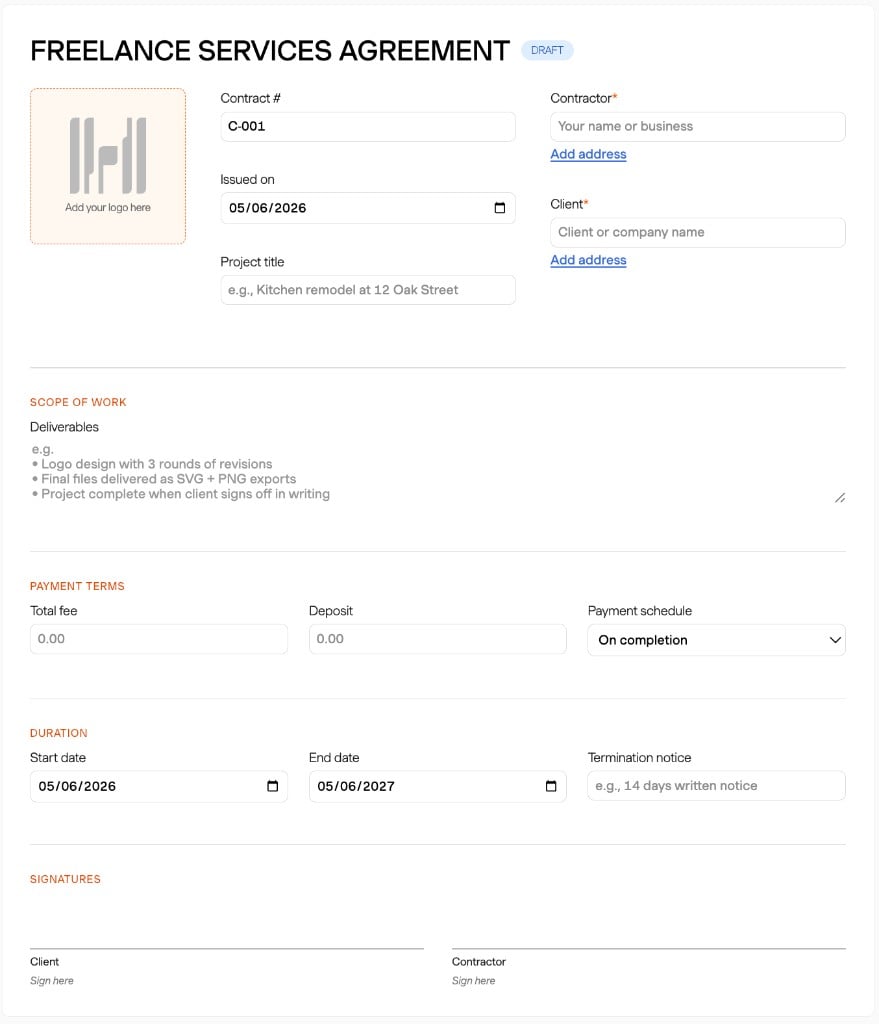
Screenshot of Harvest's contract drafting interface.

Draft a Contract FAQs

  • Key elements of a contract include an offer, acceptance, consideration, intent to create legal relations, legal capacity of parties, and legality of purpose. Missing any of these could render a contract unenforceable.

  • To ensure legal enforceability, include all essential elements like offer, acceptance, and consideration, use clear language, and define all key terms. Consulting a legal professional can also help verify compliance with relevant laws.

  • Common types of contracts include service agreements, NDAs, sales contracts, and employment agreements. Each type serves different purposes and includes specific clauses relevant to the agreement's nature and industry.

  • Technology, like AI and contract management software, can significantly enhance drafting efficiency by reducing review times and improving accuracy. These tools streamline workflows and minimize manual errors.

  • Consulting a lawyer is advisable to ensure that your contract complies with legal standards and effectively protects your interests. Legal review can identify potential issues and reduce the risk of disputes.

  • Avoid vague language, missing key clauses, and overly relying on boilerplate terms. Ensure balanced terms and thoroughly review for consistency and accuracy to minimize legal risks.

  • While Harvest focuses on time tracking and invoicing, these features support the broader contract management process by ensuring accurate billing and efficient workflow management.

  • Harvest's time tracking and invoicing tools help identify inefficiencies, manage billing more effectively, and integrate seamlessly into broader contract management workflows, enhancing overall operational efficiency.