
Harvest
Contracts
Sign up

Service Agreement Template in Hungarian

Navigating Hungarian service agreements can be complex due to strict legal requirements. Harvest supports compliance by helping track time and manage invoicing seamlessly.

Start from a template

AGREEMENT DRAFT

Add your logo here

Scope of work

Payment terms

Duration

Signatures

Client

Sign here

Contractor

Sign here

Get paid via:
Credit card / Debit card
ACH
Wire transfer

Customize contract

Appearance

Add a logo
Show contract title

Contract settings

Include payment terms Total fee, deposit, and schedule
Include termination clause Notice required to end the contract
Include signature blocks Both parties sign at the bottom

Understanding the Legal Framework of Hungarian Service Agreements

Crafting a service agreement in Hungary requires understanding the legal framework to ensure compliance and avoid potential legal pitfalls. Service agreements in Hungary are primarily governed by Act V of 2013 on the Civil Code, while employment contracts fall under Act I of 2012 on the Labour Code. A service agreement becomes a "long-term service relationship" when it exhibits continuity, economic dependence, and duration, typically exceeding six months of uninterrupted engagement.

As of January 1, 2026, significant legal reforms in Hungary have introduced stricter reporting and classification rules for long-term service contracts. These reforms demand monthly reporting through the National Tax and Customs Administration (NAV) online portal, along with social-contribution payments, even for months without invoiced services. Non-compliance can lead to retroactive social-contribution liability, administrative fines, and reclassification of the contract as employment, posing substantial financial and legal risks.

Drafting a Compliant Service Agreement Template

When drafting a service agreement template in Hungarian, it's crucial to include mandatory clauses to ensure compliance with local law. Key clauses should define the scope of services, payment terms, termination conditions, and confidentiality obligations. The agreement should also outline clear deliverables based on output, rather than hourly attendance, to reinforce the contractor classification and reduce reclassification risks.

A comprehensive service agreement should also address the potential reclassification risk, particularly in industries like IT, where continuous service for a single payer can lead to reclassification as employment. Including clauses that allow the contractor to provide services to multiple clients, and specifying the contractor's independence, can further mitigate these risks. Consulting with a qualified Hungarian contract lawyer is recommended to tailor the agreement to specific business needs and ensure enforceability.

Navigating Language and Formatting Requirements

For businesses operating internationally, language barriers can be a significant challenge when managing service agreements in Hungary. While not legally required, providing a bilingual agreement (Hungarian and English) is best practice to prevent misunderstandings. Including a clause stating that the Hungarian version prevails in the case of a dispute can safeguard against future legal issues.

Formatting is another critical aspect. Although there are no specific formatting mandates for service agreements, maintaining a clear and structured document is essential. Robust documentation, such as signed contracts, amendments, and proof of payment, should be retained for at least five years after the end of the contract period. This aligns with the general limitation period for Hungarian tax assessments and is crucial for audits.

Ensuring Compliance and Avoiding Pitfalls

Ensuring compliance with Hungarian service agreement requirements involves more than just proper drafting. Employers must perform a classification risk assessment to identify potential reclassification risks and update contract drafting accordingly. Regularly filing reports with NAV and maintaining an ongoing audit trail are also essential steps in compliance.

Common pitfalls include vague terms and failing to engage professionals for contract review. A poorly drafted contract can lead to disputes and substantial financial liabilities. Thus, avoiding non-compete clauses, permitting service provision to other clients, and requiring an independent business presence are vital to drafting a compliant and risk-averse service agreement. Engaging local legal counsel can provide the necessary assurance that the contract meets all legal obligations and reflects the actual working relationship.

Service Agreement Templates with Harvest

Explore Harvest's service agreement templates, helping you adhere to Hungarian legal standards. Track time and manage invoicing effortlessly.

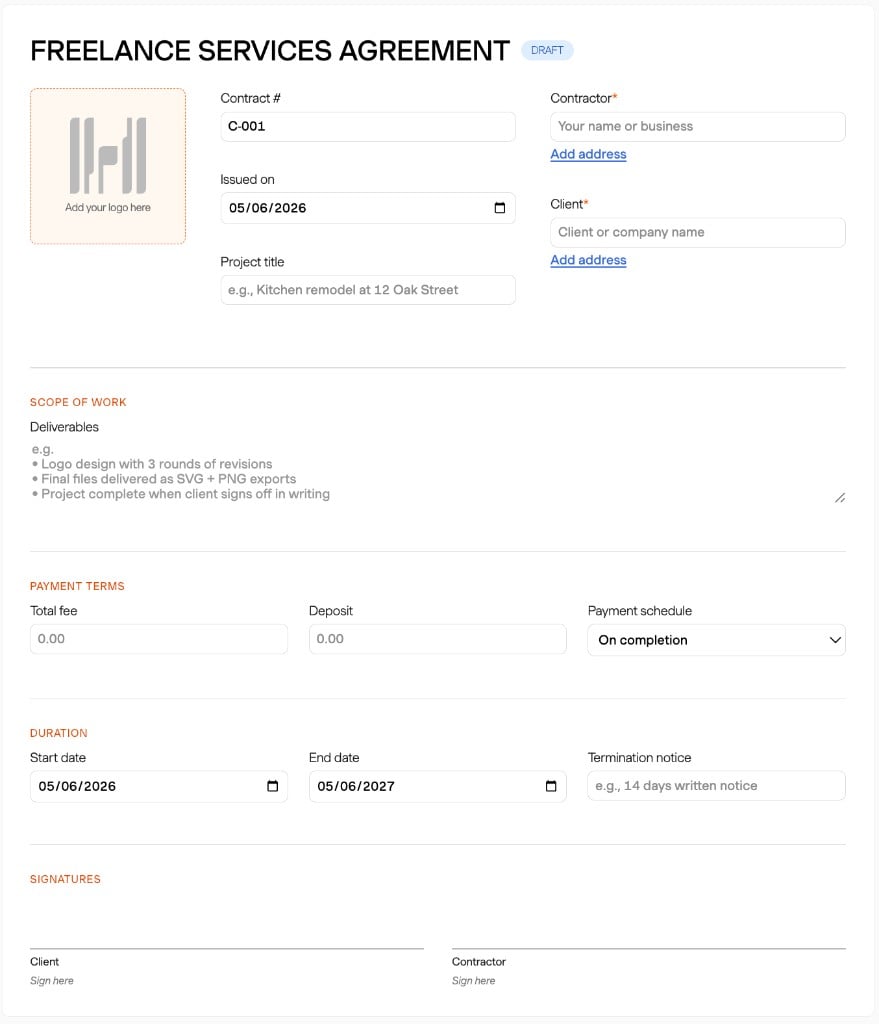
Harvest interface showing service agreement template features

Service Agreement Template in Hungarian FAQs

  • Mandatory clauses for a service agreement in Hungary include the scope of services, payment terms, termination conditions, and confidentiality obligations. It is crucial to draft these clauses clearly to ensure compliance with local laws and avoid misclassification risks.

  • Customizing a Hungarian service agreement template involves tailoring clauses to your specific business needs. This includes defining output-based deliverables and ensuring clauses reflect genuine independence to avoid reclassification as employment. Consulting with a local legal expert can help ensure compliance and enforceability.

  • Using a service agreement in Hungary without adhering to legal requirements can lead to significant financial and legal risks, including reclassification as employment. This may result in retroactive social-contribution liabilities and administrative fines. Proper drafting and compliance are essential to mitigate these risks.

  • A bilingual contract in Hungarian and English is recommended to avoid language barriers and misunderstandings. Including a clause that states the Hungarian version prevails in disputes helps protect against legal issues, especially in international business dealings.

  • A service agreement should clearly outline the scope of services, payment terms, and deliverables based on output. It should also include clauses that allow the contractor to work with multiple clients and specify the contractor's independence to comply with Hungarian labor laws and avoid reclassification.

  • The 2026 legal reforms in Hungary have introduced stricter reporting and classification rules for long-term service contracts. Businesses must file monthly reports and ensure social-contribution payments, even for non-invoiced months, to avoid penalties.