
Harvest
Contracts
Sign up

Service Agreement Template in Turkish

Navigating Turkish legal requirements for service agreements can be challenging. Harvest provides tools to streamline time tracking and invoicing, simplifying business operations in Turkey.

Start from a template

AGREEMENT DRAFT

Add your logo here

Scope of work

Payment terms

Duration

Signatures

Client

Sign here

Contractor

Sign here

Get paid via:
Credit card / Debit card
ACH
Wire transfer

Customize contract

Appearance

Add a logo
Show contract title

Contract settings

Include payment terms Total fee, deposit, and schedule
Include termination clause Notice required to end the contract
Include signature blocks Both parties sign at the bottom

Understanding Service Agreements in Turkey

Service agreements in Turkey are governed by the Turkish Code of Obligations (Law No. 6098), which provides a comprehensive framework for various types of contracts, including general service contracts, marketing contracts, and home service contracts. The law emphasizes the importance of clearly defined terms and conditions to avoid disputes and ensure compliance with Turkish legal standards. A service agreement must include key elements such as the parties' identities, scope of services, fee structure, duration, termination conditions, confidentiality, and dispute resolution mechanisms.

One critical aspect is the language requirement. According to Law No. 805, contracts between Turkish commercial enterprises must be in Turkish. This means that even if a service agreement involves foreign parties, a Turkish version is often necessary to ensure enforceability in Turkish courts. Additionally, the agreement should address currency denomination and exchange rate risks, especially for cross-border transactions.

Given the complexities of Turkish contract law, customization of service agreements is essential. Generic templates from foreign jurisdictions may not meet the specific legal requirements of Turkey, potentially leading to unenforceable contracts. Therefore, it's advisable to seek legal advice when drafting or customizing a service agreement to align with Turkish legal standards.

Mandatory Elements of Turkish Service Agreements

To comply with Turkish law, service agreements need to incorporate several mandatory elements. These include a detailed scope of services, which should specify the standards and duration of the services, the tools or equipment to be used, and any personnel qualifications required. Ambiguity in these areas can lead to disputes and challenges in enforcement.

Payment terms must be clearly defined, stating the service fee, payment schedule, currency, and invoicing procedures. For contracts involving international parties, it is crucial to address currency denomination and exchange rate risk to prevent potential conflicts. Additionally, Turkish consumer protection laws invalidate clauses that allow unilateral changes to terms or prices without a legitimate reason.

Termination clauses are another critical element. Indefinite-term contracts can be terminated with notice periods, while those exceeding ten years allow for termination by giving six months' notice after the tenth year. These clauses ensure that both parties understand the conditions under which the contract can be ended, helping to prevent disputes and potential legal action.

The Role of Digital Contracts and Bilingual Agreements

The digitalization of contracts has become increasingly prevalent in Turkey, allowing for faster and more efficient commercial transactions. Under Turkish law, digital signatures, including "Secure Electronic Signatures," hold the same legal weight as traditional wet signatures, making them a viable option for executing service agreements.

For agreements involving international parties, a bilingual contract format is often used, typically in Turkish and another language like English. It is advisable to obtain a notarized Turkish translation and specify which version prevails in case of discrepancies. This approach not only facilitates understanding between parties but also helps meet the language requirements set by Turkish law.

Despite the convenience of digital contracts, it is essential to ensure they are customized to reflect the specific nature of the services and comply with Turkish legal standards. This includes meeting execution formalities such as verifying signing authority, calculating and paying stamp tax, and obtaining notarization if required. Adhering to these requirements helps to avoid any legal challenges that may arise from improperly executed agreements.

Challenges and Best Practices for Compliance

One of the significant challenges in drafting service agreements in Turkey is ensuring compliance with the country's specific legal and regulatory environment. This involves addressing sector-specific needs, such as data privacy for technology firms or delivery guarantees for construction companies. A well-drafted contract that considers these factors can be a powerful tool for establishing and maintaining successful business relationships.

Customization of service agreements is crucial to avoid potential pitfalls. Legal experts strongly advise against using generic templates without tailoring them to Turkish legal requirements. This includes addressing compliance with labor and social security laws, especially in agreements that might be interpreted as employment contracts.

Proper execution formalities are also vital. These include verifying the signing authority of representatives, calculating and paying any applicable stamp tax, and obtaining notarization or registration when legally required. Errors in these areas can render a contract void or unenforceable, leading to significant legal and financial consequences.

Streamline Agreements with Harvest

Harvest helps create service agreements in Turkish, ensuring compliance with local laws and efficient time tracking and invoicing.

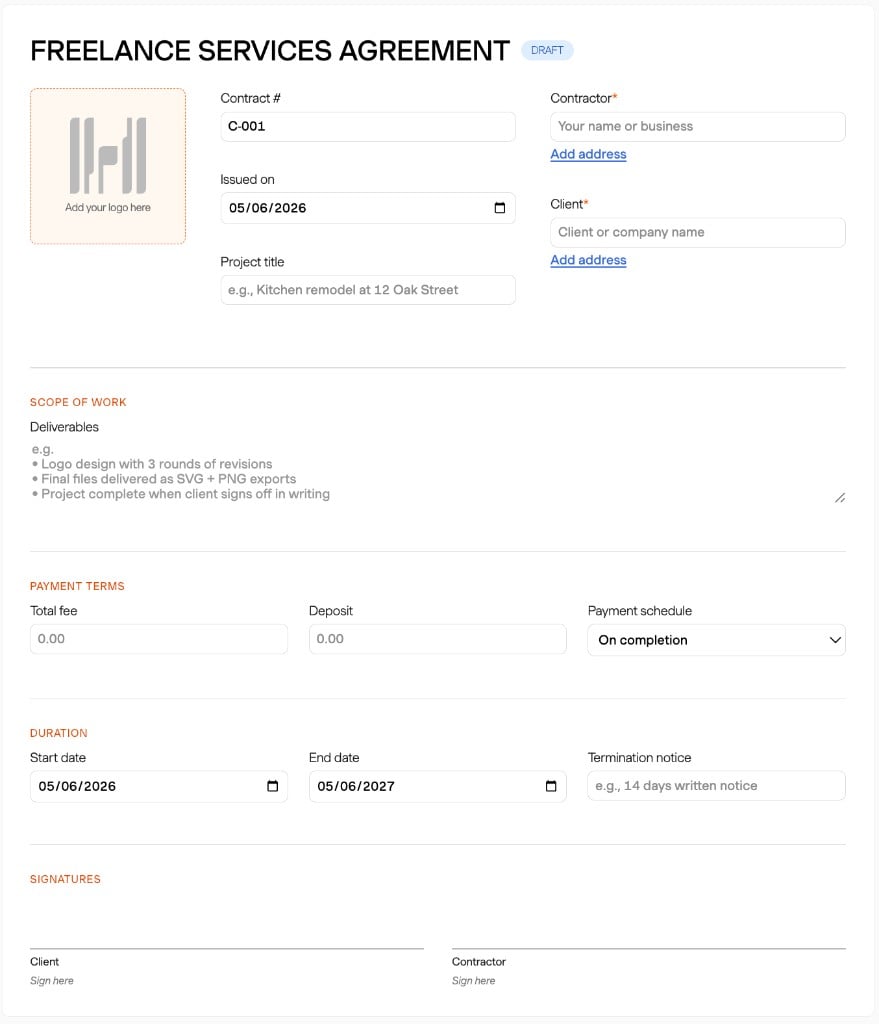
Screenshot of a service agreement template in Turkish created with Harvest.

Service Agreement Template in Turkish FAQs

  • A Turkish service agreement should include the parties' identities, scope of services, fee structure, duration, termination conditions, confidentiality, and dispute resolution mechanisms. These elements ensure clarity and compliance with Turkish law.

  • While not always mandatory, a bilingual format is recommended for international contracts. A Turkish version is often required to ensure enforceability in Turkish courts, and specifying which version prevails can prevent disputes.

  • Digital signatures, including "Secure Electronic Signatures," are legally equivalent to wet signatures in Turkey. They streamline the contract execution process, provided all legal formalities are observed.

  • Indefinite-term contracts can be terminated with notice periods, while contracts longer than ten years can be ended with a six-month notice after the tenth year. These conditions help clarify the process for ending an agreement legally.

  • Customization ensures that service agreements meet Turkish legal standards and sector-specific needs. Relying on generic templates can lead to unenforceable contracts and legal challenges.

  • The payment terms should clearly state the service fee, schedule, currency, and invoicing procedures. For international contracts, address currency denomination and exchange rate risks to prevent conflicts.

  • Yes, non-compliance can lead to contracts being void or unenforceable. For instance, failing to adhere to notice periods in indefinite-term contracts may result in compensation claims by the affected party.