
Harvest
Contracts
Sign up

Freelance Contract Template in Turkish

Freelancers in Turkey face legal complexities that can impact their work. Harvest helps by simplifying time tracking and invoicing, allowing freelancers to focus on their contracts and compliance.

Start from a template

AGREEMENT DRAFT

Add your logo here

Scope of work

Payment terms

Duration

Signatures

Client

Sign here

Contractor

Sign here

Get paid via:
Credit card / Debit card
ACH
Wire transfer

Customize contract

Appearance

Add a logo
Show contract title

Contract settings

Include payment terms Total fee, deposit, and schedule
Include termination clause Notice required to end the contract
Include signature blocks Both parties sign at the bottom

Understanding Freelance Contracts in Turkey

Freelance contracts in Turkey are essential for ensuring clear expectations and compliance with local regulations. As the freelance economy grows, driven by digitalization and the demand for flexible work, the need for well-crafted contracts has become more pronounced. According to the Turkish Code of Obligations, freelance work is categorized as an "eser sözleşmesi" or a "hizmet sözleşmesi". This classification helps freelancers and clients alike by setting a legal framework that governs their agreements, distinct from traditional employment contracts.

Freelancers in Turkey often face challenges such as payment delays and undefined intellectual property rights, which can be mitigated through carefully drafted contracts. For instance, including specific payment terms and intellectual property clauses can protect both parties. Legal experts emphasize the importance of written contracts for evidentiary purposes. Despite not being mandatory, a written agreement can prevent disputes and serve as a legal document in court.

Legal and Compliance Considerations for Turkish Freelancers

Freelancers in Turkey must navigate a complex legal landscape to ensure compliance with tax and social security obligations. Classified as "serbest meslek erbabı", freelancers are subject to income tax, VAT, and are required to register with tax authorities. They must issue "serbest meslek makbuzu" for their services and maintain records using the digital "Defter-Beyan Sistemi". The VAT rate for freelance activities is generally 20%, though there are exceptions for certain services like education.

Social security is another crucial aspect, with freelancers covered under the Bağ-Kur system. Many are unaware of this requirement, leading to potential gaps in benefits. Legal compliance extends to contract drafting, where it's vital to ensure that freelance agreements do not resemble employment contracts to avoid reclassification under the Labor Law. Harvest, while not providing legal advice, can assist freelancers in managing the financial aspects of their business, such as tracking time and expenses.

Crafting a Comprehensive Freelance Contract

Creating a robust freelance contract involves several key steps to protect both freelancers and clients. Initially, the contract should clearly identify the parties involved, including full names, addresses, and contact information. It's crucial to define the services provided in detail, specifying how and when they will be performed, and outline the duration and evaluation criteria. This clarity helps prevent misunderstandings and scope creep.

Payment terms are another vital component, with the contract specifying fees, payment schedules, methods, and late payment penalties. Additionally, intellectual property rights must be addressed, detailing who retains ownership upon project completion. Confidentiality clauses protect sensitive information shared during the project. Harvest supports freelancers by enabling efficient time tracking and invoicing, ensuring they can focus on their contractual obligations without administrative burdens.

Avoiding Common Pitfalls in Freelance Contracts

Freelancers and clients should be aware of common pitfalls when drafting contracts in Turkey. Starting work without a written contract is a critical error that leaves parties vulnerable to disputes. Ambiguous project descriptions can lead to disagreements and scope creep, while ignoring tax and social security obligations can result in legal and financial issues.

It's essential to define revision limits to prevent excessive demands on a freelancer's time and profit. Assuming intellectual property transfers without a written agreement can also pose significant risks. Harvest helps freelancers streamline their invoicing and time tracking processes, though it does not handle legal compliance aspects such as contract provisions. Freelancers are advised to seek legal counsel to ensure their contracts meet Turkish legal standards.

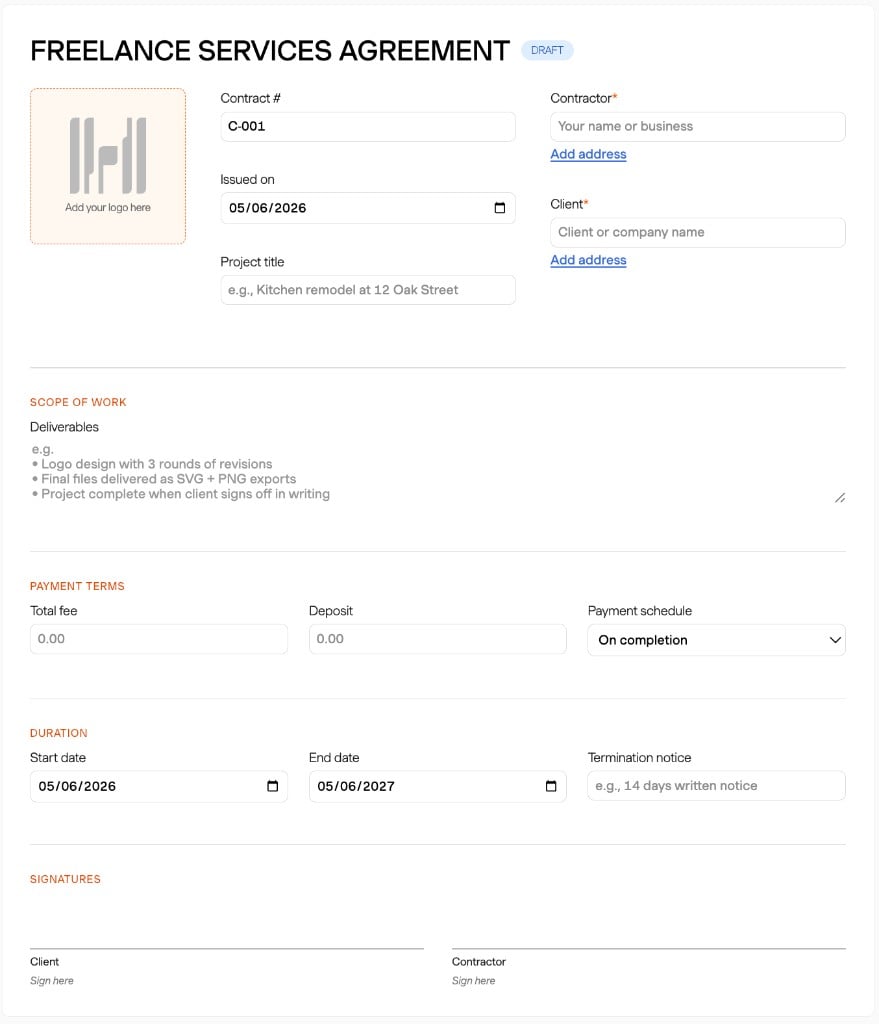
Freelance Contract Template with Harvest

Explore how Harvest helps freelancers in Turkey manage time tracking and invoicing, tailored for local contract needs.

Screenshot of Harvest's freelance contract template in Turkish.

Freelance Contract Template in Turkish FAQs

  • Freelance contracts in Turkey are governed by the Turkish Code of Obligations, typically classified as "eser sözleşmesi" or "hizmet sözleşmesi". Key elements include clear definitions of services, payment terms, and intellectual property clauses.

  • A comprehensive Turkish freelance contract should include party identification, detailed service descriptions, payment terms, intellectual property rights, confidentiality clauses, and termination conditions.

  • Freelancers must register with tax authorities, issue "serbest meslek makbuzu", and use the "Defter-Beyan Sistemi" for records. They are subject to income tax, temporary tax, and VAT, generally at 20%.

  • Delayed payments can disrupt freelancers' cash flow. Contracts should include clear payment schedules and penalties for late payments to mitigate this risk.

  • Freelancers are generally covered by the Bağ-Kur social security system. Many freelancers are unaware of this obligation, which can lead to gaps in social security benefits and retirement rights.

  • Harvest aids Turkish freelancers by providing efficient tools for time tracking and invoicing. It helps manage financial aspects, allowing freelancers to focus on their projects and compliance.

  • A written contract serves as a legal document for evidentiary purposes, helping prevent disputes and clarifying rights and responsibilities between freelancers and clients.