
Harvest
Contracts
Sign up

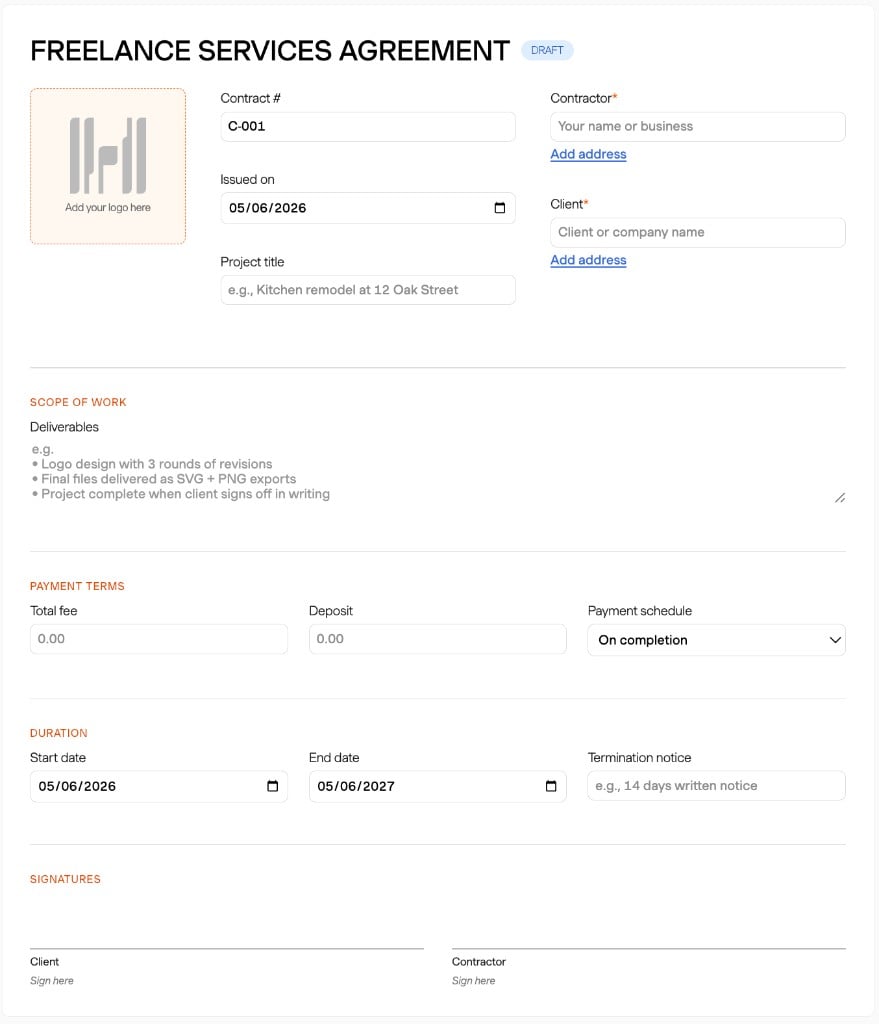
Simple Contract Template

Standard contract templates can save businesses significant time and reduce complexity. Harvest supports contractors by managing time, expenses, and invoicing around these templates.

Start from a template

AGREEMENT DRAFT

Add your logo here

Scope of work

Payment terms

Duration

Signatures

Client

Sign here

Contractor

Sign here

Get paid via:
Credit card / Debit card
ACH
Wire transfer

Customize contract

Appearance

Add a logo
Show contract title

Contract settings

Include payment terms Total fee, deposit, and schedule
Include termination clause Notice required to end the contract
Include signature blocks Both parties sign at the bottom

The Benefits of Using Simple Contract Templates

Simple contract templates offer a streamlined approach for creating agreements that saves time and reduces complexity. Industry research shows that standardized contracts can cut negotiation time by up to 60% Harvard Business Review. By using a pre-designed template, contractors and freelancers can quickly draft agreements that meet their needs without the hassle of starting from scratch. This efficiency is crucial for high-volume, low-touch agreements, such as NDAs, which average just 12 days to sign when templates are utilized, compared to weeks or even months with custom contracts.

Contract templates are not just time-saving tools; they also help ensure consistency and accuracy across agreements. By adopting fixed templates, organizations can minimize errors and improve stakeholder satisfaction, as evidenced by a global retail company that saw a 25% increase in satisfaction after implementing personalized contract templates. This practice is becoming more widespread, with 53% of organizations now using standardized templates, a 29% increase since 2021.

Customizing Your Simple Contract Template

Customizing a simple contract template to fit your specific needs is a straightforward process. While Harvest does not offer legal contract templates, it provides tools that support the administrative processes surrounding contract work, such as time tracking and invoicing. When customizing a template, it is essential to focus on the core elements of the contract, such as parties involved, scope of work, payment terms, and duration.

Experts recommend regularly reviewing and updating your templates to prevent legal liabilities from outdated terms. For example, a company could integrate AI in contract management to reduce lifecycle time by 39% and increase productivity by 44%, ensuring that templates remain current and effective. Customization does not mean one-size-fits-all; smart fields for automatic data population and conditional clauses can make templates adaptable to various scenarios.

Legal Considerations for Using Contract Templates

While simple contract templates provide a convenient starting point, it is important to consider legal and compliance aspects. Contracts should be reviewed periodically to align with evolving legal standards and business needs. Despite Harvest not providing legal compliance features, utilizing templates can still significantly reduce the time and complexity associated with contract creation and management.

Ensuring compliance involves incorporating industry-specific requirements and best practices into templates. For instance, in the tech industry, data contracts include fields for data schema validation and row count to ensure quality and governance. It is advisable to seek legal review for critical agreements to ensure that the contract terms are enforceable and protect your interests effectively. In many jurisdictions, a written contract is necessary for enforceability, emphasizing the importance of maintaining accurate and comprehensive records.

Managing Contract Workflows Efficiently

Efficiently managing contract workflows is crucial for maintaining organizational consistency and reducing risks. While Harvest focuses on time tracking, invoicing, and expense management, it complements contract management by handling the administrative tasks that accompany contract execution. Using a Contract Lifecycle Management (CLM) system can centralize updates, automate workflows, and create searchable repositories, enhancing the efficiency of managing a large volume of contracts.

For those managing contract workflows, it is essential to establish a governance framework that defines user access, specifies legal review triggers, and monitors changes. This approach minimizes errors and promotes efficient contract management practices. Global studies indicate that robust contract management can enhance profitability by as much as 9%, demonstrating the tangible benefits of efficient contract workflows.

Harvest Simplifies Contract Management

See how Harvest aids in managing time, expenses, and invoicing around contract templates, enhancing efficiency and accuracy.

Screenshot of Harvest's contract template support in action

Simple Contract Template FAQs

  • Using a simple contract template significantly reduces the time required to draft agreements, cutting negotiation time by as much as 60%. Templates ensure consistency and accuracy in agreements, which can lead to improved stakeholder satisfaction and fewer errors.

  • Customizing a contract template involves focusing on essential elements like parties involved, scope of work, and payment terms. Regular reviews and updates prevent legal liabilities from outdated terms. Smart fields and conditional clauses can make templates flexible for different scenarios.

  • Ensure that your contract templates align with current legal standards and industry-specific requirements. Regular legal reviews and updates are crucial to maintain compliance and enforceability. In many jurisdictions, a written contract is required for enforceability.

  • Efficient contract workflow management reduces risks, promotes consistency, and enhances profitability by up to 9%. Using a CLM system can centralize updates, automate workflows, and create searchable repositories, improving contract handling efficiency.

  • Common mistakes include neglecting regular template reviews, which can lead to outdated terms and legal liabilities. Storing templates in unorganized drives can impede management and realization of full benefits. Regular updates and centralized storage are recommended.

  • To maintain compliance, review and update templates regularly, particularly in rapidly evolving industries. Incorporating industry-specific legal requirements and best practices ensures that your contracts protect your interests effectively.