
Harvest
Contracts
Sign up

Contract Template for Government Contractors

Government contractors face stringent compliance regulations. Harvest helps streamline operations with accurate time tracking and invoicing, supporting regulatory adherence.

Start from a template

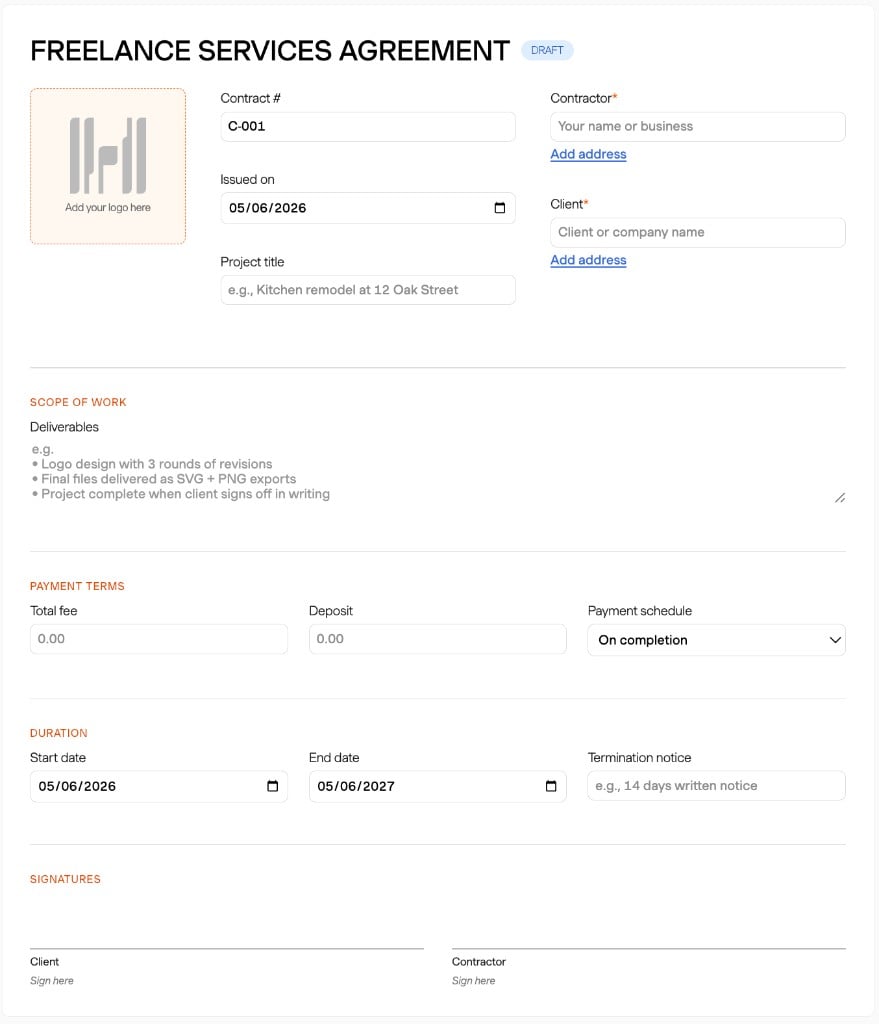
AGREEMENT DRAFT

Add your logo here

Scope of work

Payment terms

Duration

Signatures

Client

Sign here

Contractor

Sign here

Get paid via:
Credit card / Debit card
ACH
Wire transfer

Customize contract

Appearance

Add a logo
Show contract title

Contract settings

Include payment terms Total fee, deposit, and schedule
Include termination clause Notice required to end the contract
Include signature blocks Both parties sign at the bottom

Understanding Government Contract Templates

A government contract template is essential for contractors engaging with federal agencies, ensuring compliance with stringent regulations. These templates incorporate necessary clauses mandated by the Federal Acquisition Regulation (FAR) and, for defense contractors, the Defense Federal Acquisition Regulation Supplement (DFARS). Compliance with these regulations is non-negotiable, as failure to adhere can result in severe penalties, including financial and legal consequences. For instance, DFARS 252.204-7012 requires defense contractors to adhere to strict cybersecurity standards to protect sensitive information.

Government contract templates are not one-size-fits-all. They vary based on the type and complexity of services or goods provided. For example, the UK Cabinet Office offers different templates for high-value services versus low-value goods, reflecting the project's complexity and financial scale. This tailored approach ensures contractors meet specific regulatory and technical requirements, avoiding generic responses that lead to non-compliance.

Key Clauses in Government Contracts

When drafting a government contract, several critical clauses must be included to meet regulatory requirements. These include compliance with FAR for general federal contracts and DFARS for defense-related agreements. Key clauses focus on cost accounting standards, cybersecurity measures, and compliance plans to prevent trafficking in persons, especially for contracts over $550,000 involving international services.

Contractors must also ensure that their templates accommodate amendments, pricing adjustments, and timelines changes. This flexibility is crucial, as government contracts often involve extended timelines and fluctuating requirements. Real-time tracking and adjustments are vital to maintaining compliance and managing costs effectively. For instance, automated Contract Lifecycle Management (CLM) systems can help manage these dynamic aspects by providing real-time updates on contract status and compliance metrics.

Avoiding Common Pitfalls in Government Contracting

Government contractors must navigate complex compliance landscapes to avoid common pitfalls. One such pitfall is relying on generic templates that fail to address specific agency requirements. Using boilerplate language can lead to proposals being dismissed as non-responsive. Instead, contractors should customize each template to fit the specific solicitation, incorporating agency-specific terminology and highlighting relevant past performances.

Additionally, a lack of integration between contract management and other business systems can impede efficiency. For example, integrating contract management software with ERP systems can streamline billing and payroll processes, ensuring accurate cost tracking and compliance with financial reporting standards. This integration not only enhances workflow efficiency but also ensures that all contractual obligations are met in a timely and compliant manner.

Leveraging Technology for Efficient Contract Management

The digital transformation in government procurement is reshaping how contracts are managed, emphasizing efficiency, transparency, and compliance. Adopting e-procurement platforms and AI-powered tools is becoming essential for contractors to stay competitive and compliant. For instance, the U.S. Department of Health and Human Services (HHS) uses AI to consolidate contract vehicles, which enhances efficiency and reduces administrative burdens.

For government contractors, utilizing technology such as automated CLM systems can significantly improve contract management processes. These systems provide real-time data tracking, ensuring that all compliance requirements are met and documented. They also facilitate better integration with existing business tools, such as CRM and project management platforms, aligning deliverables and ensuring that all project milestones are met. This approach not only enhances compliance but also improves overall operational efficiency.

Harvest's Role in Supporting Government Contractors

While Harvest does not provide specific contract templates for government contractors, it plays a crucial role in supporting the operational efficiency of contracting businesses. Harvest's time tracking and invoicing capabilities are invaluable for contractors needing to manage labor costs and billing accurately. Accurate time tracking can prevent revenue leakage and ensure compliance with stringent cost-accounting standards.

Harvest gives contractors the tools to monitor project budgets and expenses, offering visibility into project financials and facilitating timely invoicing. This functionality helps contractors maintain compliance with financial regulations, ensuring that all billable hours are captured and invoiced accurately. By integrating with other business tools, Harvest supports a streamlined workflow that aligns with government contracting demands, enhancing both efficiency and compliance.

Streamline with Harvest

Harvest supports government contractors with time tracking and invoicing to ensure compliance and efficiency.

Harvest's time tracking and invoicing features for government contractors

Contract Template for Government Contractors FAQs

  • Government contracts must include clauses that ensure compliance with the Federal Acquisition Regulation (FAR) and, for defense contracts, the Defense Federal Acquisition Regulation Supplement (DFARS). Key clauses include cost accounting standards, cybersecurity measures, and compliance plans to prevent trafficking in persons.

  • To ensure compliance, include all necessary clauses mandated by FAR and DFARS, document all procedures, and maintain accurate records. Utilizing automated Contract Lifecycle Management systems can help track compliance requirements and ensure all obligations are met efficiently.

  • Yes, there are different templates depending on the complexity and value of the services or goods provided. For example, the UK Cabinet Office provides various templates, like the Model Services Contract for high-value services, to ensure all regulatory and technical requirements are met.

  • A common pitfall is using generic templates that don't address specific agency requirements. Customizing templates and integrating contract management with other business systems can enhance compliance and efficiency, avoiding such pitfalls.

  • Technology, like AI-powered contract management systems, can improve efficiency, transparency, and compliance. These systems provide real-time tracking and integration with other business tools, ensuring all contractual obligations are met effectively.

  • Harvest aids contractors by providing tools for accurate time tracking and invoicing, ensuring that all labor costs are accounted for and billed correctly, which supports compliance with federal regulations.