
Harvest
Contracts
Sign up

Create a Consulting Agreement

Creating consulting agreements can be complex, but Harvest simplifies managing the financial aspects with robust invoicing and expense tools.

Start from a template

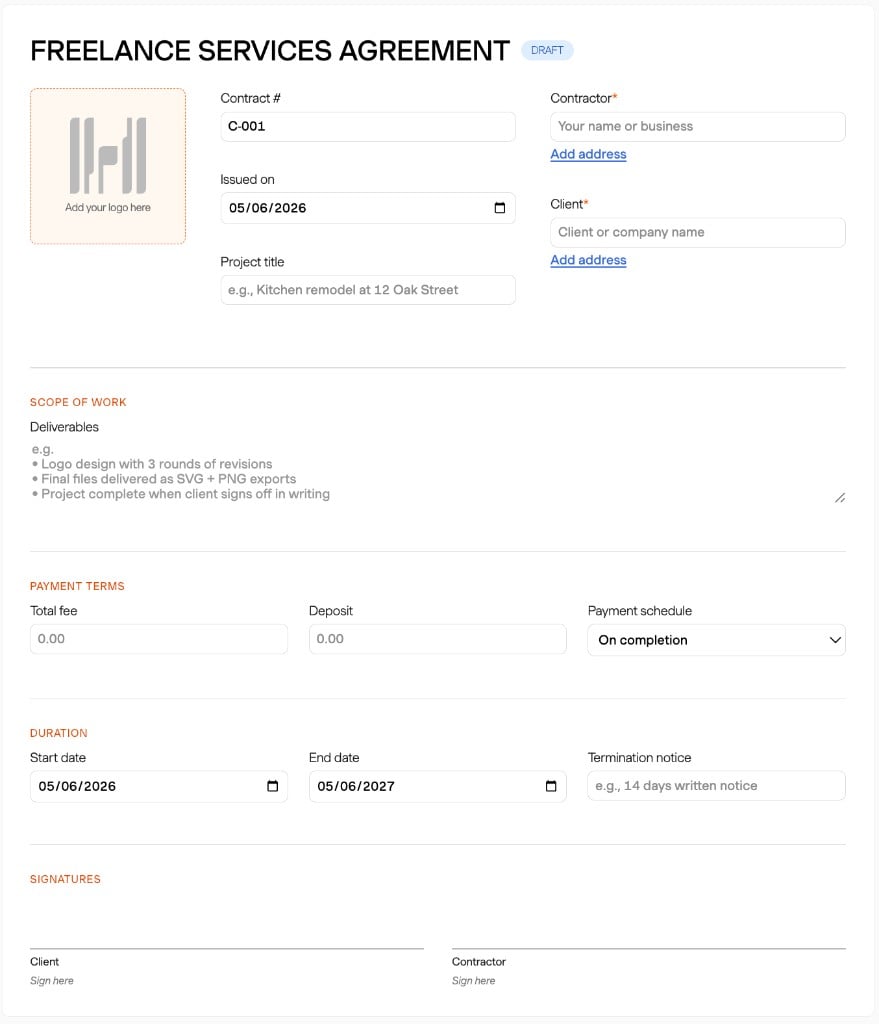
AGREEMENT DRAFT

Add your logo here

Scope of work

Payment terms

Duration

Signatures

Client

Sign here

Contractor

Sign here

Get paid via:
Credit card / Debit card
ACH
Wire transfer

Customize contract

Appearance

Add a logo
Show contract title

Contract settings

Include payment terms Total fee, deposit, and schedule
Include termination clause Notice required to end the contract
Include signature blocks Both parties sign at the bottom

Key Elements of a Consulting Agreement

Creating a consulting agreement involves several critical components that ensure both parties are aligned on expectations and responsibilities. Firstly, it is essential to clearly define the parties involved by stating their full legal names and addresses. Next, the scope of services must be outlined in detail, specifying deliverables, milestones, and the consultant's compensation structure, including rates and payment schedules. This precision helps avoid misunderstandings and scope creep, which can lead to disputes and project delays.

To ensure legal protection, the agreement should state the consultant's status as an independent contractor, not an employee, to avoid tax and employment disputes. Additionally, clauses for intellectual property rights, confidentiality, and non-compete agreements are crucial, especially in sectors like financial services where data protection is paramount. It's advisable to review and finalize the agreement with legal assistance to ensure compliance with applicable laws and regulations, such as the GDPR in the EU.

While Harvest does not create legal agreements, it offers tools that help manage the financial aspects of consulting projects. Through its invoicing features, Harvest allows consultants to set up specific payment terms, manage invoices, and enforce late payment penalties, ensuring that the financial components of the agreement are adhered to efficiently.

Avoiding Common Pitfalls in Consulting Agreements

Consultants often make critical mistakes in drafting agreements, such as relying on verbal agreements or failing to specify the scope of work. These oversights can lead to late payments and scope creep, impacting project success and client relationships. To prevent these issues, always use a written contract that includes all agreed-upon terms and avoid starting work until the agreement is signed.

Another common mistake is ignoring legal nuances. Each region has specific laws and regulations that must be adhered to, and failing to incorporate these can lead to unenforceable clauses and legal penalties. For instance, in the US, recent changes like the prohibition of non-compete clauses by the FTC must be considered in contract drafting. Legal expertise is crucial in ensuring that contracts are compliant and offer the necessary protections for both parties.

Harvest aids consultants in managing ongoing project work by tracking time and project budgets. Although it does not draft agreements, Harvest supports consultants in adhering to financial aspects like billing and expense management, ensuring that the financial elements of their consulting agreements are executed smoothly.

Integrating Consulting Agreements with Business Processes

Integrating consulting agreements with other business processes ensures seamless operations and alignment with strategic goals. Utilizing contract management systems can help track and manage agreements, preventing automatic renewals of contracts that no longer add value. Involving a legal team in drafting or reviewing agreements ensures they are tailored to specific needs and protect business interests effectively.

Open communication channels with clients are vital for maintaining trust and preventing misunderstandings. Regular project reviews and progress meetings, as outlined in the consulting agreement, help keep both parties informed and aligned on expectations. This proactive approach can prevent disputes and foster a collaborative working relationship.

While Harvest does not provide governance models or manage contract-specific clauses, it supports consultants by offering robust tools for tracking time, managing expenses, and invoicing. These features help consultants focus on delivering value while ensuring that the financial aspects of their agreements are managed effectively.

Legal Considerations in Consulting Agreements

Legal considerations are a crucial aspect of consulting agreements, ensuring compliance and protection for both parties. In the US, agreements must explicitly state that the consultant is an independent contractor to avoid disputes over employment rights. Non-compliance with state-specific laws can render parts of the agreement unenforceable and lead to penalties.

Recent legal changes, such as the FTC's ban on non-compete clauses, require consultants to adapt their agreements to focus on alternative retention strategies like NDAs and non-solicitation agreements. In the EU, compliance with data protection regulations, such as the GDPR, is essential, especially for agreements involving international clients or data processing.

While Harvest does not draft legal agreements or include specific clauses for confidentiality or indemnification, it helps consultants manage project timelines and deliverables through efficient time tracking and project budget monitoring. This allows consultants to focus on meeting the agreed terms of their contracts while ensuring compliance with their financial commitments.

Create Consulting Agreements with Harvest

Harvest helps consultants manage invoicing and expenses in consulting agreements, ensuring financial alignment and efficiency.

Screenshot of Harvest showing consulting agreement management features.

Create a Consulting Agreement FAQs

  • A consulting agreement should include the identities of both parties, a detailed scope of services, compensation details, and clauses for intellectual property, confidentiality, and dispute resolution. Ensuring clear definitions helps prevent misunderstandings and legal disputes.

  • A written consulting agreement is crucial as it defines the scope of services, payment terms, and other essential clauses, protecting both parties from disputes. It sets clear expectations and fosters transparency and trust between the consultant and client.

  • To customize a consulting agreement template, include specific details about the services provided, payment terms, and any unique clauses required by your industry or client. Consulting with a legal expert ensures compliance with local laws and enhances the agreement's enforceability.

  • Common mistakes include vague service descriptions, lack of legal compliance, and relying on verbal agreements. These can lead to disputes and legal issues, underscoring the importance of a well-drafted, comprehensive written agreement.

  • Harvest supports consulting agreements by managing financial aspects such as invoicing, payment schedules, and expense tracking. While it doesn't draft legal agreements, it ensures that the financial terms are adhered to efficiently.

  • Recent legal changes, like the FTC's ban on non-compete clauses, impact consulting agreements by requiring alternative retention strategies. Keeping agreements updated with such changes ensures compliance and legal protection.

  • Consultants ensure compliance with data protection laws by including clauses that address data security and privacy in their agreements. This is especially important for international engagements subject to regulations like the GDPR.