
Harvest
Contracts
Sign up

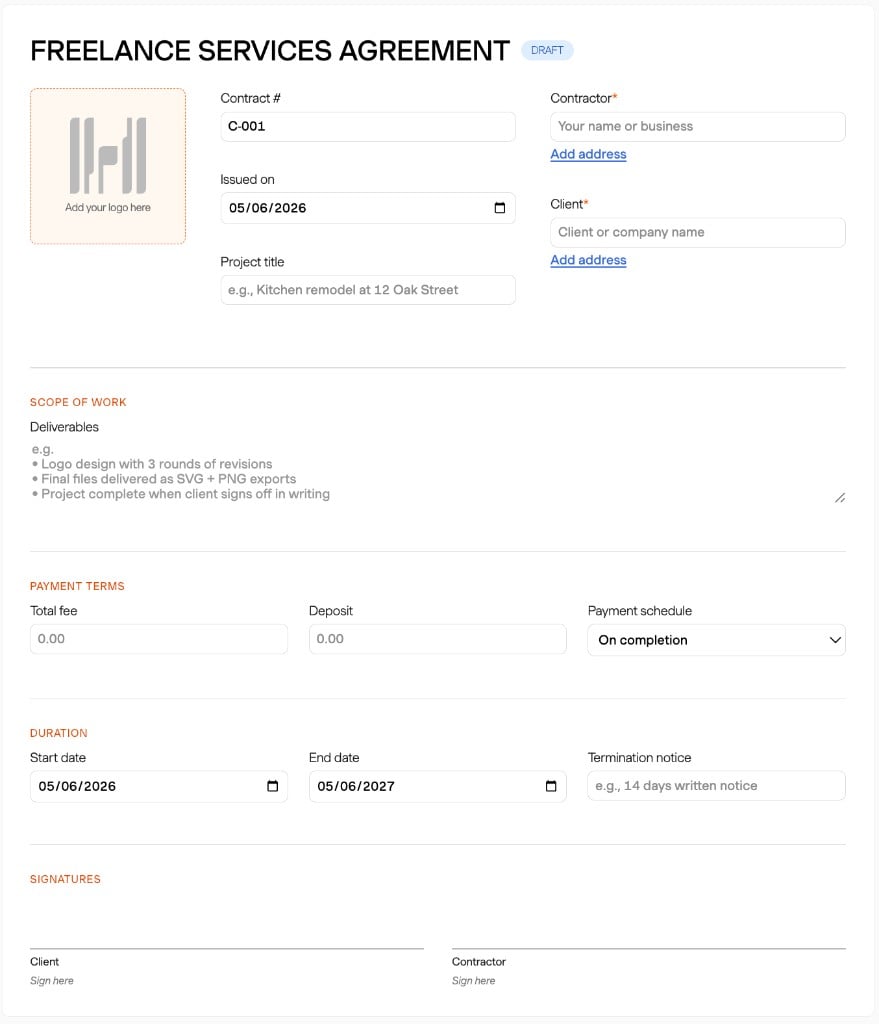
Contract Template for Restoration Contractors

Incomplete documentation can lead to costly disputes in restoration projects. Harvest helps contractors streamline time tracking and invoicing, ensuring accurate and timely payments.

Start from a template

AGREEMENT DRAFT

Add your logo here

Scope of work

Payment terms

Duration

Signatures

Client

Sign here

Contractor

Sign here

Get paid via:
Credit card / Debit card
ACH
Wire transfer

Customize contract

Appearance

Add a logo
Show contract title

Contract settings

Include payment terms Total fee, deposit, and schedule
Include termination clause Notice required to end the contract
Include signature blocks Both parties sign at the bottom

Essential Clauses in Restoration Contracts

Restoration contracts must include essential clauses to protect both contractors and clients. Key components of a robust contract are the scope of work, payment terms, and provisions for emergency situations. Specifically, the scope of work should clearly outline all tasks, materials, and timelines involved, which helps prevent scope creep—a common issue that can delay projects and increase costs. Moreover, detailed payment terms, including down payments and milestone payments, ensure that financial transactions are transparent and agreed upon by all parties.

Provisions for emergency situations are also crucial, especially in restoration projects where unforeseen events often occur. These clauses delineate how changes in the project will be handled, ensuring that both parties have a clear understanding of their responsibilities. By incorporating these elements, restoration contractors can significantly reduce the likelihood of disputes and payment delays, which are frequent challenges in the industry.

Adapting to Legal and Regional Requirements

Restoration contracts must adhere to various legal and regional requirements to ensure compliance and avoid penalties. For example, the Federal Trade Commission (FTC) Cooling-Off Rule grants consumers a three-day right to cancel certain home improvement contracts, a rule applicable to restoration work. In states like Arizona, specific regulations mandate disclosures for storm damage repairs and limit down payments to 50% of the contract price. Failure to comply with these regulations can result in severe disciplinary actions, including license suspension or revocation.

Additionally, contracts for mold remediation in states like Texas and Florida must comply with state-mandated disclosure language and include license numbers. By tailoring contracts to meet these state-specific requirements, restoration contractors can avoid legal pitfalls and protect their business operations. This attention to detail not only safeguards against regulatory penalties but also enhances client trust and satisfaction, thereby supporting long-term business success.

Mitigating Risks with Well-Structured Agreements

Well-structured agreements are essential for mitigating risks in restoration contracts. Incomplete documentation is a significant issue, often leading to disputes and delayed payments. However, by adopting detailed contracts that explicitly outline every aspect of the project—from materials to payment schedules—contractors can prevent these common pitfalls. Industry research shows that such standardized contracts can reduce negotiation time by up to 35% and significantly decrease the likelihood of disputes.

Moreover, integrating digital tools into the contract management process can further enhance efficiency. These tools enable real-time documentation of work, including photo capture and client signatures, creating a comprehensive audit trail. By leveraging these technologies, restoration contractors can maintain detailed records, ensuring accountability and transparency throughout the project lifecycle.

Importance of Continuous Industry Education

The restoration industry is constantly evolving, with new technologies and standards emerging regularly. Contractors must stay informed about these changes to maintain compliance and competitive advantage. Organizations like the Institute of Inspection, Cleaning and Restoration Certification (IICRC) provide valuable resources and standards that contractors can reference to align their practices with industry expectations.

Incorporating IICRC standards, such as the S500 for water damage and S520 for mold remediation, into contracts can help contractors establish credibility and reduce legal risks. These standards are frequently cited in legal disputes as the benchmark for quality and care, underscoring their importance in contract development. Continuous education and adaptation to industry advancements not only protect contractors from potential liabilities but also enhance their service quality and reputation.

Streamline Your Contracts with Harvest

See how Harvest helps restoration contractors with efficient time tracking and invoicing, ensuring accurate payments and streamlined operations.

Screenshot of Harvest contract template for restoration contractors.

Contract Template for Restoration Contractors FAQs

  • A restoration contract should include the scope of work, payment terms, emergency provisions, and change order procedures. These elements help prevent disputes and ensure clarity throughout the project.

  • Yes, many states have specific requirements for restoration contracts. For example, Arizona limits down payments for storm damage repairs and mandates certain disclosures. Adhering to these regulations is crucial for compliance.

  • To protect your business, ensure your contracts are detailed and include all necessary clauses. Using digital tools for real-time documentation can also help maintain accurate records and prevent disputes.

  • Common pitfalls include incomplete documentation, vague terms, and lack of compliance with legal requirements. Detailed contracts and adherence to state-specific laws can help mitigate these issues.

  • Harvest assists restoration contractors by providing tools for efficient time tracking and invoicing, ensuring accurate billing and timely payments. This streamlines operations and reduces administrative burdens.

  • Yes, contract templates can often be customized to fit specific project requirements. This includes adjusting clauses to meet unique client needs or regional regulations.

  • Staying updated ensures compliance with evolving standards and enhances service quality. Organizations like the IICRC provide guidelines that can be integrated into contracts for better outcomes.