
Harvest
Contracts
Sign up

Contract Template in Italian

Italian real estate contracts require precision and legal compliance. While Harvest doesn't provide contract templates, it supports related workflows like time tracking and invoicing.

Start from a template

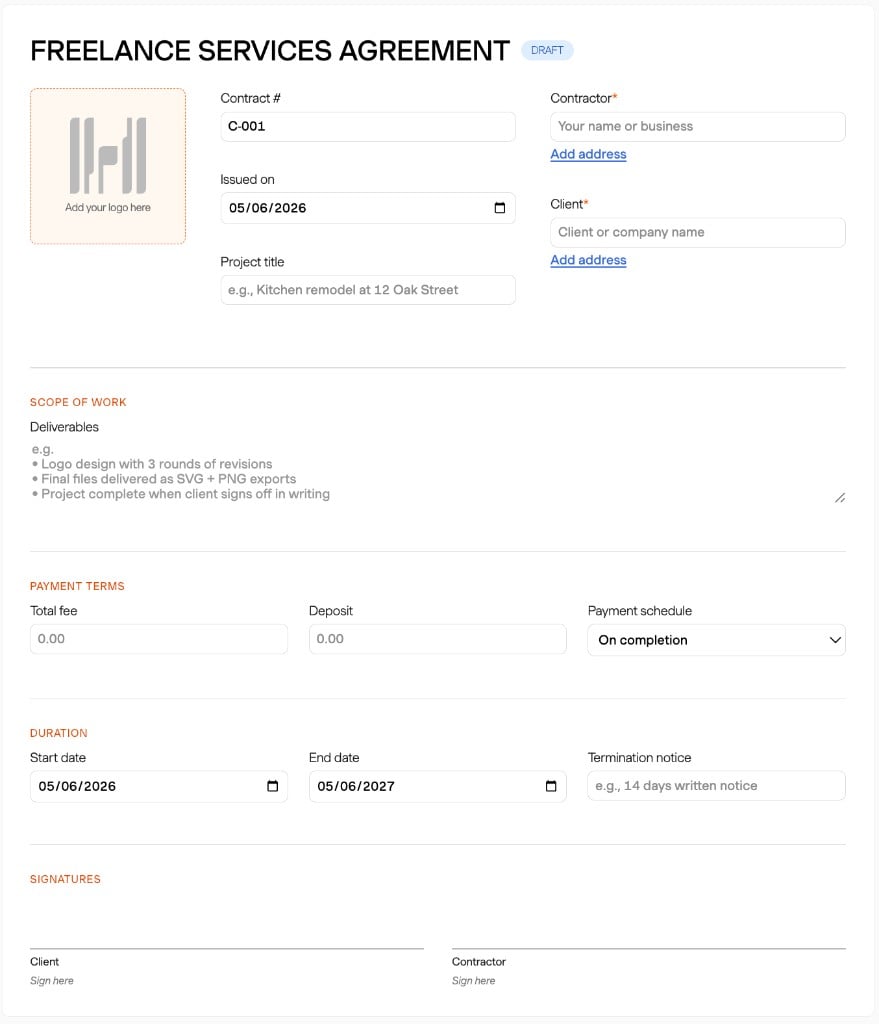
AGREEMENT DRAFT

Add your logo here

Scope of work

Payment terms

Duration

Signatures

Client

Sign here

Contractor

Sign here

Get paid via:
Credit card / Debit card
ACH
Wire transfer

Customize contract

Appearance

Add a logo
Show contract title

Contract settings

Include payment terms Total fee, deposit, and schedule
Include termination clause Notice required to end the contract
Include signature blocks Both parties sign at the bottom

Understanding Italian Real Estate Contracts

Italian real estate contracts are guided by the Italian Civil Code (Codice Civile), which provides comprehensive rules that reduce the need for extensive clauses. A key component of these contracts is the principle of "buona fede" or good faith, which requires parties to act honestly and inform each other of any potential cause for contract invalidity. This principle is crucial during negotiations and drafting, ensuring transparency and fairness.

Italian contracts tend to be more concise than those in common law countries due to this codified approach. However, it's essential to include specific clauses such as property descriptions, payment terms, and conditions for default or breach. For real estate transactions, including a clause for arbitration can be beneficial, as it allows for disputes to be settled outside of court, provided it's in writing and approved as per Article 1341(2) of the Civil Code.

Moreover, contracts must comply with local notarization requirements, particularly for property transfers. Notarization ensures the contract's legality and aids in preventing fraud, as notarized agreements are necessary for the registration of property rights in Italy.

Essential Clauses in an Italian Real Estate Contract

When drafting a real estate contract in Italy, several key clauses must be included to ensure legal compliance and protection. Liability clauses that define the responsibilities and potential risks for each party are essential. Additionally, clauses regarding confidentiality and termination terms help safeguard the interests of both parties.

Payment structures are another critical component. Contracts should outline the payment schedule, including any advance payments, which typically should not exceed 30%. Incorporating milestone-based payments tied to specific deliverables can also protect against insolvency risks.

It's advisable to include a clause for bank guarantees (fideiussioni bancarie) that cover a portion of the contract value, providing security for the transaction. Furthermore, with the ongoing digitalization in Italy, integrating electronic signature options into contracts can streamline the process, ensuring quicker execution and compliance with modern business practices.

Navigating Legal Requirements and Compliance

Compliance with Italian legal requirements is vital when drafting real estate contracts. According to the Civil Code, contracts must reflect the principle of "causa", which ensures that the contract has a legitimate socio-economic purpose. This principle, combined with "buona fede", ensures contracts are fair and equitable.

Real estate contracts in Italy must also comply with urban planning regulations, which can vary significantly across different regions. Therefore, it is crucial to conduct due diligence to ensure that the property adheres to local zoning laws and building codes before finalizing the contract.

Additionally, understanding the tax obligations associated with real estate transactions is essential. While not a direct component of the contract, ensuring that all parties are aware of their tax liabilities can prevent future disputes. Consulting with a legal professional can provide clarity and help navigate these complex areas, ensuring the contract's validity and effectiveness.

Legal Support and Professional Drafting

Given the complexity of Italian real estate contracts, professional legal support is often invaluable. The cost of professional contract review in Italy generally ranges from €2,000 to €5,000, which is a prudent investment compared to potential litigation costs, which can be significantly higher and more uncertain.

Legal professionals can ensure that contracts are comprehensive and compliant with all relevant laws. They can also help customize standard templates to fit specific needs, avoiding common pitfalls like non-customizable templates or overly complex jargon that can lead to misunderstandings.

Furthermore, leveraging digital tools for contract management can enhance efficiency. While Harvest does not offer specific contract drafting capabilities, it supports related workflows such as time tracking and invoicing, which are crucial once the contract is in place, ensuring smooth project execution and financial management.

Contract Templates with Harvest

Harvest aids in workflow management with features like time tracking and invoicing, complementing Italian contract needs.

Screenshot of Italian contract template in Harvest.

Contract Template in Italian FAQs

  • An Italian real estate contract should include clauses on liability, confidentiality, payment terms, and termination. It's also crucial to outline payment structures, such as advance payments and bank guarantees, to secure the transaction.

  • Yes, for property transfers, Italian contracts must be notarized to ensure legality and to facilitate the registration of property rights. Notarization helps prevent fraud and ensures compliance with local laws.

  • "Buona fede" or good faith is a key principle in Italian contract law, requiring parties to act honestly during negotiations and drafting. It ensures transparency and fairness, reducing potential disputes.

  • Bank guarantees (fideiussioni bancarie) in Italy act as a security measure, covering 10-30% of the contract value. They provide immediate payment protection without needing to prove a breach.

  • While not part of the contract, parties should be aware of tax liabilities associated with real estate transactions, as these can affect the overall financial obligations of the parties involved.

  • Professional legal support ensures that contracts comply with Italian laws, are comprehensive, and customized to specific needs. This reduces the risk of costly litigation due to potential contract disputes.