
Harvest
Contracts
Sign up

Contract Template in Japanese

Navigating the complexities of contract templates in Japan can be daunting. Harvest simplifies your workflow by helping manage time, expenses, and invoices, so you can focus on local legal compliance.

Start from a template

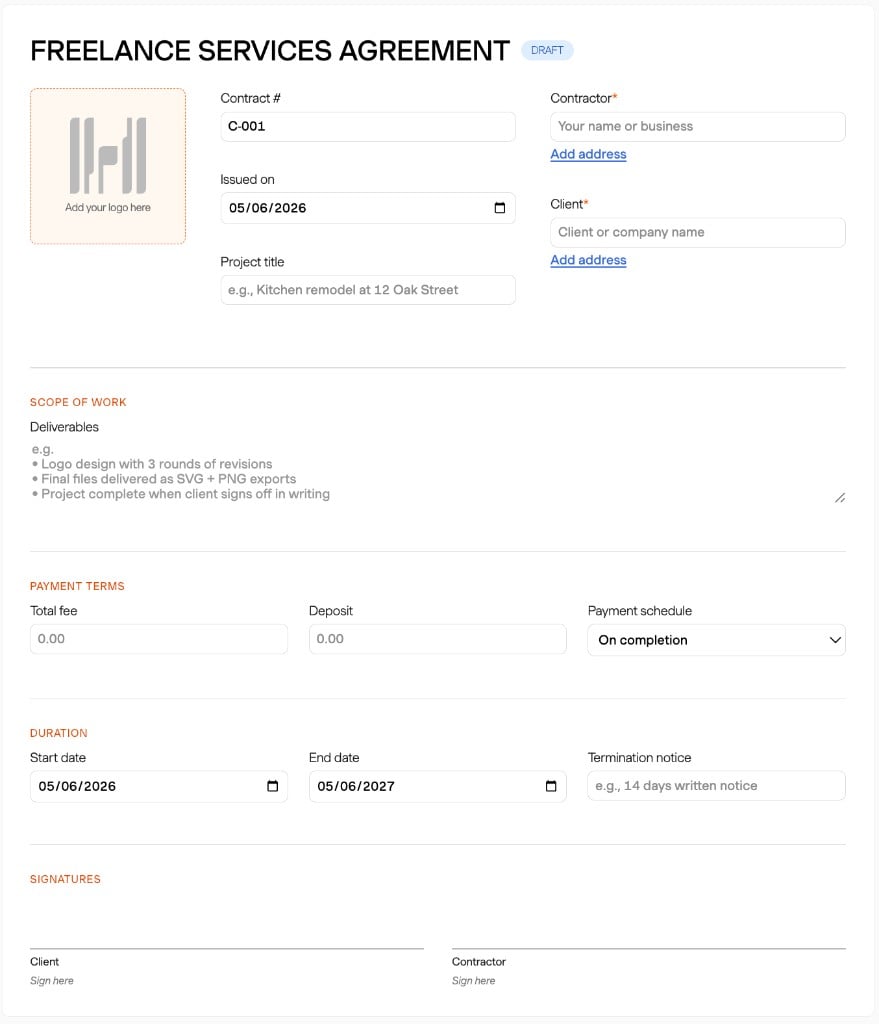
AGREEMENT DRAFT

Add your logo here

Scope of work

Payment terms

Duration

Signatures

Client

Sign here

Contractor

Sign here

Get paid via:
Credit card / Debit card
ACH
Wire transfer

Customize contract

Appearance

Add a logo
Show contract title

Contract settings

Include payment terms Total fee, deposit, and schedule
Include termination clause Notice required to end the contract
Include signature blocks Both parties sign at the bottom

Understanding Contract Templates in Japan

Creating a contract template in Japan requires careful consideration of legal and cultural norms. Japan operates under a Civil Law system, where contracts are interpreted based on statutory laws, making written agreements strongly preferred. Unlike common law systems, the concept of "consideration" is not necessary for a contract's validity in Japan. However, contracts must still include key elements such as the governing law, jurisdiction, and specific clauses tailored to the Japanese context.

To ensure compliance, it's crucial to include essential clauses like governing law and jurisdiction, termination conditions, and clear employment terms. Japanese contracts often require explicit language to outline the job description, remuneration, and termination conditions. Non-compete clauses, while common, are difficult to enforce under Japanese labor law and require precise language to be effective.

Localization is key. Foreign businesses entering the Japanese market should adapt their contracts to align with local legal norms. Engaging Japanese legal counsel for review is recommended to avoid misalignments and ensure enforceability. This is particularly important for employment contracts, which must adhere to Japanese labor standards and cultural expectations.

Legal and Compliance Considerations

Japan's legal landscape for contracts is shaped by several critical laws, including the Act on Electronic Signatures and Certification Business, which gives electronic signatures the same legal standing as traditional signatures. However, some documents, like real estate agreements and wills, cannot be executed electronically, so understanding these nuances is vital.

Recent legislative changes, such as the Japan Freelance Act effective November 2024, mandate clear transaction terms and timely payments for freelancers, reflecting a trend towards stronger protections. The Proper Transactions Act, effective January 2026, imposes obligations on main contractors to ensure fair pricing and prompt payments to subcontractors, highlighting the importance of compliance with evolving regulations.

Contracts should explicitly state the governing law and jurisdiction, typically Japanese law and courts, to avoid disputes. Legal experts recommend drafting contracts entirely in Japanese to prevent misinterpretation and ensure legal certainty. Bilingual contracts can introduce legal uncertainty, even with prevailing language clauses.

Practical Tips for Crafting Effective Contracts

When crafting a contract template for use in Japan, prioritize clarity and adaptability to local norms. Japanese contracts tend to have a formal structure, and plain language is preferred over legal jargon to prevent disputes. Including a "prevailing language" clause in bilingual contracts can clarify which version governs in case of conflict.

Essential clauses for Japanese contracts include termination conditions, job descriptions, and remuneration details. Avoid vague provisions, as Japanese courts may interpret them conservatively. For employment contracts, clearly define job roles, compensation packages, and termination processes to meet Japanese labor standards.

Integrating digital processes can streamline contract management. Utilizing e-signature solutions and digital HR systems can reduce manual efforts, ensure compliance, and facilitate the onboarding process. This integration helps maintain consistency and reduces the risk of errors in contract execution.

Challenges and Solutions for Foreign Businesses

Foreign businesses often face challenges when adapting contract templates to the Japanese market. Misalignment with local laws can lead to unenforceable provisions and potential disputes. It's essential to understand the cultural context and legal norms, such as the preference for written contracts and the intricate details of Japanese labor laws.

One common pitfall is "false outsourcing," where a worker is treated as an employee under an outsourcing contract, circumventing social insurance obligations. To avoid such issues, businesses should ensure their contracts clearly differentiate between employment and outsourcing arrangements.

Engaging local legal counsel can help foreign businesses navigate these complexities. They can provide insights into essential clauses and ensure that contracts are compliant with Japanese laws. This step is crucial for businesses looking to establish a reliable and legally sound presence in Japan.

The Role of Digital Transformation in Contracts

Japan's digital transformation has significantly impacted contract management, particularly with the rise of electronic signatures. Legally recognized since 2000, e-signatures have become more prevalent, especially in tech-forward industries. The Digital Society Formation Development Act of 2021 further expanded the scope of digital contracting, allowing electronic documents for a wider range of transactions.

While traditional hanko seals remain common, the dual-track approach of combining electronic and traditional methods reflects the evolving landscape. Embracing digital solutions can enhance efficiency, streamline processes, and ensure compliance with modern legal standards.

Businesses should leverage these digital advancements to improve contract management. By integrating e-signature solutions and aligning with digital-first processes, companies can reduce manual effort, enhance compliance, and position themselves for success in the Japanese market.

Simplify Contract Management with Harvest

Harvest helps streamline your contract workflow, focusing on time tracking and expenses, while you ensure legal compliance in Japan.

Screenshot of Harvest's contract management tool in use for Japanese contracts.

Contract Template in Japanese FAQs

  • Essential elements of a contract in Japan include governing law and jurisdiction, termination conditions, and specific clauses tailored to the Japanese legal context. Employment contracts must clearly outline job descriptions, remuneration, and termination procedures.

  • Yes, electronic signatures are legally recognized in Japan under the Act on Electronic Signatures and Certification Business. They hold the same validity as traditional signatures, although certain documents, like real estate agreements, cannot be executed electronically.

  • Localization is crucial because it ensures that contract templates align with Japanese legal norms and cultural expectations. Using localized contracts helps avoid unenforceable provisions and potential disputes, especially for foreign businesses entering the Japanese market.

  • In Japan, contracts are often viewed as a symbol of mutual trust rather than merely a legally binding tool. Japanese courts interpret contracts with an emphasis on the overall intent, and "gentlemen's clauses" are common, suggesting resolving doubts through consultation.

  • Foreign businesses should engage Japanese legal counsel to review and adapt contracts to local norms. It's important to draft contracts entirely in Japanese to prevent legal uncertainty and ensure compliance with Japanese law.

  • Using foreign templates without localization can lead to provisions that misalign with Japanese law, creating potential misunderstandings and disputes. It's vital to adapt contracts to Japanese legal standards and cultural expectations.