
Harvest
Contracts
Sign up

Create a Web Development Contract

Poorly drafted web development contracts can lead to payment disputes and project delays. Harvest helps manage project budgets, track time, and invoice clients efficiently.

Start from a template

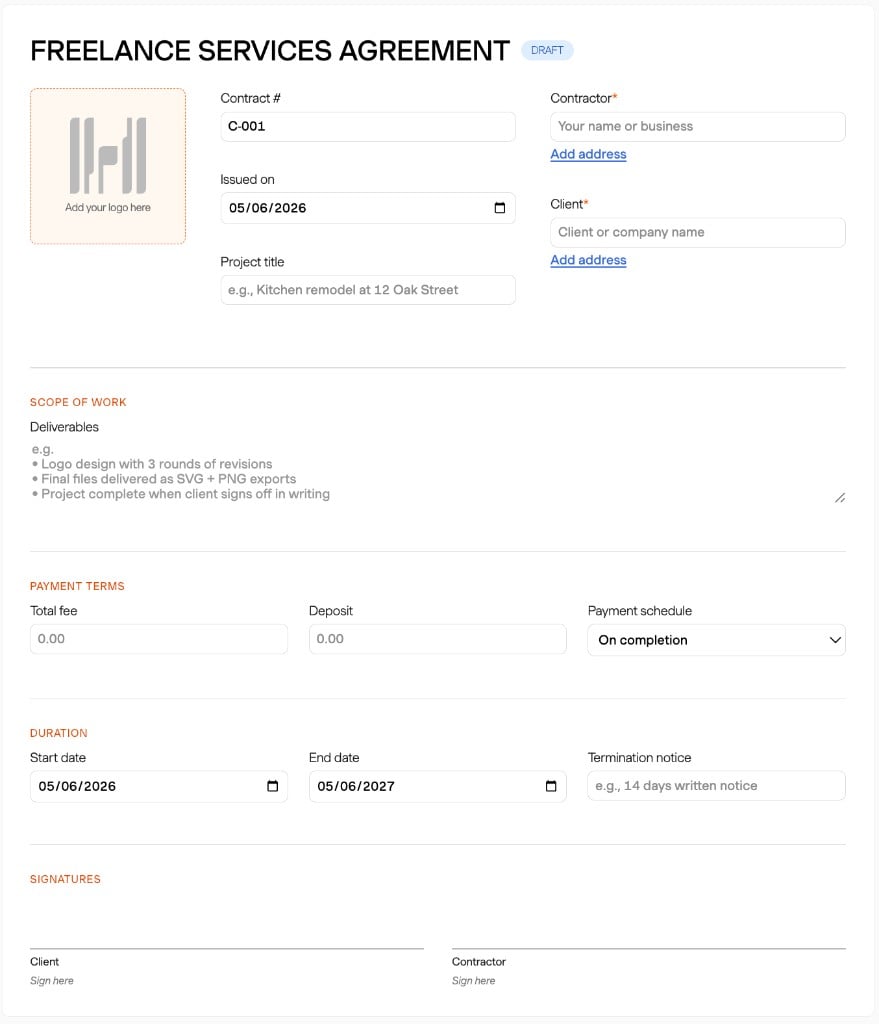
AGREEMENT DRAFT

Add your logo here

Scope of work

Payment terms

Duration

Signatures

Client

Sign here

Contractor

Sign here

Get paid via:
Credit card / Debit card
ACH
Wire transfer

Customize contract

Appearance

Add a logo
Show contract title

Contract settings

Include payment terms Total fee, deposit, and schedule
Include termination clause Notice required to end the contract
Include signature blocks Both parties sign at the bottom

Essential Elements of a Web Development Contract

A comprehensive web development contract is crucial for setting clear expectations and protecting both parties involved. At its core, such a contract should outline the project scope, deliverables, payment terms, and timelines. Without these elements, developers and clients might face misunderstandings. For instance, one industry case highlighted an agency that curbed endless client revisions by defining scope and termination terms upfront, ensuring clarity and accountability.

Essential clauses include payment structures, intellectual property rights, and confidentiality agreements. According to industry experts, outlining specific deliverables and timelines prevents 'scope creep' and ensures projects stay on track. Clear payment terms can prevent disputes, with some contracts imposing a 1.5-2% monthly interest on late payments. Legal experts also recommend including intellectual property transfer clauses to avoid future ownership disputes.

Customizing Your Web Development Contract

Customizing a web development contract to fit specific project needs is vital. Each contract should consider unique aspects such as project size, client expectations, and regulatory requirements. For example, a finance company successfully customized their contract by specifying frameworks and libraries to be used, which led to positive client feedback and extended cooperation.

To customize effectively, begin by clearly defining the scope of work, including the number of pages, design specifics, and technical requirements. This prevents misunderstandings and ensures both parties have a mutual understanding from the outset. Additionally, addressing legal and compliance needs, such as GDPR or CCPA, is crucial, especially for projects involving sensitive data. Failing to do so can result in significant fines, as seen in a 2021 case where a company faced a $1.5 million penalty for GDPR non-compliance.

Legal Considerations in Web Development Contracts

Understanding legal considerations in web development contracts is critical to avoiding costly disputes. Compliance with laws such as the GDPR or Section 508 of the Rehabilitation Act is non-negotiable. For instance, non-compliance with GDPR can result in fines up to €20 million or 4% of global turnover, emphasizing the importance of including data protection clauses in contracts.

Moreover, contracts should address intellectual property rights explicitly. Under English law, the developer typically retains IP rights unless otherwise stated. Therefore, contracts must clearly transfer these rights to the client upon project completion. Additionally, accessibility standards like WCAG 2.0 Level AA should be specified to avoid penalties under regulations like the ADA. In the US, ADA violations can incur fines up to $75,000 for the first violation, underscoring the importance of including accessibility clauses in contracts.

Leveraging Harvest for Project Management

While Harvest is not a dedicated contract management tool, it offers valuable features for managing web development projects effectively. Harvest excels in tracking project budgets and time, providing real-time visibility into project progress. This helps developers stay on budget and schedule, minimizing the risk of scope creep.

Harvest also supports invoicing with flexible payment terms, whether based on time-and-materials or fixed fees. This flexibility allows developers to manage cash flow efficiently and ensures timely payments. By using Harvest to track time and manage project budgets, developers can focus on delivering quality work while maintaining financial clarity.

Manage Contracts with Harvest

See how Harvest can help manage web development project budgets and timelines efficiently.

Screenshot of Harvest managing a web development project contract.

Create a Web Development Contract FAQs

  • A web development contract should include the project scope, payment terms, timelines, and intellectual property rights. It should also address confidentiality and compliance with regulations like GDPR.

  • To customize your contract, define the project scope and deliverables clearly. Include specific clauses for legal compliance, intellectual property transfer, and payment structures tailored to the project's needs.

  • Include data protection clauses to comply with GDPR or CCPA, intellectual property rights transfer, and accessibility requirements like WCAG 2.0 Level AA to avoid legal penalties.

  • Harvest provides tools for tracking project budgets and time, offering real-time insights that help developers manage projects efficiently. It supports invoicing with flexible payment terms.

  • Contracts set clear expectations, define deliverables, and protect both parties from disputes. They ensure payment terms are understood and that intellectual property rights are clearly defined.

  • Avoid vague scope definitions and unclear payment terms. Ensure intellectual property rights are transferred to the client to prevent future disputes. Include compliance clauses to avoid legal penalties.

  • Define payment structures clearly, including rates, billing frequency, and penalties for late payments. Harvest supports invoicing with flexible payment terms to manage cash flow.