
Harvest
Contracts
Sign up

Contract Template in Greek

Navigating Greek contract law can be complex. Harvest provides a starting point with customizable contract templates, ensuring compliance with Greek legal standards.

Start from a template

AGREEMENT DRAFT

Add your logo here

Scope of work

Payment terms

Duration

Signatures

Client

Sign here

Contractor

Sign here

Get paid via:
Credit card / Debit card
ACH
Wire transfer

Customize contract

Appearance

Add a logo
Show contract title

Contract settings

Include payment terms Total fee, deposit, and schedule
Include termination clause Notice required to end the contract
Include signature blocks Both parties sign at the bottom

Understanding Greek Contract Essentials

Creating a valid contract in Greece requires attention to several key elements, ensuring that the agreement is legally sound and enforceable. Under the Greek Civil Code, a contract must include a clear declaration of will, mutual consent, legal capacity of the parties involved, and a lawful and definite subject matter. Additionally, any legally required formalities, such as a written document or a notarial deed, must be strictly observed. For instance, certain real estate contracts like long-term commercial leases require execution via a notarial deed and registration to be valid against third parties.

Moreover, the principle of freedom of contract allows parties significant autonomy in defining their terms, as long as these do not violate mandatory legal provisions, such as criminal or tax laws. Hence, understanding and incorporating these elements correctly is vital for ensuring the contract's validity and enforceability.

The Role of Electronic Signatures in Greek Contracts

Electronic signatures have been legally recognized in Greece since 2001, with significant advancements following the adoption of the eIDAS Regulation (EU 910/2014) in 2016. This regulation categorizes electronic signatures into three types: Standard Electronic Signature (SES), Advanced Electronic Signature (AES), and Qualified Electronic Signature (QES). Among these, QES holds the same legal effect as a handwritten signature, providing a robust option for legally binding agreements.

The increasing adoption of electronic signatures is part of Greece's broader digital transformation, which also includes mandatory e-invoicing for business-to-government contracts starting in 2023. This shift not only enhances efficiency but also aligns Greek business practices with modern technological standards, offering significant potential for cost savings and streamlined contract management.

Customizing Contract Templates for Greek Law

When customizing contract templates to comply with Greek law, it is essential to consider specific legal requirements and industry standards. For example, employment contracts must include key terms such as the identities of the parties, job title, start and end dates, and salary, provided in writing within one week of employment commencement. Contracts lacking these essential elements may face legal challenges.

Furthermore, while Greek law permits oral agreements, written contracts are strongly recommended for clarity and enforceability. This is especially relevant for complex agreements where detailed terms and conditions need to be clearly communicated and agreed upon by all parties. By incorporating these considerations, businesses can tailor their contract templates effectively to meet Greek legal standards.

Navigating Greek Legal and Compliance Standards

Understanding Greek legal and compliance standards is crucial for effective contract management. Greek contract law, primarily governed by the Greek Civil Code, emphasizes principles such as freedom of contract and good faith. These principles allow for significant flexibility in contract terms, provided they do not breach statutory requirements.

Compliance with these standards ensures that contracts are not only legally valid but also safeguard the parties' interests. For instance, ensuring that standard contract terms do not create an unreasonable disadvantage is essential, as Greek law prohibits the abusive exercise of rights. By adhering to these guidelines, businesses can navigate the complexities of Greek contract law with confidence.

Harvest's Greek Contract Templates

Explore Harvest's customizable contract templates designed for Greek legal standards. Ensure compliance and clarity in your agreements.

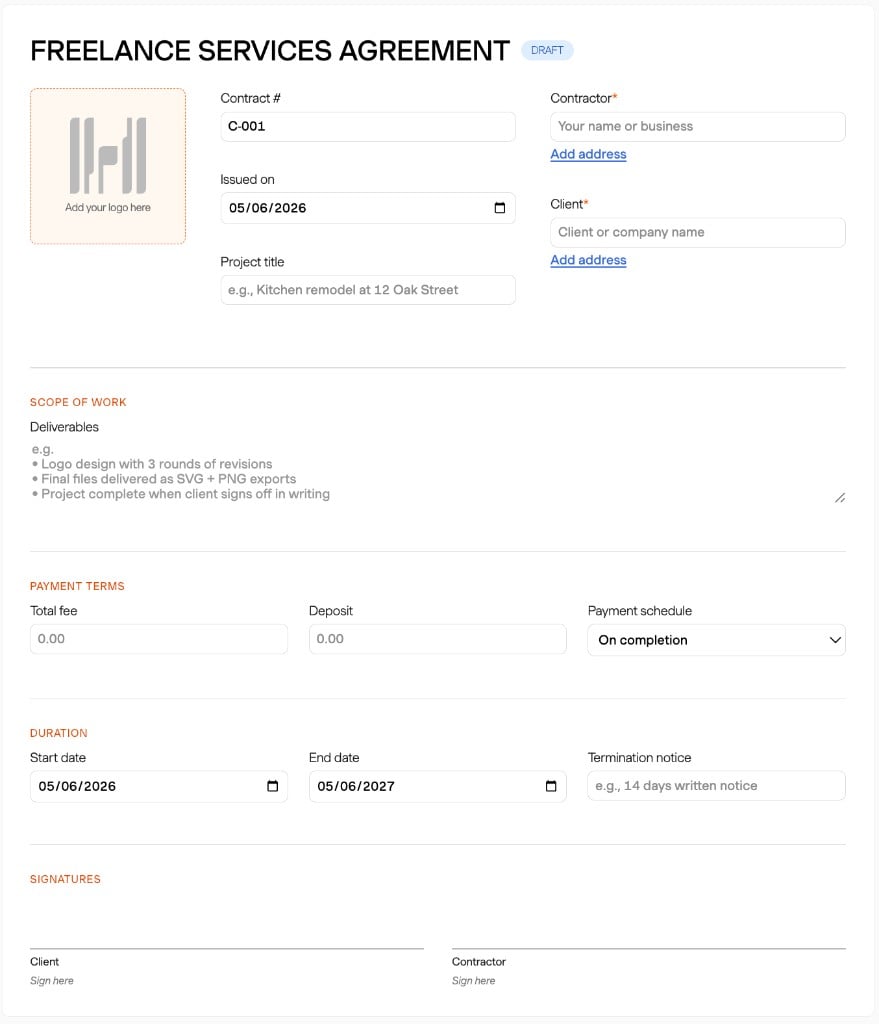
Screenshot of Harvest's contract template tool in Greek.

Contract Template in Greek FAQs

  • A Greek contract must include a clear declaration of will, mutual consent, legal capacity of the parties, and a lawful subject matter. Legally required formalities, such as a written document or notarial deed, must also be observed.

  • Yes, electronic signatures are legally recognized in Greece, with Qualified Electronic Signatures (QES) holding the same legal status as handwritten signatures. This is regulated under the eIDAS Regulation and Greek Law 4727/2020.

  • To customize a contract template for Greek law, include all required elements, such as party identities and terms. Written agreements are recommended for clarity and enforceability, especially for complex contracts.

  • Greek contract law is governed by the Greek Civil Code, emphasizing freedom of contract and good faith. Ensure terms do not violate statutory requirements to avoid invalidation of the contract.

  • Greece recognizes three types of electronic signatures: Standard Electronic Signature (SES), Advanced Electronic Signature (AES), and Qualified Electronic Signature (QES), with QES being legally equivalent to handwritten signatures.

  • While not legally required, translating contracts into Greek may be necessary for enforcement in Greek courts, provided all parties understand the terms.

  • Common mistakes include using outdated probationary periods and miscalculating severance pay. Ensure compliance with Greek standards, such as the "annualized monthly salary" formula for severance calculations.