
Harvest
Contracts
Sign up

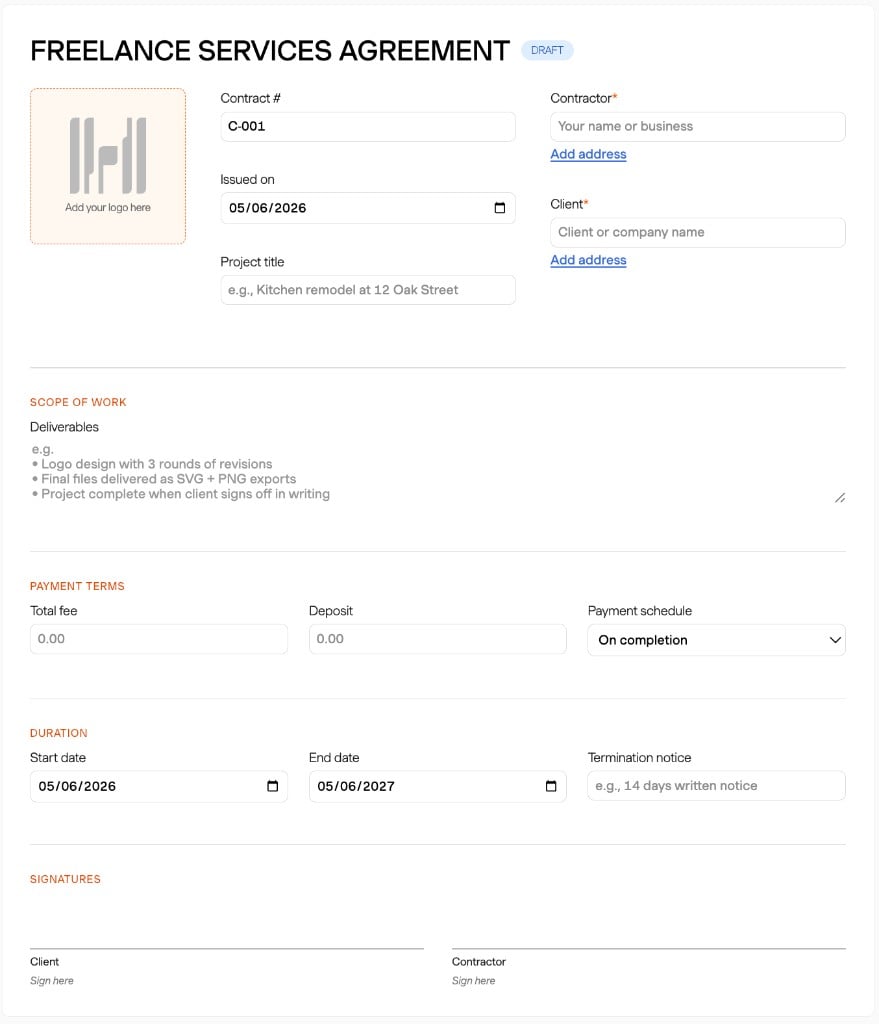
Create a Statement of Work

Harvest supports project management by tracking time and linking payment terms to deliverables, ensuring financial clarity and aiding in successful project execution.

Start from a template

AGREEMENT DRAFT

Add your logo here

Scope of work

Payment terms

Duration

Signatures

Client

Sign here

Contractor

Sign here

Get paid via:
Credit card / Debit card
ACH
Wire transfer

Customize contract

Appearance

Add a logo
Show contract title

Contract settings

Include payment terms Total fee, deposit, and schedule
Include termination clause Notice required to end the contract
Include signature blocks Both parties sign at the bottom

Understanding the Core Components of a Statement of Work

Creating a Statement of Work (SOW) is a critical step in project management, serving as the foundational document that outlines project objectives, scope, deliverables, and terms. A well-defined SOW can significantly enhance project outcomes, reducing failure rates by up to 28% according to industry studies. The core components of an SOW include project objectives, a detailed scope of work, specific tasks and deliverables, timelines with milestones, roles and responsibilities, performance standards, acceptance criteria, payment terms, and a change management process.

Each component plays a vital role in aligning stakeholders and ensuring clarity. For example, clearly defined objectives and scope help prevent misunderstandings, while specific tasks and deliverables ensure all parties are on the same page. Timelines and milestones provide a roadmap for project progress, and acceptance criteria set the benchmarks for success. Although Harvest does not create SOWs, it supports project management by linking payment terms to deliverables, ensuring financial clarity through its invoicing capabilities.

Crafting an Effective SOW: Best Practices and Common Mistakes

Effective SOWs transform subjective expectations into objective, measurable criteria, which is crucial for successful project management. A key best practice is to involve all stakeholders early in the drafting process, ensuring comprehensive input and preventing overlooked requirements. Clear, unambiguous language is essential; vague terms like "reasonable effort" should be replaced with specific, measurable criteria. This helps avoid misinterpretations and potential disputes.

Common mistakes in SOW creation include failing to manage scope creep and omitting critical details. To mitigate these issues, proactively define project boundaries and include a robust change management process. Documenting all assumptions and dependencies is also critical to prevent misunderstandings. While Harvest doesn't manage SOWs directly, it supports project management by tracking time and budgets, helping you monitor project progress and financial aspects effectively.

Legal Considerations and Compliance in SOW Creation

Legal compliance is a crucial aspect of creating a Statement of Work. In regions like Australia, legal risks such as "sham contracting" can lead to significant penalties, emphasizing the importance of a well-crafted SOW. Globally, non-compliance can result in fines averaging $145.33 million, highlighting the necessity of adhering to regulatory standards.

To ensure compliance, an SOW should detail services, deliverables, and payment terms clearly, serving as a legal reference in case of disputes. Recent trends show stricter enforcement and higher penalties, making it essential to integrate compliance considerations from the onset. Although Harvest does not manage legal compliance directly, it provides tools to track project budgets and link payment terms to deliverables, aiding financial clarity and accountability.

Integrating SOWs with Project Management Tools

Integrating Statements of Work with project management tools enhances visibility, communication, and collaboration among stakeholders. Modern trends indicate a shift towards flexible, adaptable SOWs that integrate with software for real-time updates and improved project management. Such integration helps in tracking progress, managing budgets, and maintaining clarity across all project phases.

While Harvest does not create SOWs, it supports the project workflow by providing insights into project progress and budget management. By linking payment terms to deliverables, Harvest ensures that financial aspects are clear and aligned with project objectives. This integration can transform SOW management from a transactional task into a strategic advantage, enhancing project efficiency and reducing the risk of disputes.

Craft Your Statement of Work with Harvest

Explore how Harvest supports project management by tracking time and linking payment terms to deliverables, enhancing financial clarity.

Screenshot of Harvest's project management tracking tools

Create a Statement of Work FAQs

  • Key components of a Statement of Work (SOW) include project objectives, scope, deliverables, timelines, roles, responsibilities, performance standards, and payment terms. Each component ensures clarity and alignment among stakeholders.

  • To define the scope and objectives, gather detailed requirements from stakeholders, use clear, specific language, and establish measurable criteria. This prevents misunderstandings and aligns all parties on project goals.

  • Avoid using vague language and failing to manage scope creep. Clearly define project boundaries, include a change management process, and document all assumptions and dependencies to prevent misunderstandings.

  • Harvest supports project management by tracking time and budgets, providing insights into project progress, and linking payment terms to deliverables. This ensures financial clarity and aids in successful project execution.

  • Harvest does not create Statements of Work directly. However, it supports project management by tracking budgets and linking payment terms to deliverables, enhancing financial clarity.

  • Legal considerations include ensuring clear terms for services, deliverables, and payment. Non-compliance can result in significant fines, making it essential to integrate compliance from the onset of SOW creation.

  • Integrating SOWs with project management tools allows for real-time updates, improved communication, and enhanced collaboration. Harvest aids this process by providing project tracking and financial management capabilities.