
Harvest
Contracts
Sign up

Create a Scope of Work

Scope creep affects 50% of projects, leading to cost overruns. Harvest helps contractors track time and manage budgets to mitigate these risks.

Start from a template

AGREEMENT DRAFT

Add your logo here

Scope of work

Payment terms

Duration

Signatures

Client

Sign here

Contractor

Sign here

Get paid via:
Credit card / Debit card
ACH
Wire transfer

Customize contract

Appearance

Add a logo
Show contract title

Contract settings

Include payment terms Total fee, deposit, and schedule
Include termination clause Notice required to end the contract
Include signature blocks Both parties sign at the bottom

Understanding the Key Components of a Scope of Work

A comprehensive Scope of Work (SOW) is essential in project management as it clearly outlines the deliverables, tasks, and responsibilities involved in a project. This document acts as a roadmap, helping all stakeholders align their expectations and ensuring the project stays on track. According to industry research, 52% of projects experience scope creep, which can lead to cost overruns and delays. A well-defined SOW can mitigate these risks by providing a detailed overview of what the project entails and how it will be executed.

Key components of an effective SOW include project objectives, deliverables, timelines, and roles and responsibilities. Listing these elements clearly helps prevent misunderstandings and ensures that all parties are on the same page. Additionally, identifying any assumptions and constraints within the SOW can help set realistic expectations and avoid potential conflicts. High-performing organizations that utilize clear project scopes and proven management methods tend to lose 28 times less money due to successful strategic initiatives.

Structuring a Scope of Work Document

Structuring a Scope of Work document requires attention to detail and a clear understanding of the project at hand. A well-structured SOW should start with a project overview, followed by specific objectives and deliverables. This ensures that everyone involved understands the end goals and the means to achieve them. It's important to include detailed descriptions of each deliverable, along with acceptance criteria to clarify how the final product will be evaluated.

Timelines and milestones are crucial in a SOW, as they provide a schedule for when each deliverable should be completed. Breaking the project down into smaller, manageable components—known as scope decomposition—helps in identifying dependencies and assigning tasks effectively. Furthermore, a formal change control process should be integrated to manage any changes in scope, which is vital for preventing scope creep. Having clear documentation not only aids in risk management but also serves as a contractual reference in case of disputes.

Avoiding Common Mistakes in Scope of Work Creation

Creating a Scope of Work is a meticulous process that requires precision and clarity. One common mistake is leaving room for ambiguity, which can lead to scope creep. In fact, 52% of projects experience this issue, often resulting in budget overruns. To avoid this, ensure that the SOW is specific and leaves no room for improvisation. Every aspect of the project should be documented, including detailed cost estimates and resource allocations.

Another frequent error is poor estimation of project costs and timelines. This can be mitigated by improving estimation accuracy and establishing clear baselines. Implementing a formal change control process is also crucial for managing any adjustments to the project scope, ensuring transparency and accountability. By addressing these common pitfalls, organizations can optimize their resources and achieve their project goals more effectively.

Ensuring Stakeholder Alignment in the Scope of Work

Stakeholder alignment is essential for the success of any project, and the Scope of Work plays a pivotal role in achieving this. Engaging stakeholders early in the scope definition process helps align their expectations with the project objectives. This involvement is crucial, as it ensures that everyone is committed to the same goals and understands their roles and responsibilities.

Effective communication channels and tools facilitate real-time collaboration and feedback, enabling stakeholders to stay informed about project progress and any changes in scope. While Harvest excels in tracking time and managing project budgets, it does not specifically handle stakeholder sign-offs on project scopes. However, by using project management software that supports stakeholder engagement, organizations can enhance transparency and improve project outcomes.

The Role of Technology in Scope of Work Management

Technology plays a significant role in managing the Scope of Work, offering tools that streamline and automate various project management activities. Project management software can aid in requirements management, task tracking, and collaboration, providing a centralized platform for all project-related activities. Artificial intelligence and data analytics are increasingly used to identify early signs of scope creep, offering real-time insights that support informed decision-making.

Although Harvest does not provide specific tools for creating or managing a Scope of Work, it supports contractors by helping them track time and manage project budgets effectively. By integrating technology into scope management, organizations can enhance productivity and reduce the risk of scope creep, ultimately leading to more successful project outcomes.

Create a Scope of Work with Harvest

Harvest helps contractors track time and manage project budgets effectively, reducing risks of scope creep and budget overruns.

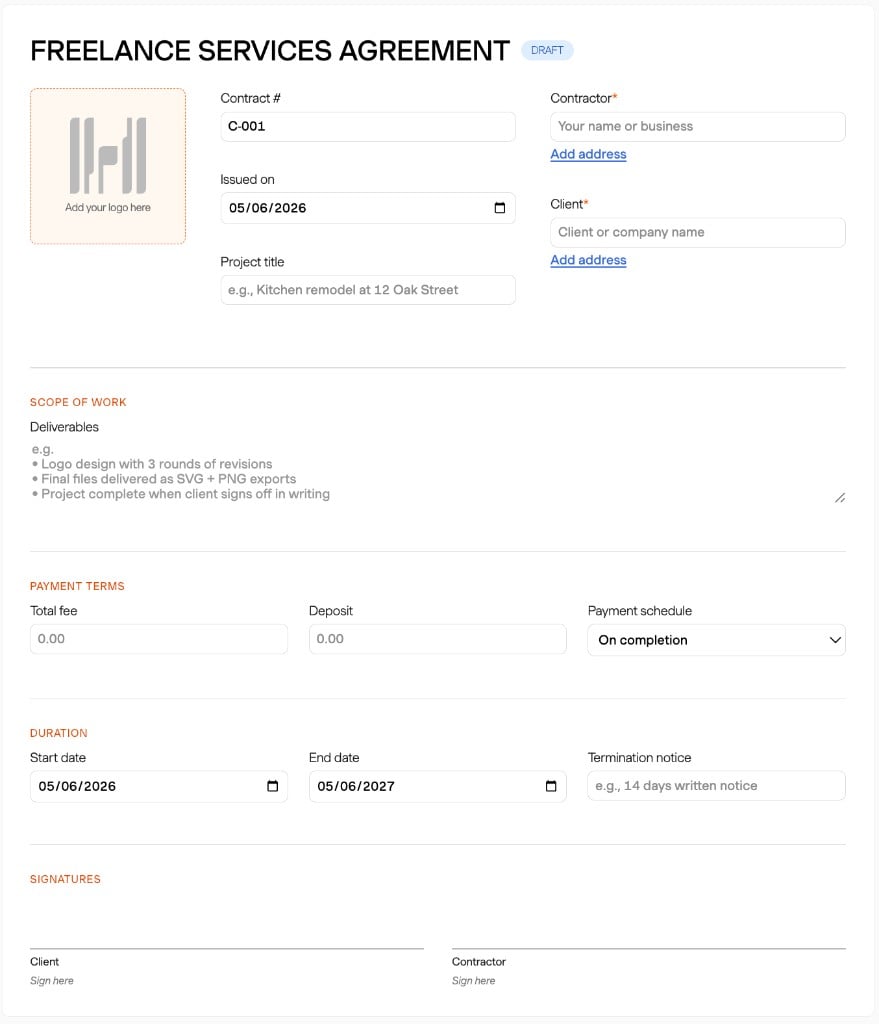
Scope of Work document interface in Harvest

Create a Scope of Work FAQs

  • The key components of a Scope of Work include project objectives, deliverables, timelines, and roles and responsibilities. These elements help in aligning expectations and preventing misunderstandings among stakeholders.

  • To structure a Scope of Work document, start with a project overview, followed by detailed objectives and deliverables. Include timelines, milestones, and acceptance criteria to provide a clear roadmap for the project.

  • Common mistakes include leaving room for ambiguity, poor estimation of costs and timelines, and lack of a formal change control process. These can lead to scope creep and budget overruns. Ensure specificity and clear documentation to avoid these pitfalls.

  • Technology aids in managing a Scope of Work by providing tools for task tracking, collaboration, and requirements management. AI and data analytics can identify early signs of scope creep, enabling informed decision-making.

  • Ensuring stakeholder alignment involves engaging them early in the scope definition process. Effective communication channels and real-time feedback help align expectations with project objectives.

  • A Scope of Work is crucial in project management as it defines the project's deliverables, tasks, and responsibilities. It helps align stakeholder expectations and prevents scope creep, reducing the risk of cost overruns.

  • Scope creep refers to the uncontrolled expansion of project requirements. It can be prevented by creating a clear Scope of Work, implementing a formal change control process, and ensuring stakeholder alignment.