Understanding Time Tracking in Consulting
In consulting, time tracking is more than just keeping tabs on hours worked. It’s a strategic tool that ensures effective project management and profitability. By meticulously recording time spent on tasks, consulting firms can better allocate resources, forecast project timelines, and ultimately deliver projects more efficiently.
For consultants, time tracking is crucial because it provides visibility into how time is consumed across various projects. This visibility is not only useful for project managers to adjust workloads but also essential for clients who need transparent billing. A consulting firm that fails to track time accurately could lose significant revenue, as inefficient time tracking systems can lead to a loss of 15-25% of billable hours, equating to a substantial financial impact for many firms timerewards.com.
Moreover, time tracking forms the backbone of project management by enabling better planning and execution. It allows firms to pinpoint where projects may be going over budget or where additional resources are needed, fostering a proactive rather than reactive approach. In industries like engineering and legal services, where every billable hour counts, precise time tracking often translates to improved project outcomes and increased client satisfaction.
Ultimately, understanding and implementing effective time tracking in consulting is vital for maintaining competitive advantage. It not only helps in project management but also serves as a reflection of how well a consulting firm operates. By investing in effective time tracking systems, firms can avoid revenue leakage and ensure that they are compensated fairly for the work they deliver.
What Are the Benefits of Time Tracking for Consultants?
Time tracking offers numerous advantages to consulting firms, chief among them being improved billing accuracy. By accurately recording every billable hour, consultants can ensure that they are compensated for all the work they perform, reducing disputes with clients over invoices. This leads to a more transparent and trusted relationship with clients, which is vital in a service-oriented industry like consulting.
Beyond billing, time tracking enhances overall project management. With precise data on how time is allocated, firms can make informed decisions about resource allocation and project timelines. According to toggl.com, proper time tracking can increase billable hour capture by 20-30% within 90 days. This boost not only improves profitability but also helps in setting realistic project deadlines and expectations for both clients and team members.
Additionally, time tracking can significantly enhance productivity within consulting teams. By analyzing time data, firms can identify bottlenecks and areas where efficiency can be improved. For example, marketing consultancies have leveraged existing data to streamline timesheet entries, making the process nearly ten times faster. This kind of efficiency not only boosts productivity but also leaves more time for consultants to focus on value-added activities.
In summary, the benefits of time tracking for consultants extend far beyond just accurate billing. It provides critical insights into project management, enhances productivity, and fosters a more efficient and transparent working environment. By adopting robust time tracking practices, consulting firms can ensure they are maximizing their revenue potential while maintaining high standards of client service.
How Time Tracking Improves Productivity
Implementing effective time tracking practices is a powerful way to enhance productivity in consulting firms. When every minute is accounted for, teams can identify inefficiencies and focus on optimizing their workflows. This leads to more strategic allocation of time and resources, ultimately boosting the firm's output.
A common misconception is that time tracking is merely a tool for monitoring employees. However, it serves a much broader purpose. According to getharvest.com, teams tracking time daily have 25% fewer billing disputes, indicating that time tracking can also enhance client satisfaction by providing accurate billing.
In practice, time tracking helps identify where delays occur and which processes require streamlining. For instance, PR firms have reported a 20% increase in profitability by reallocating time from less productive activities. This kind of insight allows teams to focus on high-impact tasks, ensuring that time is spent where it matters most.
To maximize productivity, consulting firms should encourage real-time tracking rather than retrospective entry. This practice minimizes reliance on memory, which can lead to inaccuracies and lost hours. By using tools that integrate seamlessly with existing workflows, such as Harvest, teams can track time effortlessly without disrupting their daily operations.
In conclusion, effective time tracking is a catalyst for improved productivity. It enables consulting firms to optimize their processes, reduce waste, and enhance the value they deliver to clients. By integrating time tracking into their daily routines, consulting teams can work smarter, not just harder.
Best Practices for Time Tracking in Consulting
Optimizing time tracking in consulting requires implementing best practices that ensure both efficiency and accuracy. A key starting point is to establish clear policies and guidelines. This involves defining what needs to be tracked and the level of detail required. By setting these expectations, firms can standardize their time tracking processes and reduce ambiguity.
Effective categorization of time and tasks is also essential. Firms should develop concise categories for both billable and non-billable activities, providing clear examples to minimize confusion. It's crucial to keep these categories straightforward to prevent them from becoming cumbersome for employees. According to accelo.com, integrating time tracking with project management tools can eliminate redundant data entry and improve accuracy.
Another best practice is to promote real-time tracking. Encouraging employees to start timers at the beginning of tasks rather than relying on memory can significantly enhance the accuracy of time records. This practice helps capture all billable hours and reduces the likelihood of overlooking small but significant time increments.
Providing user-friendly tools and thorough training is equally important. Choose intuitive time tracking solutions that offer multiple entry methods, such as timers, calendar sync, and mobile apps, to accommodate different work styles. Training should not only cover how to use the tools but also emphasize the benefits of accurate time tracking in improving project outcomes and client relations.
By adopting these best practices, consulting firms can ensure that their time tracking systems are not only efficient but also contribute to the overall productivity and profitability of the business. Keeping time tracking simple, consistent, and integrated into daily operations will yield significant benefits in managing projects and enhancing client satisfaction.
Common Pitfalls in Time Tracking
Consulting firms often stumble on common pitfalls when it comes to time tracking, leading to inefficiencies and revenue loss. One major mistake is relying heavily on manual entry. Over 75% of employees reportedly spend three hours daily on this task, which is not only time-consuming but prone to errors. A practical solution is to automate time tracking where possible, reducing reliance on memory and manual input. This can be achieved by using software that integrates with existing workflows, capturing time spent on projects automatically.
Another frequent error is the lack of clear guidelines and categorization for billable and non-billable hours. Ambiguous categorization leads to misclassification, which can result in client dissatisfaction and lost revenue. Consulting firms should establish explicit categories with examples to ensure consistency and clarity. This approach minimizes confusion and ensures that all team members are on the same page about what constitutes billable work.
There's also the challenge of low employee engagement in time tracking practices. Nearly 69% of employees admit to not tracking their time accurately. To counteract this, firms can foster a culture that values accuracy in time tracking. Encouraging daily entries and providing training on the importance of accurate timekeeping can significantly improve data integrity. According to timerewards.com, addressing these pitfalls can lead to measurable productivity and financial gains, such as a 20-30% increase in billable hour capture within 90 days.
Top Tools and Software for Time Tracking in Consulting Firms
Choosing the right tools and software is crucial for effective time tracking in consulting firms. With the shift towards integrated and intelligent systems, tools that offer automation and integration capabilities stand out. Software like Harvest, which provides seamless integration with project management tools and automatic time capture, can significantly enhance efficiency.
Popular choices include Toggl, known for its user-friendly interface and real-time tracking features. It's particularly favored in the legal sector for its compliance with stringent timekeeping standards. Another top contender is QuickBooks Time, which not only tracks time but also integrates with payroll systems to streamline billing and payroll processes. Such integration is essential for eliminating redundant data entry and ensuring accurate records.
For firms looking to embrace AI-driven solutions, tools like Timely offer intelligent tracking that categorizes activities automatically, providing valuable insights into productivity patterns. According to getharvest.com, these modern solutions not only enhance accuracy but also support strategic decision-making by linking time data directly with reporting and invoicing systems. When selecting a tool, consider the specific needs of your firm and the level of automation and integration required.
Case Studies: Successful Time Tracking Implementation
Real-world examples of successful time tracking implementations can offer valuable lessons for consulting firms. For instance, a PR firm significantly increased its profitability by 20% after re-evaluating how time was spent on tasks. By implementing a robust time tracking system, the firm was able to identify less productive activities and reallocate resources more efficiently.
Marketing agencies also benefit greatly from efficient time tracking. One such agency reported a tenfold increase in timesheet entry speed by leveraging integrated data sources. This not only streamlined administrative processes but also improved client billing accuracy. Engineering firms have similarly seen success, with some saving engineers up to 10 hours per month by upgrading their time tracking and reporting systems.
These cases highlight the importance of choosing the right technology and adopting a strategic approach to time tracking. It's not just about logging hours but using the data to drive business decisions. According to accelo.com, firms that adopt integrated time tracking solutions gain real-time visibility into project costs and team productivity, which ultimately enhances profitability and client satisfaction.
Getting Started with Time Tracking in Your Consulting Firm
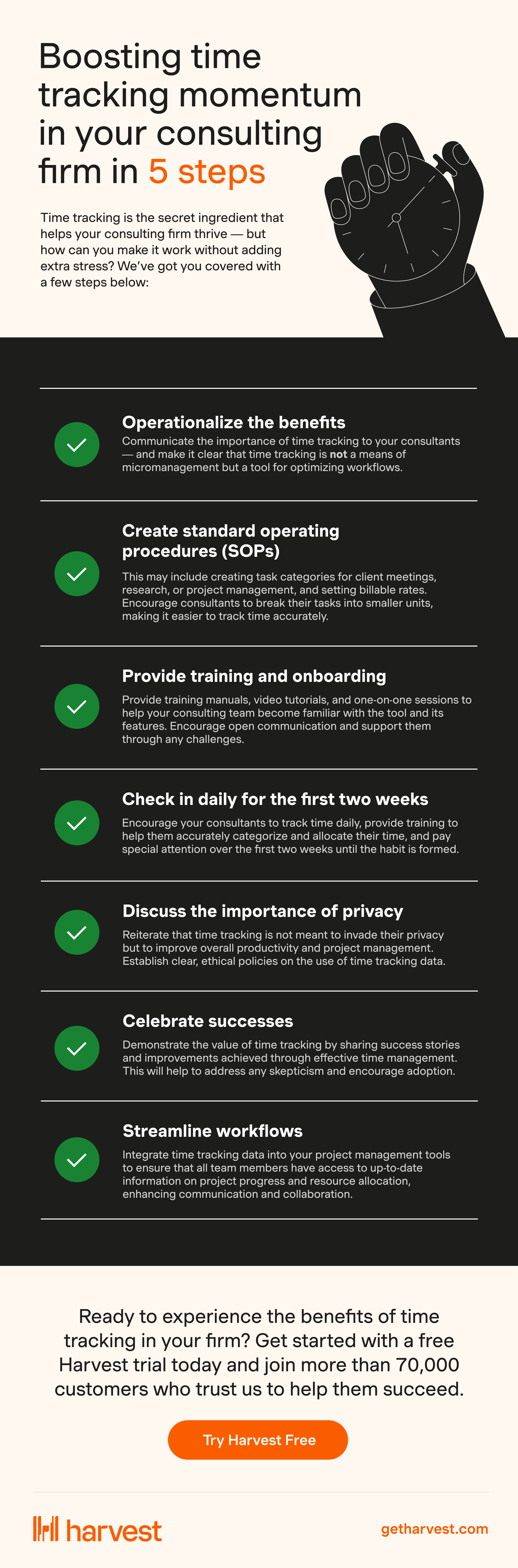
Starting with time tracking in your consulting firm doesn't have to be daunting. Begin by establishing clear policies and guidelines that outline what needs to be tracked and the level of detail required. This foundational step ensures everyone on your team understands the expectations and the importance of accurate time tracking.
Next, choose intuitive time tracking tools that integrate well with your existing systems. This will help minimize the learning curve and encourage adoption among your team. User-friendly tools like Harvest offer features such as one-click timers and calendar integrations, which make it easier for employees to log time accurately and consistently.
Encourage your team to track time in real-time rather than relying on memory to enter hours retrospectively. This practice not only improves accuracy but also helps in identifying time-draining tasks that could be streamlined or eliminated. According to mocoapp.com, consistency in time tracking is key to capturing more billable hours and reducing revenue leakage.
Finally, provide adequate training and support to your team. Make sure they understand how to use the tools effectively and are aware of the benefits time tracking brings, not just to the firm but also to their workflows. By emphasizing the positive aspects, such as reduced administrative tasks and better project management, you're more likely to gain their buy-in and commitment.
Frequently Asked Questions
How does time tracking benefit consulting firms?
Time tracking significantly benefits consulting firms by improving billable hour capture and enhancing project management. Accurate time tracking can prevent revenue loss, with firms potentially losing 15-25% of billable hours due to inefficiencies. By implementing effective time tracking systems, firms can increase productivity, streamline invoicing, and ultimately boost profitability.
What are common mistakes in time tracking?
Common mistakes in time tracking include inaccurate data entry and failure to track all billable hours. Many employees neglect to log their time, leading to significant revenue losses, often estimated at hundreds of thousands annually. Additionally, relying on outdated or isolated systems can hinder efficiency, making it crucial for firms to adopt modern, integrated time tracking solutions.
Which tools are best for time tracking in consulting?
The best tools for time tracking in consulting include integrated software solutions that automate data entry and provide real-time insights. Tools like Toggl, Harvest, and Clockify are popular for their user-friendly interfaces and comprehensive reporting features. These tools not only simplify time tracking but also enhance project management and invoicing processes, leading to increased efficiency.
How can time tracking be implemented successfully?
Successful implementation of time tracking involves choosing the right tools and fostering a culture of accountability. Training employees on the importance of accurate time tracking is crucial, as well as integrating the system into daily workflows. Regularly reviewing time tracking data can help identify inefficiencies and improve processes, ensuring the firm maximizes its billable hours.


